Abstract
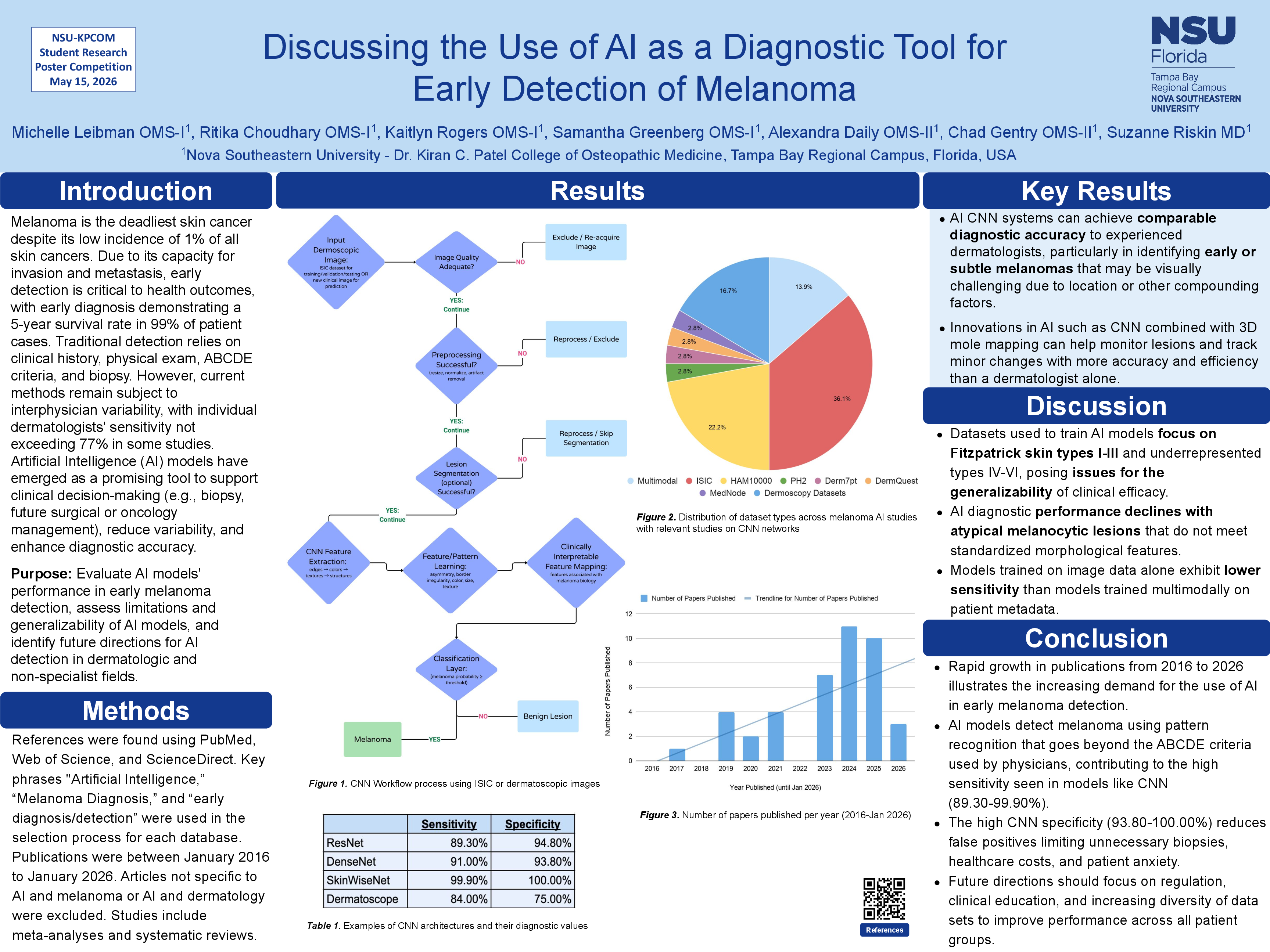
Background: The emergence of artificial intelligence (AI) has introduced significant opportunities for technological innovation in medicine, including potential applications in dermatologic diagnostics. With the increasing prevalence of melanoma, AI presents an opportunity to improve early detection and support clinical decision-making in melanoma diagnosis. Melanoma represents the most consequential manifestation of skin cancer and, although highly curable when detected early, it carries a high risk of mortality if diagnosis is delayed. Patients diagnosed with localized melanoma have a 5-year survival rate exceeding 99%; however, this rate decreases to approximately 35% once metastasis has occurred, illustrating the importance of early detection. Early detection enables reduced healthcare costs, improved survival rates, and reduced patient anxiety.
Objectives: This narrative review investigates the current role of AI modalities, including convolutional neural network (CNN)-based systems, in early melanoma detection, as well as the limitations and potential future directions for integrating AI into clinical dermatologic practice.
Methods: References for this narrative review were found using PubMed, Web of Science, and Science Direct. Focused concepts including "Artificial Intelligence,” “Melanoma Diagnosis,” and “early diagnosis/detection” were used as key phrases in the process of selection for each database. Articles were selected based on the time frame of January 2016 through January 2026. Articles not specific to Artificial Intelligence and melanoma or Artificial Intelligence and dermatology were also excluded.
Results: AI techniques can be used to highlight specific dermatologic features, contributing to overall accuracy of diagnosis. CNN is able to outperform dermatologists, with studies suggesting up to 92% accuracy in melanoma detection when using a large and broad database, in particular International Skin Imaging Collaboration (ISIC). These modalities can aid in identifying subtle nevi changes and early melanoma manifestations. In addition, AI increases the confidence of practitioners with respect to the decision-making of melanoma diagnoses.
Conclusion: Current limitations of AI prevent its use as a stand-alone diagnostic tool due to insufficient databases and require the use of adjunct diagnostic methods for proper verification, particularly in early detection. Nevertheless, AI may serve as a supplementary tool to enhance diagnostic accuracy among dermatologists and non-dermatologic practitioners, such as primary care physicians performing routine skin examinations.