Abstract
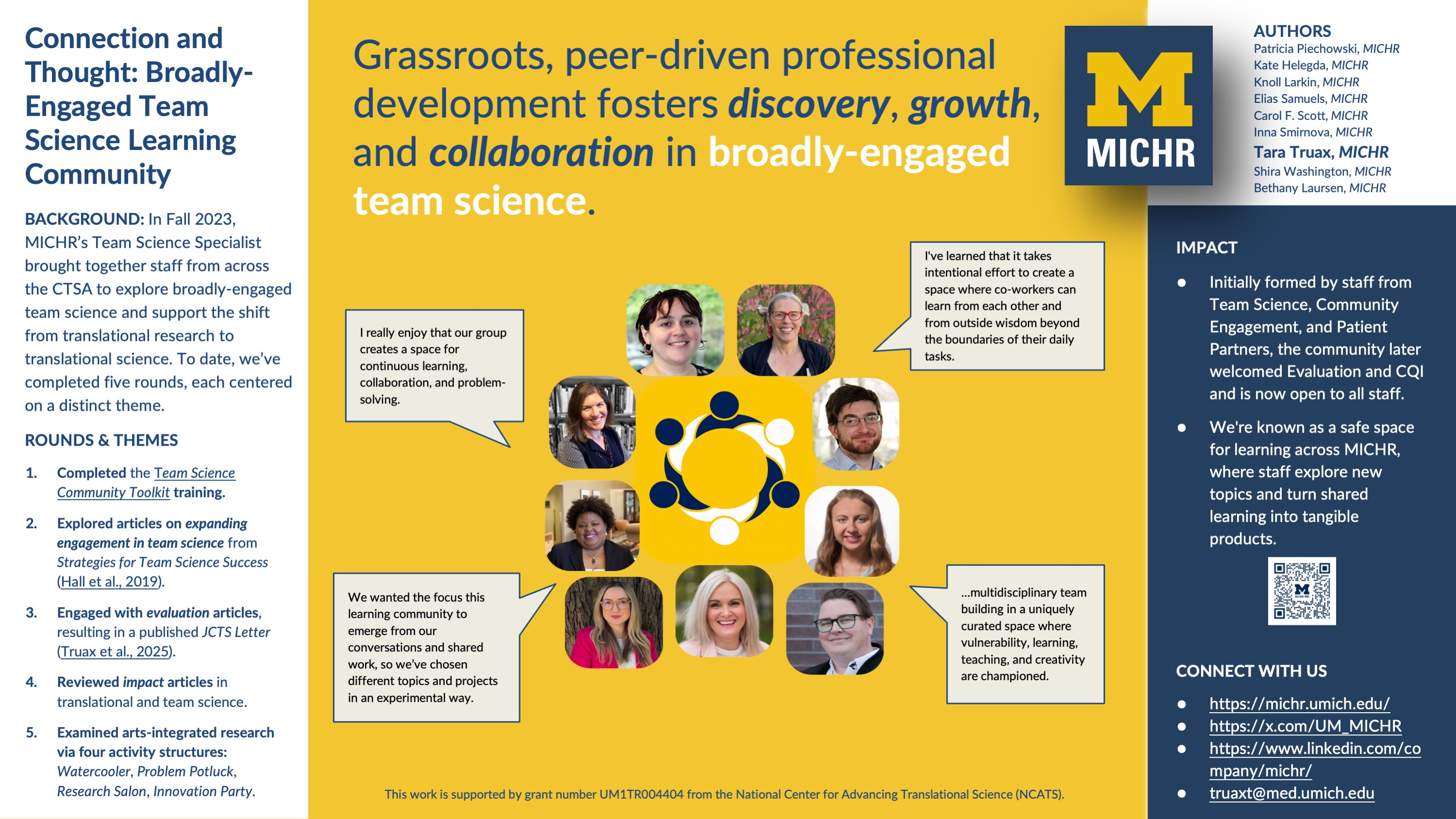
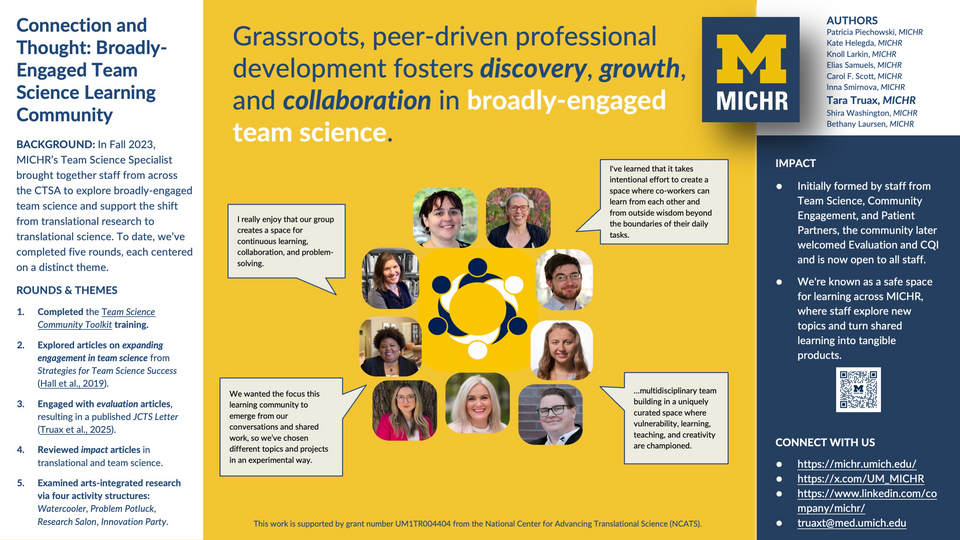
Over a year ago, the team science specialist at the Michigan Institute for Clinical and Health Research (MICHR), the Clinical & Translational Science Award (CTSA) of the state of Michigan, brought together a diverse group of individuals from various cores to meet weekly and consider topics in broadly engaged team science, especially the inclusion of community partners. Each of the four learning communities implemented thus far has had a different focus and slightly different members.
CTSAs across the consortium of funded institutes through the National Institutes of Health's National Center for Advancing Translational Science (NCATS) have been charged with translational science. One principle of translational science that NCATS finds essential is to leverage cross-disciplinary team science (NCATS, 2025). NCATS (2025) encourages research with team members "with expertise across disciplines, fields, and professions to produce research that advances translation along the translational research continuum."
Within MICHR, the staff-driven, broadly-engaged team science learning community set out to begin to dialogue and ideate about topics in team science, especially regarding engaging community partners in teams.
Over the last year and a half, this group has implemented four distinct rounds of the learning community around various topics in broadly engaged team science. This group used a weekly format where one member presented a training module, article, podcast, or brought their programmatic innovation to the group for a consultation. The topic of the learning community, which changed quarterly to engage new MICHR staff members, guided the structured presentations and discussions within the team.
The group at MICHR has increased members' knowledge through reviewing over 30 articles and resources around broadly engaged team science themes, including community engagement, theory of team science, evaluation for impact, training, and integration of the arts. During the third learning community, after reviewing the article by Mendell et al., within the Journal of Clinical & Translational Science, the members composed a commentary, encouraging teams to embrace non-linearity in team sciences competencies. A new project at MICHR recently emerged, and this learning community was well poised to lead the project to study how to integrate the arts within translational science.
Inter-institute outcomes have also been collected around knowledge gained and value to members. One member said, "I've learned that it takes intentional effort to create a space. Inter-institute outcomes have also been collected around knowledge gained and value to members. One member said, "I've learned that it takes intentional effort to create a space.
At one CTSA, grassroots peer-driven and lead professional development opportunities can lead to fruitful discovery, growth, and innovative collaborations around broadly-engaged team science.
Reference
National Institutes of Health's National Center for Advancing Translational Science (NCATS) (2025) https://ncats.nih.gov/about/about-translational-science/principles5:
Poster presentation abstracts at INSciTS 2025: https://julnet.swoogo.com/scits25/poster-abstracts?source=qrcode