Abstract
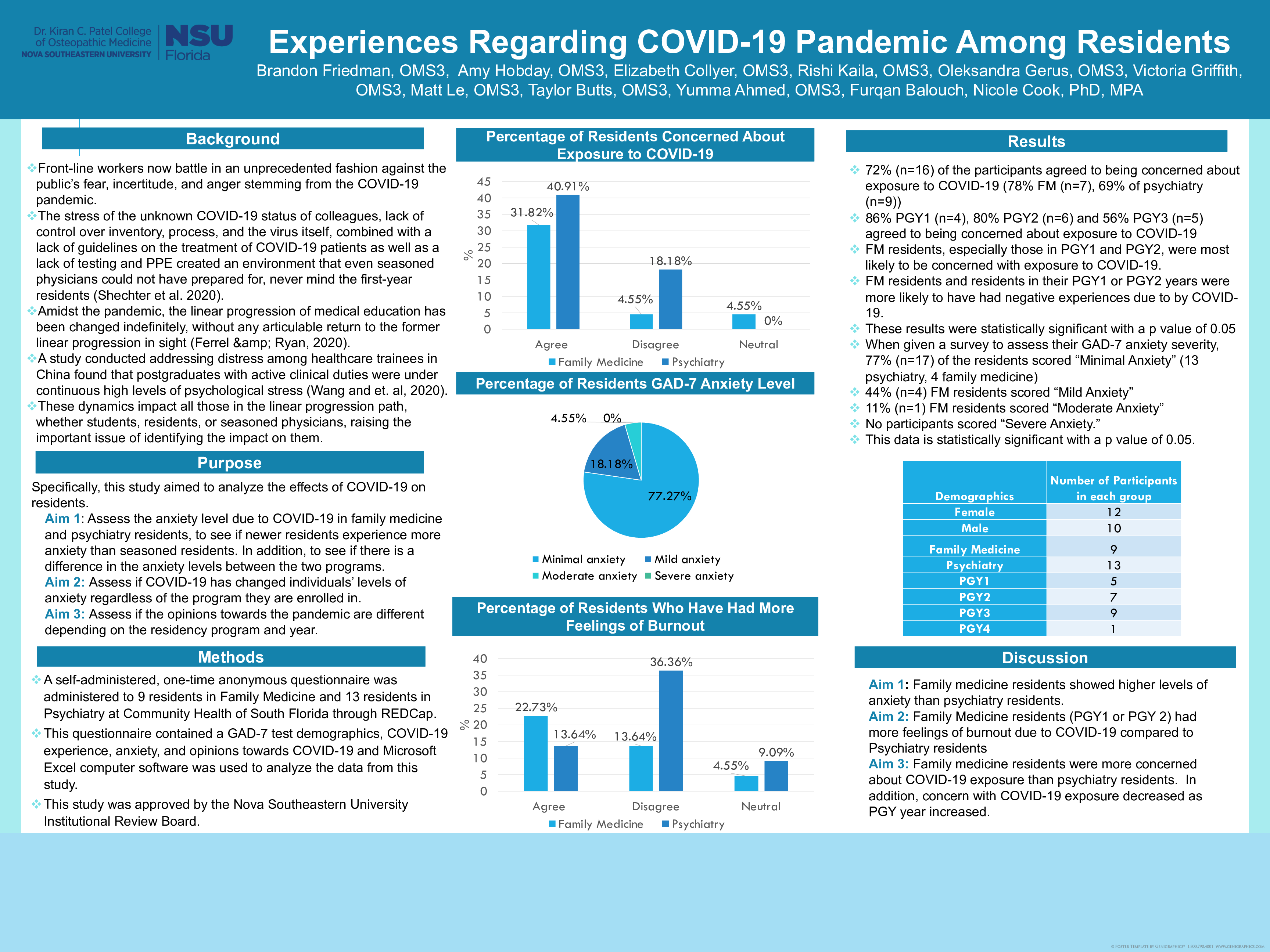
Background: COVID-19 has led to a lot of fear, uneasiness, and psychological stress for individuals across all facets of society. More specifically, hospital front-line workers including doctors, residents, nurses, medical assistants, and the rest of the healthcare team have all been impacted to a significant degree. Each year, a group of newly licensed physicians begin their medical residencies at hospitals all around the country. In 2020, new physicians entered residency during the peak of the COVID-19 pandemic. Limited resources for coping with psychological stresses due to self-isolation, can lead to the development of certain unwanted psychopathological outcomes such as anxiety.
Objective: To assess and compare COVID-19 related anxiety levels of residents in Family Medicine and Psychiatry residency programs.
Methods: A self-administered, one-time anonymous questionnaire developed by the researchers was administered to 9 residents in Family Medicine and 13 residents in Psychiatry at Community Health of South Florida through REDCap, an online survey platform. This questionnaire also contained a GAD-7 test. The questionnaire collected cross-sectional data on participant demographics, COVID-19 experience, anxiety, learned helplessness, illness anxiety and opinions towards COVID-19. This study was approved by the Nova Southeastern University Institutional Review Board. The Microsoft Excel computer software was used to analyze the data from this study.
Results: Seventy-two percent (n=16) of participants reported being concerned about exposure to COVID-19. 78% of Family Medicine residents (n=7) and 69% of Psychiatry residents (n=9) reported concern related to COVID-19 exposure. Survey results from GAD-7 indicated 77% (n=17) of residents scored “Minimal Anxiety” including (n=13) Psychiatry residents, but only 44% (n=4) of the Family Medicine residents. An additional (n=4) 44% of the Family Medicine residents scored “Mild Anxiety,” and 11% (n=1) scored “Moderate Anxiety”. No participants scored “Severe Anxiety”. This data is statistically significant with a p-value of 0.05.
Conclusion: Family Medicine and Psychiatry residents who entered residency during the height of the COVID-19 pandemic experienced a range of anxiety levels from “Minimal Anxiety” to “Moderate Anxiety”. Incoming residents in both programs expressed concern with potential exposure to COVID-19 during their training. Residents in both programs observed increasing anxiety regarding COVID-19 among fellow healthcare workers. One limitation to the study was a small sample size, only 22 residents participated in the survey. Future studies may consider utilizing larger resident sample sizes to enhance validity of results. Family resident programs may want to consider some anxiety reducing strategies/experiences to modify feelings of fear and burnout due to COVID-19 pandemic and other local emergencies.