Abstract
Technological resources, in particular telemedicine, have been increasingly used in medicine. This medical innovation is a method that uses several types of technologies and is defined by the World Health Organization (WHO) as "the provision of health services, where distance is a critical factor" [1].
Telemedicine not only serves to remotely monitor or diagnose a patient but also includes educational techniques to provide training to healthcare professionals that are geographically separated [2]. In addition, it is a way to spread health care to remote locations that lack medical services or certain types of medical procedures.
The application of telemedicine in the Amazon and other rural or remote places has the potential to shorten the geographic distance with regard to the sustainable development of their communities, improving the quality of care, the effectiveness of local health systems, and promoting the training of professionals who work in these locations.
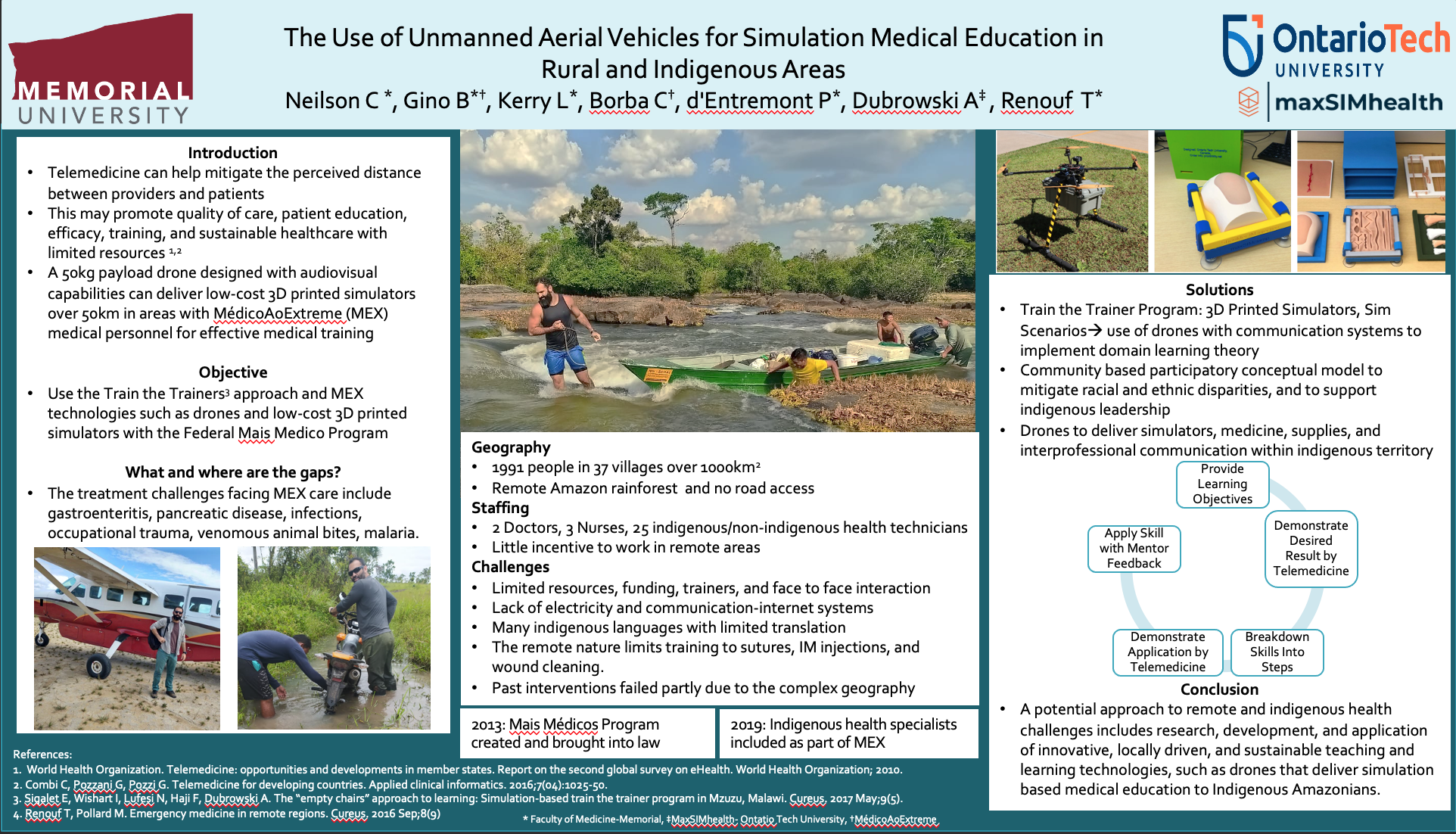
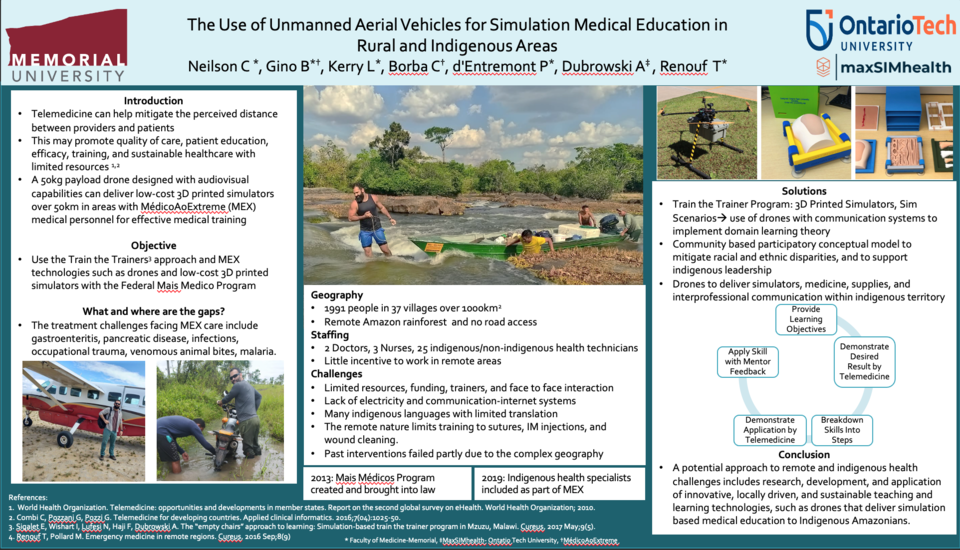
Researchers from MédicoAoExtreme (MEX), MaxSIMhealth from Ontario Tech University (OTU), and Memorial University (MUN) in a creative partnership created a drone that has a telemedicine audiovisual system and is capable of delivering medical supplies and simulators at low cost printed on a 3D printer for doctors, nurses and local Indigenous health technicians who are part of the MEX. The MEX is a non-profit organization made up of health professionals who work in the heart of Brazil's Amazon rainforest.
Studies have suggested that simulations are an effective way to train healthcare professionals in the development/improvement of skills [3]. The joint creation of this aircraft, low-cost 3D printed simulators and a simulation scenario capable of training these healthcare professionals is the subject of this poster.