Abstract
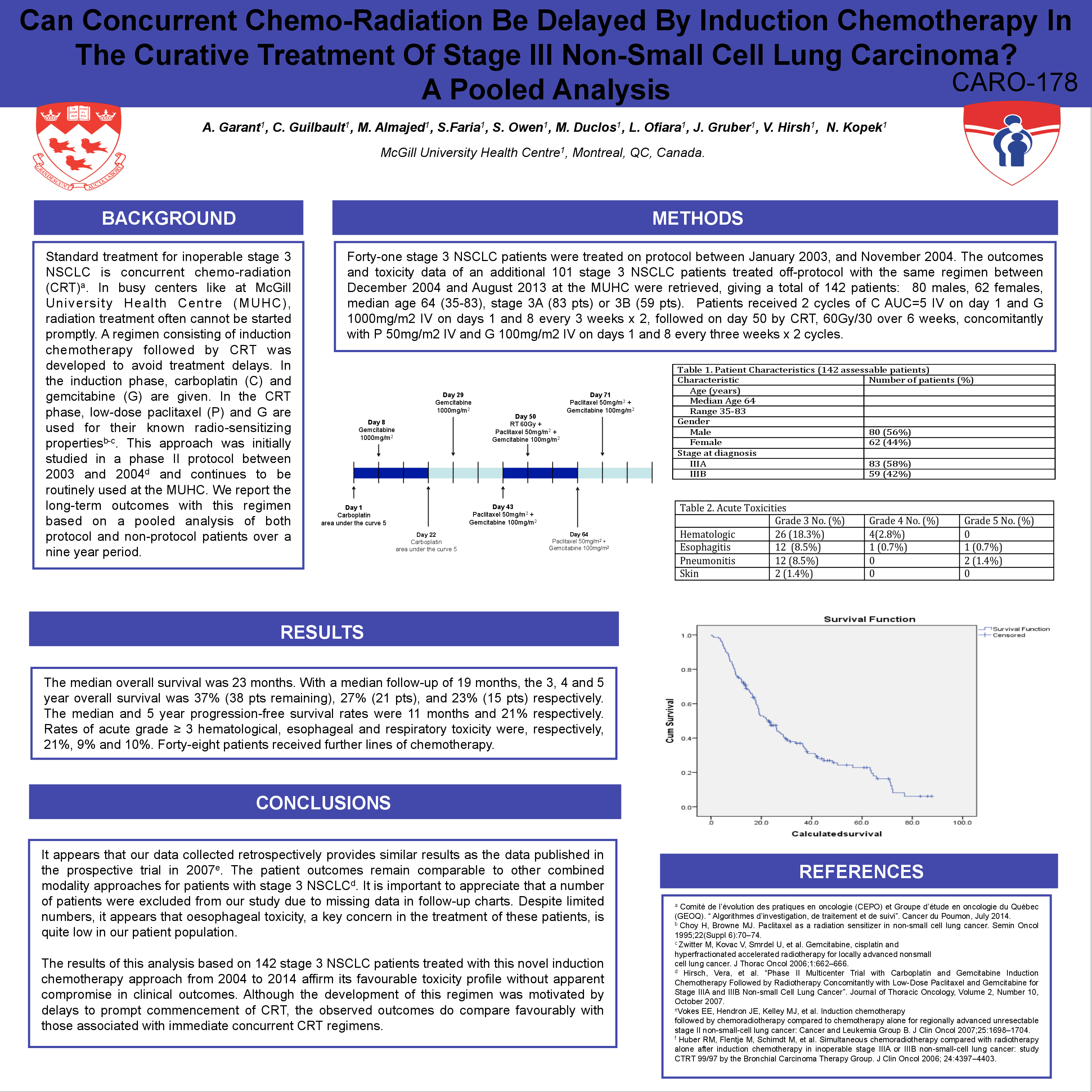
Background: Standard treatment for inoperable stage 3 NSCLC is concurrent chemo-radiation (CRT). In busy centers such as ours, radiation treatment often cannot be started promptly. To prevent treatment delays, a regimen consisting of induction chemotherapy followed by CRT was developed. In the induction phase, carboplatin (C) and gemcitabine (G) are given. In the CRT phase, low-dose paclitaxel (P) and G were used for their known radio-sensitizing properties. This approach was initially tested in a phase II protocol between 2003 and 2004 and continues to be routinely used at the McGill University Health Centre (MUHC). We report the long term outcomes with this regimen based on a pooled analysis of both protocol and non-protocol patients.
Methods and material: Forty-one stage 3 NSCLC patients were treated on protocol between January 2003, and November 2004. The outcomes and toxicity data of an additional 101 stage 3 NSCLC patients treated off-protocol with the same regimen between December 2004 and August 2013 at the MUHC were retrieved, giving a total of 142 patients: 80 males, 62 females, median age 64 (35-83), stage 3A (83 pts) or 3B (59 pts). Patients received 2 cycles of C AUC=5 IV on day 1 and G 1000mg/m2 IV on days 1 and 8 every 3 weeks x 2, followed on day 50 by CRT, 60Gy/30 over 6 weeks, concomitantly with P 50mg/m2 IV and G 100mg/m2 IV on days 1 and 8 every three weeks x 2 cycles.
Results: The median overall survival was 23 months. With a median follow-up of 19 months, the 3, 4 and 5 year overall survival was 37% (38 pts remaining), 27% (21 pts), and 23% (15 pts) respectively. The median and 5 year progression-free survival rates were 11 months and 21% respectively. Rates of acute grade ≥ 3 hematological, esophageal and respiratory toxicity were, respectively, 20%, 8% and 7%. Forty-eight patients received further lines of chemotherapy.
Conclusion: The results of the present analysis based on 142 stage 3 NSCLC patients treated with this novel induction chemotherapy approach affirm its favourable toxicity profile without apparent compromise in clinical outcomes. Indeed, although the development of this regimen was motivated by delays to prompt commencement of CRT, the observed outcomes do compare favourably with those associated with immediate concurrent CRT regimens.