Abstract
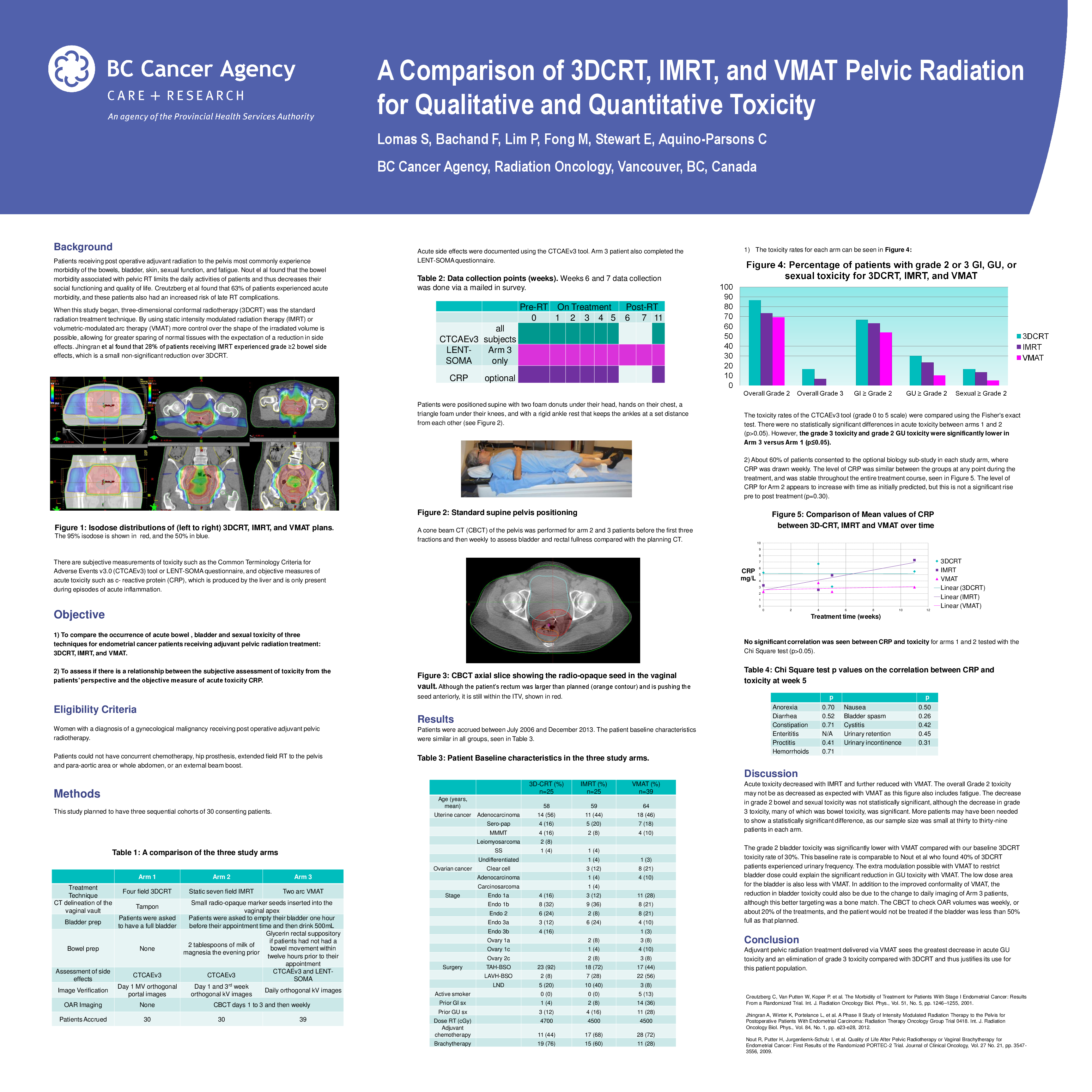
Purpose: This study compared the occurrence of acute bowel and bladder toxicity of three techniques for endometrial cancer patients receiving adjuvant pelvic radiation treatment: standard 3-D conformal (3DCRT), intensity-modulated radiation therapy (IMRT), and volumetric-modulated arc therapy (VMAT). The secondary aim was to assess if there is a relationship between the subjective assessment of toxicity from the patients’ perspective and objective measures of acute toxicity using serum acute phase reactant c- reactive protein (CRP).
Materials and Methods: Women with a diagnosis of a gynecological malignancy receiving post operative adjuvant pelvic radiotherapy were eligible. This study planned to have three sequential cohorts of 30 consenting patients.
Arm 1 were treated with four field 3DCRT, arm 2 were treated with static seven field IMRT, and arm 3 were treated with two arc VMAT. A cone beam CT (CBCT) of the pelvis was performed for arm 2 and 3 patients before the first three fractions and then weekly to ensure the radio-opaque marker seeds inserted into the vaginal apex prior to CT Simulation were in the ITV, and to assess bladder and rectal fullness.
Acute side effects were documented using the Common Terminology Criteria for Adverse Events v3.0 (CTCAEv3) tool prior to the planning CT, weekly during radiotherapy, and six weeks post treatment. In Arm 3, patients were also asked to self-complete the LENT-SOMA questionnaire at the same times as the CTCAEv3 tool, as well as one and two weeks post-treatment via mailed in survey.
For those that consented to the optional biology sub-study, a serum blood sample was drawn at the same data collection points as the CTCAEv3 tool for assessment of CRP levels.
Results: Patients were accrued between July 2006 and December 2013. Patients received 45 to 47 Gy to the pelvis.
The toxicity rates of the CTCAEv3 tool were compared using the Fisher's exact test. The grade 2 and grade 3 toxicity rate in Arm 1 was 91% and 15% versus Arm 2 with 80% and 0%, and Arm 3 with 70% and 0%. The GI grade 2-3 toxicity was similar in Arms 1 and 2 (67% versus 63%), but lower in Arm 3 (55%). The GU grade 2-3 toxicity rate was lowest for Arm 3 (30% Arm 1, 23% Arm 2, 10% Arm 3) as was the rate of sexual toxicity (17% versus 13% versus 5%). There were no significant differences in acute toxicity between Arms 1 and 2 (p>0.05). However, the grade 3 toxicity and grade 2 GU toxicity were significantly lower in Arm 3 versus Arm 1 (p≤0.05).
About 60% of patients consented to the optional biology sub-study. The level of CRP was stable throughout the entire treatment course and did not rise pre to post treatment (p=0.30). No significant correlation was seen between CRP and toxicity tested with the Chi Square test (p>0.05).
Conclusion: Adjuvant pelvic radiation treatment delivered via VMAT sees the greatest decrease in acute GU toxicity and an elimination of grade 3 toxicity compared with 3DCRT and thus justifies its use for this patient population.