Abstract
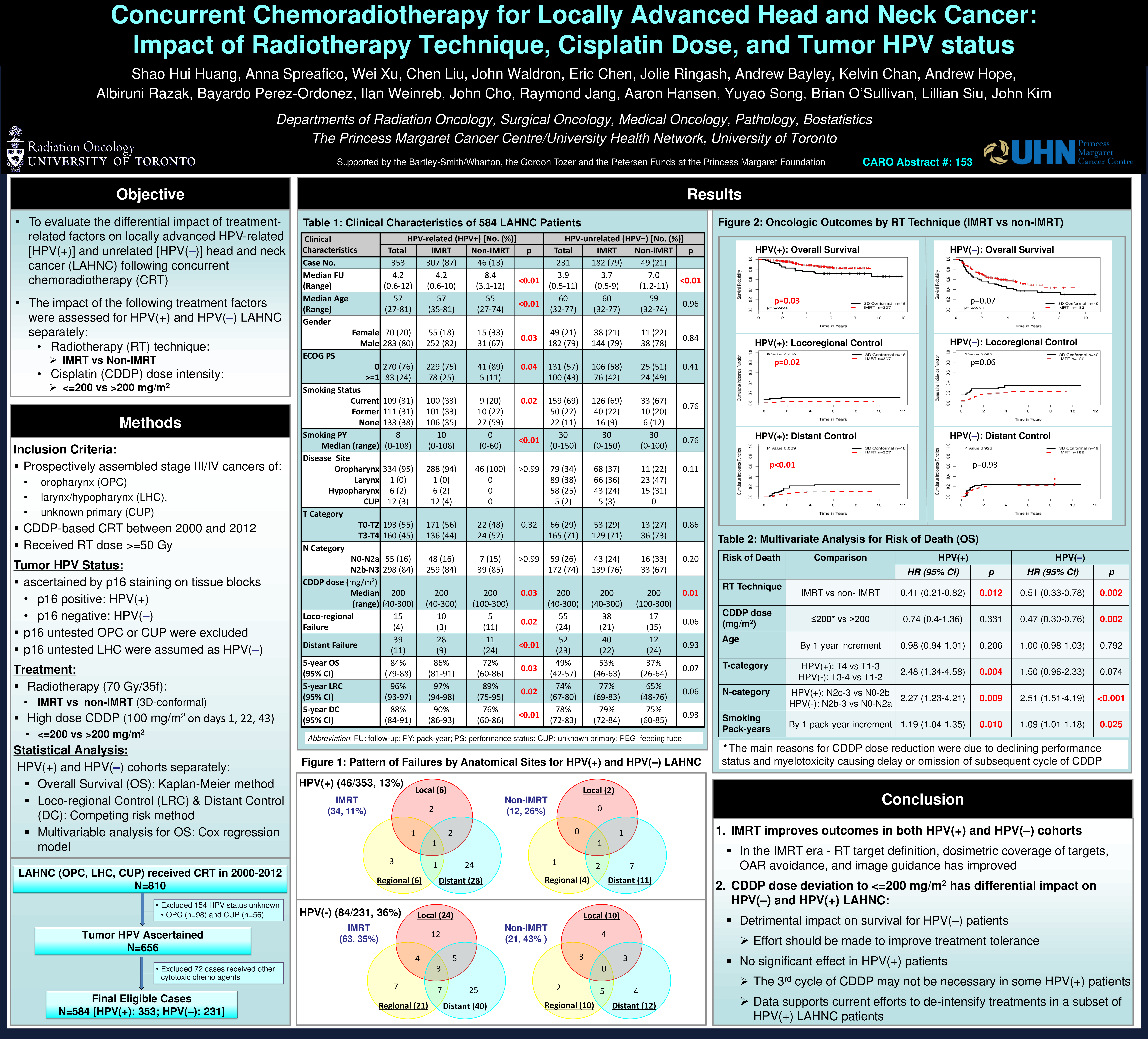
Purpose: To investigate the impact of radiation (RT) technique and cisplatin (CDDP) dose intensity (mg/m2) on outcomes of patients (pts) with HPV-related [HPV(+)] and unrelated [HPV(–)] locally advanced (stage III/IV) head and neck cancer (LAHNC) following concurrent chemoradiation (CRT).
Methods: A single institution retrospective review was conducted on a prospectively assembled cohort of all newly diagnosed LAHNC pts treated with CRT (70 Gy in 35 fractions over 7 weeks RT with CDDP 100mg/m2 x 3) from 2000 to 2012. HPV status was ascertained by p16 staining for all oropharyngeal (OPC), unknown primary (CUP), and ≤10 pack-year (PY) smokers with laryngo-hypopharyngeal cancer (LHC). Heavy smoking (>10 PY) LHC pts without p16 testing were assumed to be HPV(−). Overall survival (OS), locoregional control (LRC), and distant control (DC) were estimated using Kaplan-Meier method and compared between IMRT vs non-IMRT cohorts. Multivariable analysis (MVA) with Cox regression identified OS predictors for HPV(+) and HPV(−) pts, respectively.
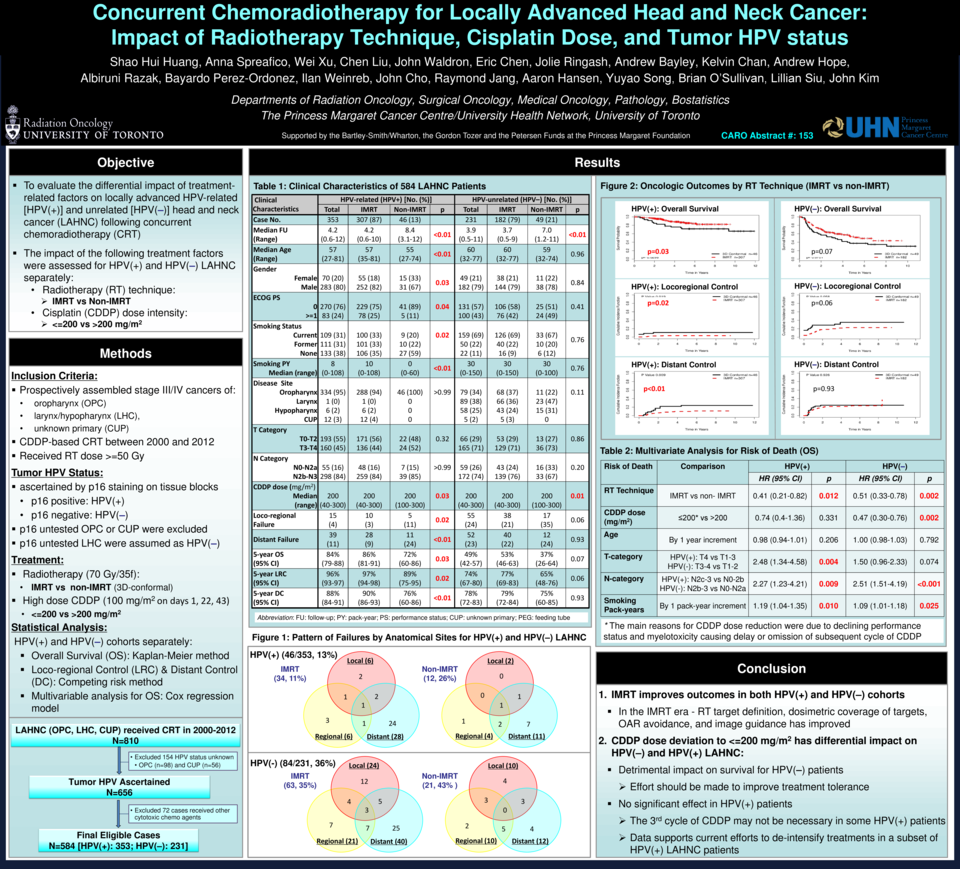
Results: Five hundred and eighty-four consecutive LAHNC cases treated with CRT were included: 353 HPV(+) (60%) and 231 HPV(–) (40%). Median age was 58 years. Primary sites were: OPC 413 (71%), LHC 154 (27%), and CUP 17 (3%). IMRT was used in 489 (84%) and non-IMRT in 95 (16%) pts. Median CDDP dose were 200 mg/m2 for both HPV(+) and HPV(–) cases. Median follow-up was 3.9 and 4.4 years for the HPV(+) and HPV(–) pts, respectively. For the HPV(+) pts, IMRT (n=307) fared better for OS, LRC, and DC at 5-years compared to non-IMRT (n=46): 86% vs 72% (p=0.03), 97% vs 89% (p=0.02), and 90% vs 76% (p<0.01), respectively. For the HPV(–) cases, IMRT (n=182) trended to better OS and LRC at 5-years compared to non-IMRT (n=49): 53% vs 37% (p=0.07), 77% vs 65% (p=0.06), respectively, but with similar DC rates: 79% vs 75% (p=0.93). In MVA, CDDP dose (>200 mg/m2) was strongly predictive for better OS in HPV(–) pts [Hazard Ratio (HR) 0.5, p<0.01] but was not predictive for the HPV(+) (p=0.33). Higher N was also predictive for OS in both HPV(+) (HR 2.3) and HPV(–) (HR 2.5) (both p<0.01). Higher T was predictive for the HPV(+) (HR 2.5, p<0.01) and marginally predictive for the HPV(–) (HR 1.5, p=0.07). After adjusting for age and smoking pack-years, IMRT remained a favorable OS and LRC predictor in both HPV(+) (HR 0.4, p=0.01) and HPV(-) (HR 0.5, p<0.01).
Conclusions: LAHNC pts treated with IMRT have superior outcomes compared to those treated with non-IMRT in both HPV(+) and HPV(–) cohorts, which is likely attributable to the improvement in RT target definition and quality of planning and delivery. CDDP dose deviation to <=200 mg/m2 has detrimental impact on survival for HPV(–) pts but has no significant effect in HPV(+) pts. These results support recent data demonstrating that quality of treatment plays an important role in patient’s outcomes.