Abstract
Aananthan Thangaroopan1, Gunita Mitera2, Anand Swaminath1
1McMaster University, Hamilton, ON
2University of Toronto, Toronto, ON
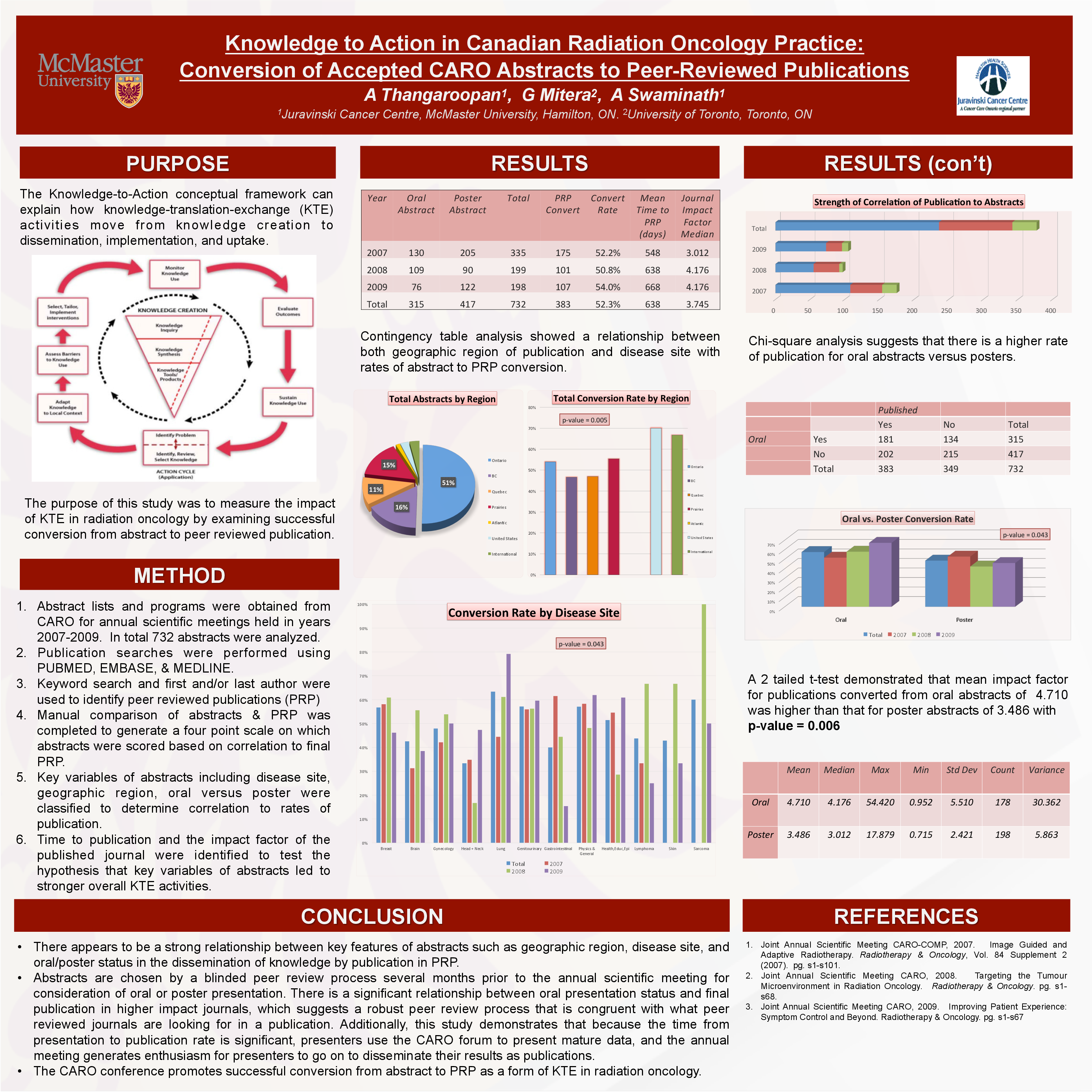
Purpose: The Knowledge-to-Action conceptual framework can explain how knowledge-translation-exchange (KTE) activities move from knowledge creation, to dissemination, implementation, and uptake. Current challenges of KTE often occur between dissemination to uptake. The purpose of this study was to measure the impact of KTE in radiation oncology by examining rates of successful conversion from an abstract (CA) presented at the Canadian Association of Radiation Oncology Annual Scientific Meeting (ASM) to peer-reviewed publication (PRP); and to explore differences between abstract and manuscript findings.
Materials and Methods: Abstract lists and programmes were obtained for the ASMs held in years 2008 and 2009. Searches for PRPs were performed using PUBMED, MEDLINE, and EMBASE, whereby keywords from each CA, and either the first or last author were inputted. Abstracts were considered as published if the PRP showed similarities in methods and results to its corresponding CA. Quality assurance was performed by a secondary search of authors within the abstract. The submitted CA was used as a surrogate for knowledge creation and dissemination, and the eventual PRP was used as a measure of knowledge implementation. Each CA was then scored according to the strength of correlation between it and its PRP, using a four-point scale (1 = no or minor difference, 2 = similar methods but expanded results, 3 = significant change to methods/results, 4 = publication occurred prior to ASM). Descriptive statistics were used to describe conversion rates and factors impacting successful conversion.
Results: A total of 398 (199 in 2008, 198 in 2009) accepted abstracts were reviewed. Of these, 208 (53%) were found to have a subsequent PRP. Median time to publication from ASM was 22 months (range -8 to 63). Correlation was high (score of 1 or 2) in 91% of successfully converted abstracts to PRP. Correlation was weak (score of 3) in 7% of abstracts. Two percent of successfully converted abstracts were published prior to the ASM (score of 4). An important factor impacting subsequent publication was the status of oral versus poster presentation. The proportion of successfully converted abstracts with oral presentations (excluding poster discussions) was significantly higher than the proportion with poster presentations (114/185, 62% versus 94/212, 44%; 2-sided p<0.0005).
Conclusions: There is a greater than 50% rate of conversion of CAs to PRPs, suggesting a net positive benefit of submission to CARO ASMs. Oral presentation status appears to improve the likelihood of successful conversion and would reflect a more impactful subgroup of abstracts. Although it appears that successful KTE activities are occurring at the CARO ASM, further implementation strategies are needed to close the gap from dissemination (CA) to uptake (PRP). Future analyses include exploring more longitudinal data, as well as regional variations in successful abstract conversion.