Abstract
Melody Xuan Lu Qu, Alexander Banashkevich, Aamer Mahmud
Cancer Centre of Southeastern Ontario, Kingston, ON
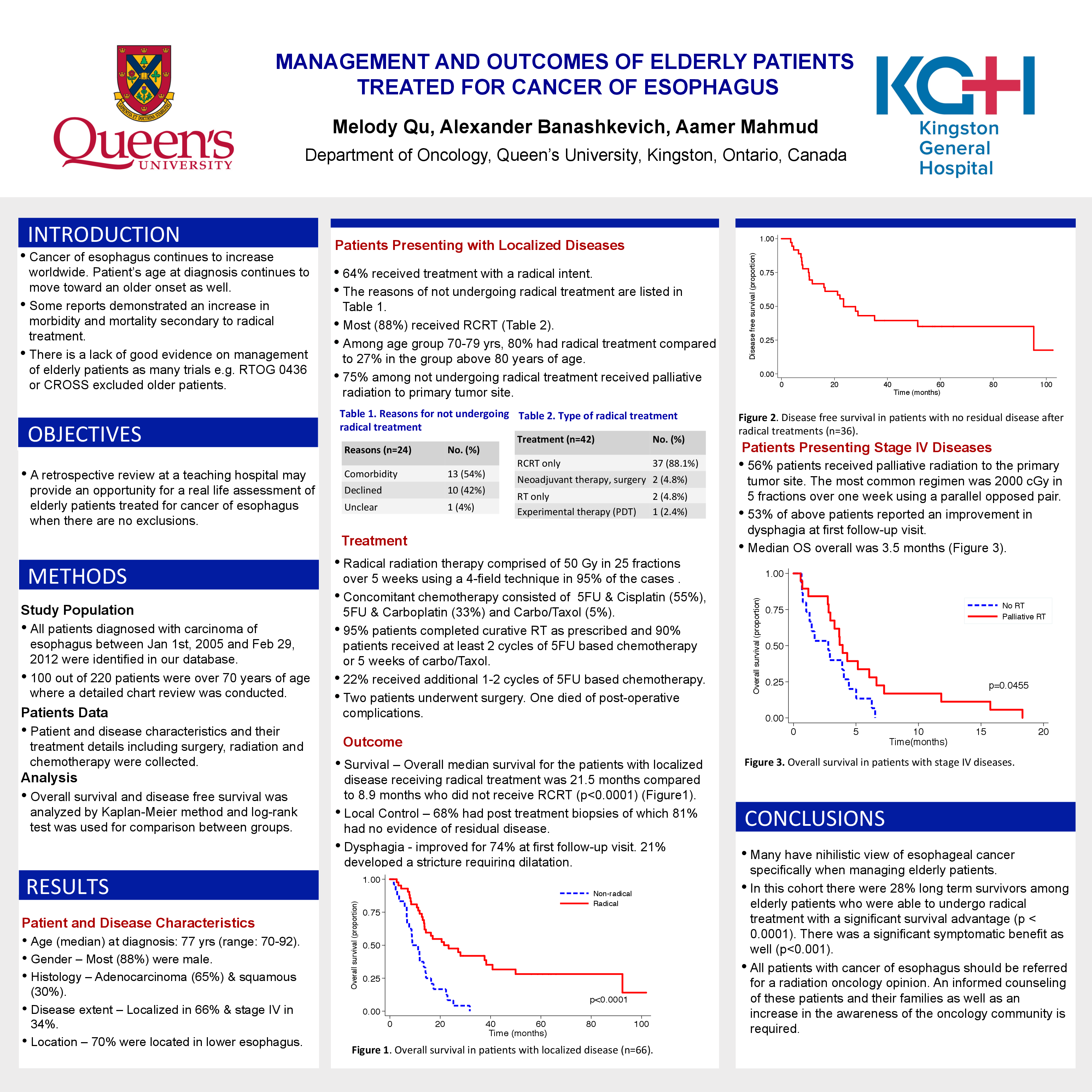
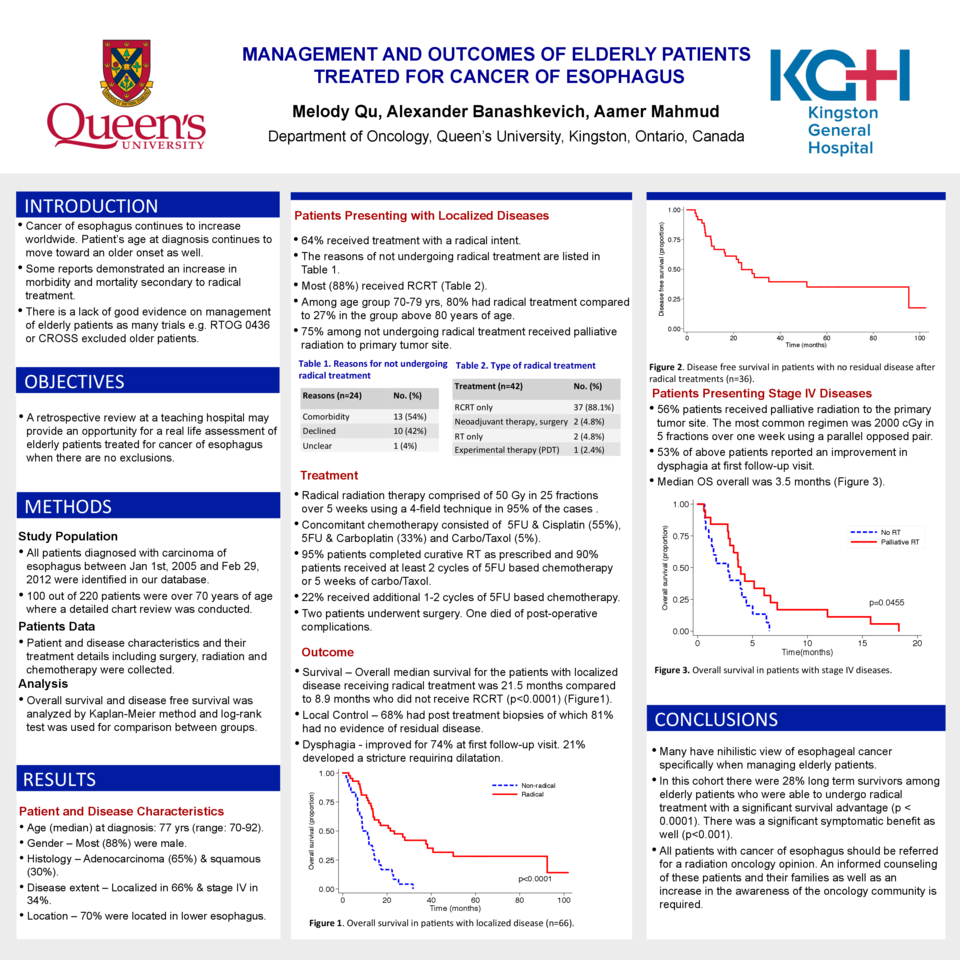
Purpose: There is a lack of literature on management of elderly patients treated for cancer of esophagus. Recent trials such as RTOG 0436 or CROSS did not include patients over 75 years of age. A retrospective review at a teaching hospital may provide an opportunity for a real life assessment of elderly patients with no exclusions.
Materials and Methods: All patients diagnosed with carcinoma of esophagus between January 1, 2005 and February 29, 2012 were identified in our database. One hundred out of 220 patients were over 70 years of age where a detailed chart review was conducted.
Results: Most (77%) were male with a median age of 77 (70-92). Sixty-five percent had an adenocarcinoma and 30% squamous cell carcinoma. 66% presented with a localized disease and 34% with Stage 4 disease. Among patients with localized disease, 64% had radical treatment. The reasons for not undergoing radical chemo-radiation (RCRT) included patient’s refusal (42%) or limiting comorbid conditions (54%). Seventy-five percent of the patients who declined RCRT received palliative radiation. RCRT comprised of 50 Gy in 25 fractions in 95% of the cases. Ninety percent received two or more cycles of concomitant chemotherapy where 55% received 5FU/ Cisplatin, 33% 5FU/ Carboplatin and 5% Carboplatin/ Taxol. Two-year overall survival (OS) for patients undergoing radical treatment was 48% compared to 8% for patients not receiving radical treatment. Five-year OS for patients receiving radical treatment was 28% compared to 0% for patients not receiving radical treatment. Sixty-eight percent had post-treatment biopsies of which 81% had no evidence of residual disease. Two patients had subsequent surgery. Seventy-four percent had an improvement in dysphagia at the first follow-up visit. Median OS for patients diagnosed with Stage 4 disease was 3.5 months.
Conclusions: Many have nihilistic view of esophageal cancer specifically when managing elderly patients. In this cohort there were 28% long-term survivors among elderly patients who were able to undergo radical treatment with a significant survival (p<0.0001) and symptomatic benefit (p<0.0001). All patients with cancer of esophagus should be referred for a radiation oncology opinion. An informed counseling of these patients and their families as well as an increase in the awareness of the oncology community is required.