Abstract
Ali Hosni, Shao Hui Huang, John De Almeida, Michael Au, Peter Dixon, Biu Chan, Susie Su, Wei Xu, John Cho, Meredith Giuliani, Andrew Hope, Andrew J. Bayley, John Kim, Jolie Ringash, Brian O’Sullivan, John Waldron
University of Toronto, Toronto, ON
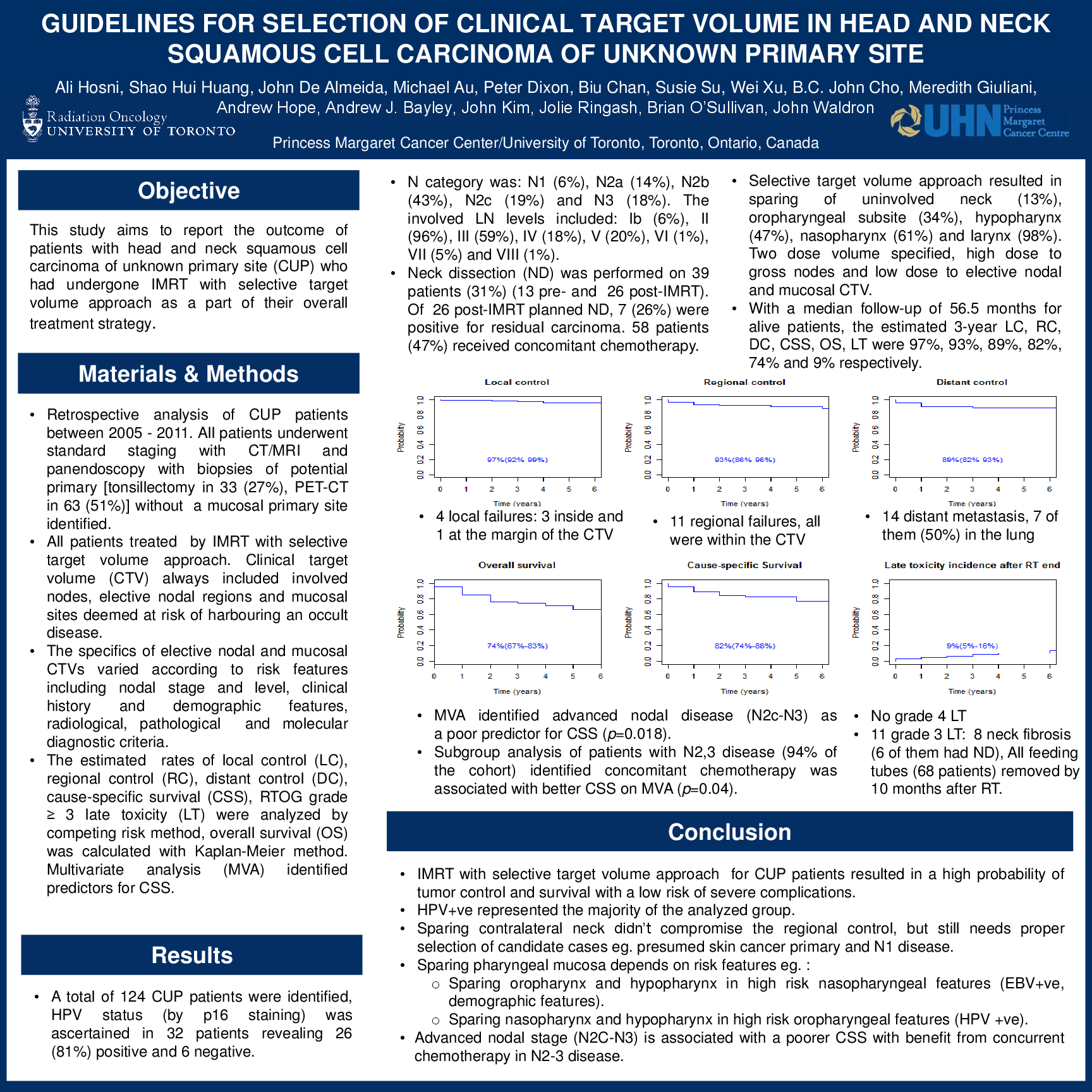
Purpose: To report outcome of patients with head and neck squamous cell carcinoma of unknown primary site (CUP) who had undergone IMRT with selective target volume approach as a part of their overall treatment strategy.
Materials and Methods: A total of 124 CUP patients treated with IMRT between 2005-2011 were included. All patients underwent standard staging with CT/MRI and panendoscopy with biopsies of potential primary sites including tonsillectomy in 33 (27%), PET-CT in 63 (51%) without a mucosal primary site identified. All patients treated with IMRT. Neck dissection (ND) was performed on 38 (31%) (13 pre- and 25 post-IMRT) and 60 (48%) received concomitant chemotherapy. Clinical target volume (CTV) always included involved nodes, elective nodal regions and mucosal sites deemed at risk of harbouring an occult disease. The specifics of nodal and mucosal CTVs varied according to risk features including nodal stage and level, clinical history, demographic features, radiological, pathological and molecular diagnostic criteria. The estimated rates of local control (LC), regional control (RC), distant control (DC), cause-specific survival (CSS), RTOG Grade ≥ 3 late toxicity (LT) were analyzed by competing risk method, overall survival (OS) was calculated with Kaplan-Meier method. Multivariate analysis (MVA) identified predictors for CSS.
Results: The N- category of the 124 CUP patients were: N1 (8), N2a (17), N2b (53), N2c (24) and N3 (22). The involved LN levels included: Ib (6%), II (96%), III (59%), IV (18%), V (20%), VI (1%) and VII (5%). HPV status (by p16 staining) was ascertained in 32 patients revealing 26 positive and six negative. Selective target volume approach resulted in sparing of contralateral neck (10%), nasopharynx (61%), oropharyngeal subsites (34%), hypopharynx (47%) and larynx (79%). Of 25 post-IMRT planned ND, 7 were positive. With a median follow-up of three years, the three-year LC, RC, DC, CSS, OS, LT were 97%, 93%, 89%, 82%, 74% and 9% respectively. Three of four local failures (at base of tongue) and 11 regional failures were within the irradiated volumes. One patient recurred at the margin of the selected mucosal CTV in the glottis. MVA identified advanced nodal disease (N2c-N3) was predictor for CSS [HR 2.64 (1.18-5.93), p=0.018], and lack of chemotherapy was marginally predictive (p=0.09). No Grade IV and 11 Grade III LT were observed: eight neck fibrosis (6 of them had ND), two osteoradionecrosis and one dysphagia. Prophylactic feeding tube was inserted in 68 patients but were all removed by 10 months after RT.
Conclusions: IMRT with selective target volume approach results in a high probability of cure with a low risk of severe complications for patients presenting with CUP in the head and neck.