Abstract
Maryam Dosani1, Ruobing Yang1, Annie Houle1, Don Wilson1, Mitchell Liu1, Hannah Carolan1, Chad R. Lund2, Devin Schellenberg2
1British Columbia Cancer Agency, Vancouver Centre, Vancouver, BC
2British Columbia Cancer Agency, Fraser Valley Centre, Surrey, BC
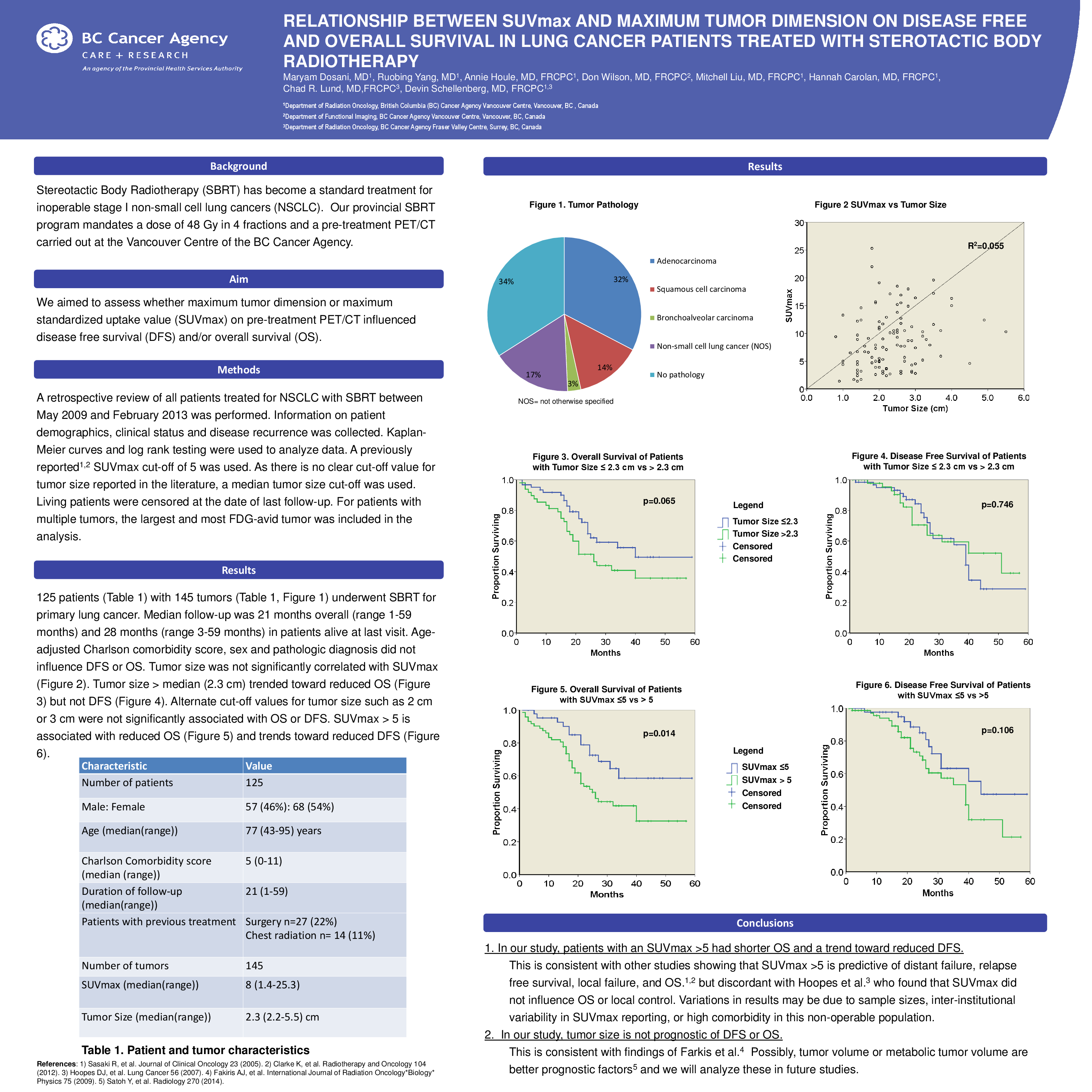
Purpose: Stereotactic Body Radiotherapy (SBRT) has become a standard treatment for inoperable Stage I non-small cell lung cancers (NSCLC). Our provincial SBRT program mandates a dose of 48 Gy in 4 fractions and a pre-treatment PET/CT, which is carried out at the only PET scanner in the province. We aimed to assess whether maximum tumour dimension or maximum standardized uptake value (SUV(max)) on pre-treatment PET/CT influenced disease-free (DFS) and/or overall survival (OS).
Materials and Methods: A retrospective review of all patients treated for NSCLC with SBRT between May 2009 and April 2012 was performed. Information on patient demographics, clinical status and disease recurrence was collected. Kaplan-Meier curves and log rank testing were used to analyze data. Living patients were censored at the date of last follow-up. For patients with multiple tumours, the largest and most FDG-avid tumour was included in the analysis.
Results: Eighty patients (38F: 42M) with 92 tumours underwent SBRT for a primary lung cancer. Median age at the time of treatment was 78 years (range 52-94) and median Charlson comorbidity score was 5 (range 2-11). Seventy-three percent had a pathologic diagnosis. The median duration of follow-up in living patients is 31 months (range 3-65 months). Median tumour size was 2.4 cm (range 1-5.5 cm), and median SUVmax was 7.8 (range 2.6- 25.3). Tumour size greater than the median trended to reduced DFS (27.2 months versus undefined, p=0.20) and reduced OS (32 versus 40 months, p=0.23). Using a previously reported SUV max cutoff of 5, patients with SUVmax above 5 had a trend toward reduced DFS (p=0.21) and a significantly reduced OS (26.8 months versus undefined, p=0.05). Age, sex and pathologic diagnosis did not influence DFS or OS.
Conclusions: Patients with SUVmax>5 had a trend to reduced DFS and reduced OS. A multivariable analysis will be conducted and the metabolic tumour volume of each patient will be calculated to observe if pre-treatment PET/CT factors influence survival in SBRT.