Abstract
A RISK-ADAPTED APPROACH TO POST-OPERATIVE RADIOTHERAPY FOR THYMOMA: LONG-TERM OUTCOMES AND PREDICTORS OF RECURRENCE
Nafisha Lalani, Najib Safieddine, David Hwang, Shaf Keshavjee, Andrea Bezjak, Anthony Brade
University of Toronto, Toronto, ON
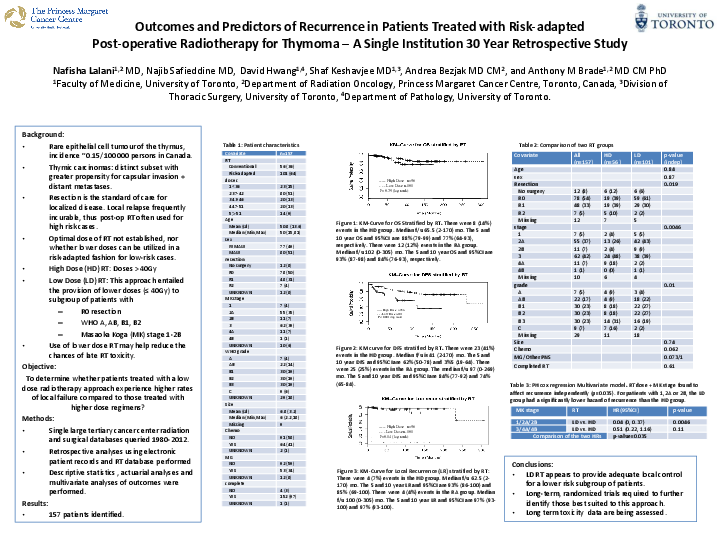
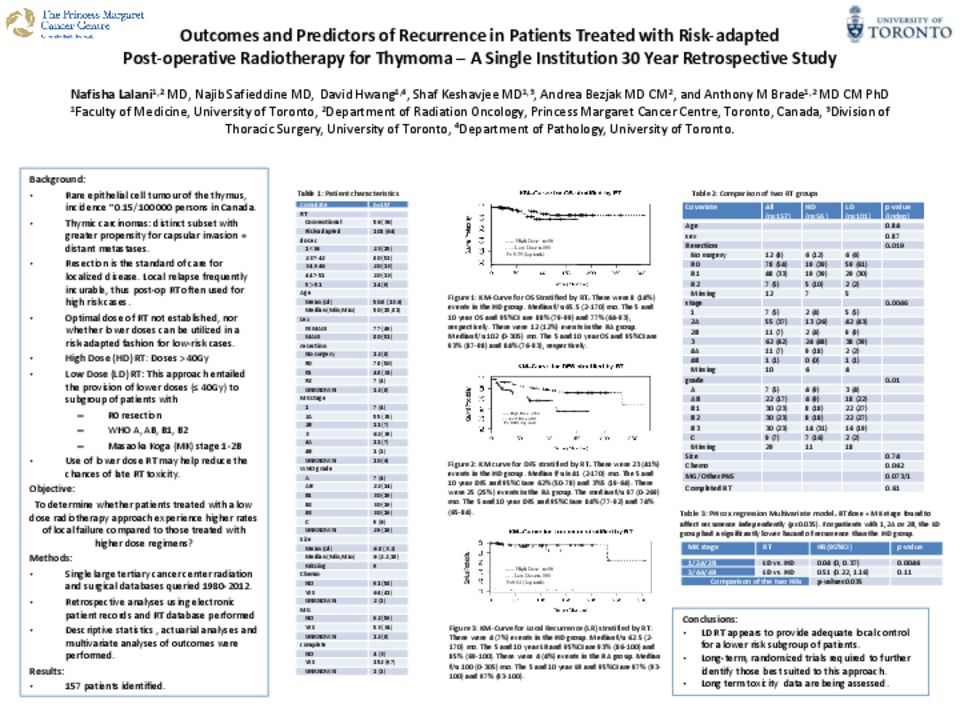
Purpose: Resection is the standard of care for localized thymic malignancies. Post-operative radiotherapy (RT) is often employed to prevent local recurrence, but the optimal dose has not yet been established. Personalized therapy using risk-adapted low-dose RT (LD) for select patients may provide equivalent local control and decreased toxicity compared to conventional high-dose regimens (HD). Our institution employs such a risk-adapted strategy and we present here our long term results.
Materials and Methods: Radiation and surgical oncology databases from a single tertiary care institution were queried from 1980-2012. Retrospective analyses using electronic patient records were performed to obtain clinical and demographic data. Actuarial analyses and correlation of outcomes with clinical variables were performed. The mean follow-up was 9.4 years (0.5-25.5).
Results: One hundred and fifty-seven patients treated with post-operative RT from 1980-2012 were identified of which 66% were treated with LD (36-42 Gy) in a risk-adapted fashion while the remaining 44% received HD (42-66Gy). The Masaoka-Koga (MK) stage distribution (I/IIA/IIB/III/IV) was 4%/35%/7%/39%/8% and 7% unknown. The majority of patients were WHO Grade B1 (19%), B2 (19%) or B3 (19%). Complete surgical resection (R0) was obtained in 50% of patients, R1 in 31%, R2 in 4%, and 18% unknown/no surgery. A total of 31% of patients experienced relapse: 14% regional, 5% local, and 4% distant. Patients receiving LD experienced a local relapse rate of 4% compared to 7% in the HD group (p=0.035). In multivariate analyses, LD and MK stage were predictive of local recurrence (p=0.035).
Conclusions: Risk-adapted post-operative RT may improve the therapeutic ratio for patients with thymoma. Long-term randomized trials are required to further identify patients best suited to this approach.