Abstract
J Jaswal, LD'Souza, M Johnson, K Willmore, K Yeow Tay, M Landis, Z Kassam, E Leung, D D'Souza, T Sexton, A Nichols, D A Palma
University of Western Ontario, London, ON
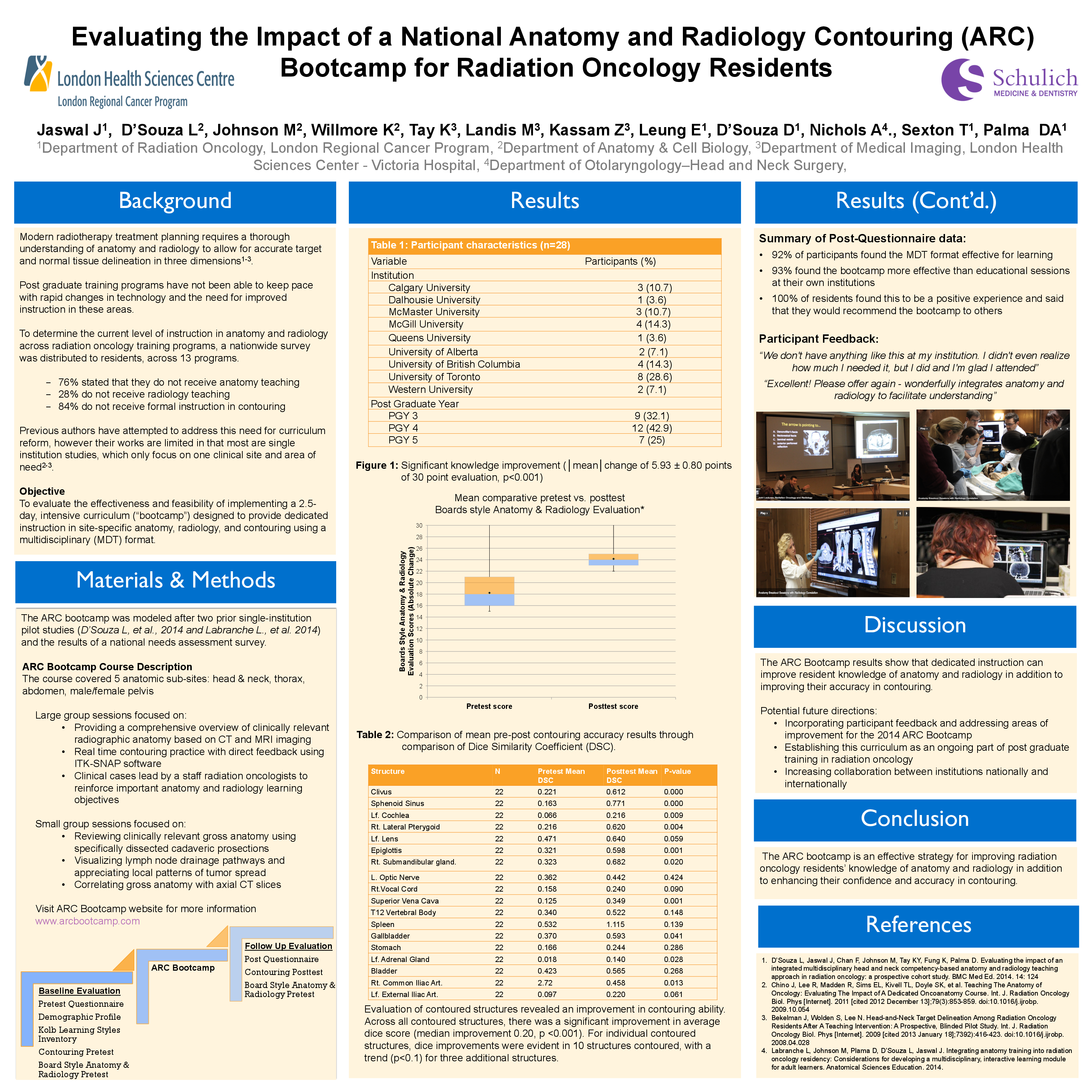
Purpose: Radiotherapy treatment planning, in the modern era, has an increased focus on three-dimensional planning. Recent studies suggest a need for improved resident instruction in this area. The purpose of this study was to evaluate the effectiveness of a 2.5-day, intensive curriculum (“bootcamp”) designed to provide dedicated instruction in site-specific anatomy, radiology, and contouring using a multidisciplinary team of clinical educators.
Materials and Methods: The bootcamp was modeled after a prior single-institution pilot study and a national needs assessment survey. The bootcamp consisted of joint didactic lectures incorporating radiation and surgical oncologists and radiologists, with hands-on contouring instruction. Interactive small group seminars with clinical anatomists were held using cadaveric prosections and correlative axial radiographs to enhance 2D-3D spatial relationships. Educational outcomes were evaluated with pre- and post-testing, including 30 multiple-choice knowledge questions and timed contouring sessions of 18 structures (evaluated relative to a gold standard using dice similarity metrics). Analyses of pre- versus post-test scores were done using non-parametric paired testing.
Results: Twenty-nine residents from ten universities participated including nine post-graduate year (PGY) 3’s, 12 PGY 4’s and seven PGY 5’s. A majority of the students had done at least one rotation in each clinical site. Twenty-seven percent, 67% and 20% of residents stated that they currently receive formal instruction in anatomy, radiology and contouring, respectively. There was a significant improvement in knowledge scores (pre-test mean 60% versus post-test mean 80%, p<0.001). Across all contoured structures there was an improvement in students’ average dice score (median improvement 0.20, p<0.001). For individual contoured structures, dice improvements were evident in 10 structures contoured, with a trend (p<0.1) for three additional structures. Students self-reported improved ability to interpret radiographs and contour OARs in all clinical sites (head & neck, thorax, abdomen, male/female pelvis p<0.01). In the post-bootcamp questionnaire, 92% found the multidisciplinary format effective for their learning, 93% found the bootcamp more effective than other educational sessions at their own institutions, and 100% stated that they would recommend this course to others.
Conclusions: The ARC bootcamp is an effective strategy for improving radiation oncology residents’ knowledge of anatomy and radiology in addition to enhancing their confidence and accuracy in contouring.