Abstract
Petra Grendarova, David Spencer, Corinne Doll, Robyn Banerjee
University of Calgary, Calgary, AB
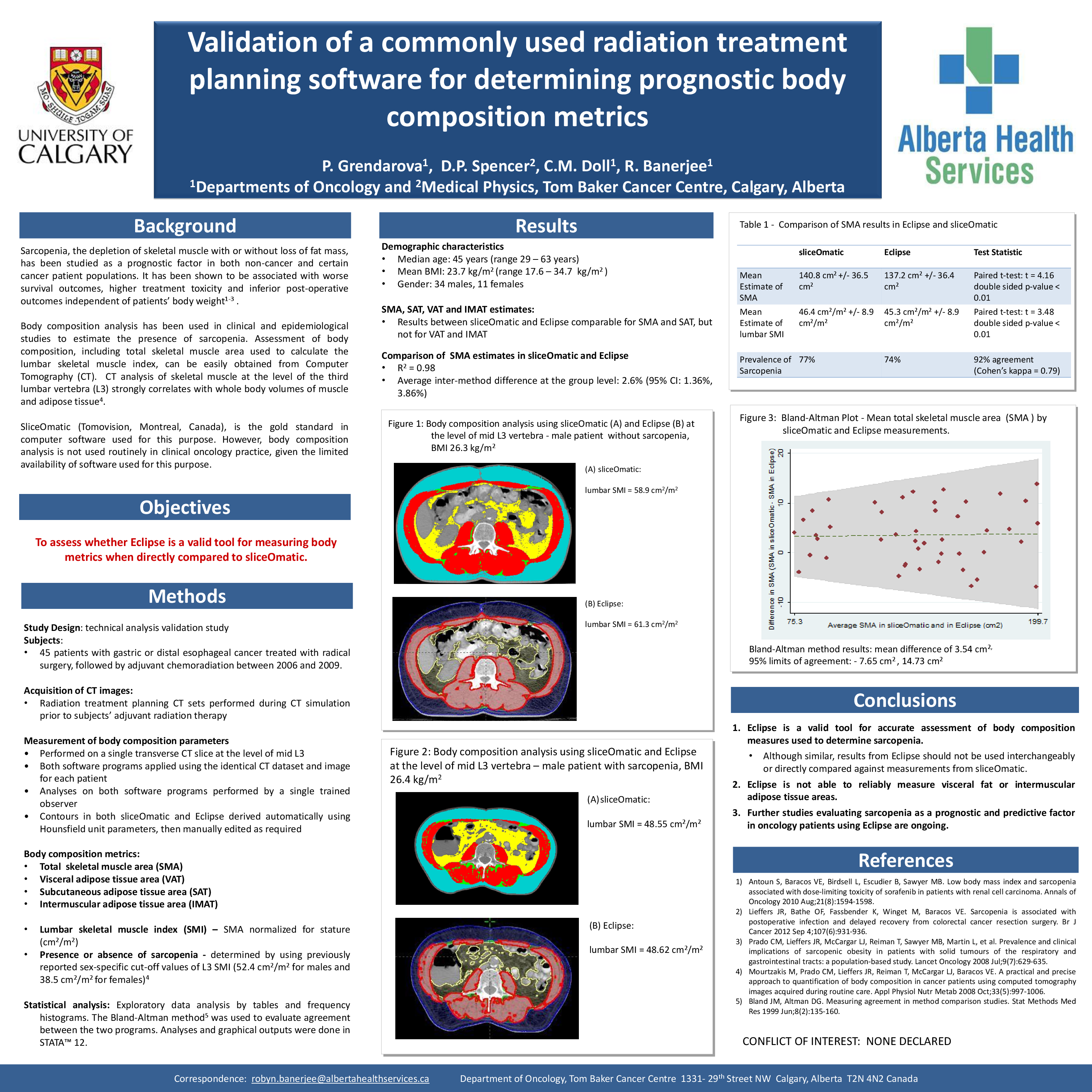
Purpose: Body composition analysis has been used in clinical and epidemiological studies to estimate presence of sarcopenia (skeletal muscle depletion). Sarcopenia is associated with increased morbidity and mortality in cancer patients. However, body composition analysis is not used routinely in clinical oncology practice given the limited availability of software used for this purpose. SliceOmatic (Tomovision, Montreal, Canada) is the gold standard in computer software used to determine sarcopenia using CT imaging data. This study aims to assess whether Eclipse (Varian, Palo Alto, CA), a widely available radiation treatment planning software, represents a valid tool for measuring body metrics when directly compared to sliceOmatic.
Materials and Methods: CT data from the radiation treatment planning scans of 45 patients (34 males, 11 females) with gastric or distal esophageal cancer treated with radical surgery followed by adjuvant chemoradiation between 2006 and 2009 were used for analysis. Mean BMI was 23.7 kg/m2 (range = 17.6 - 34.7 kg/m2). Body composition parameters were measured on a single transverse CT slice at the level of L3. Both software programs were applied using the identical CT dataset for each patient. Body composition metrics included estimates of total skeletal muscle (SMA), visceral adipose tissue (VAT), subcutaneous adipose tissue (SAT) and intermuscular adipose tissue (IMAT) areas. Contours were derived automatically using Hounsfield unit parameters, then manually edited as required. The lumbar skeletal muscle index (SMA normalized for stature) and prevalence of sarcopenia using both programs were calculated. The Bland-Altman method was used to evaluate agreement between the two programs.
Results: Estimates of lumbar skeletal muscle area were highly correlated (R2=98%) between Eclipse and sliceOmatic. The Bland-Altman method results demonstrated a mean difference of 3.54 cm2 with the 95% limits of agreement of -7.65 cm2 and 14.73 cm2. The average inter-method difference at the group level was 2.6% (95% CI 1.36%, 3.86%). Eclipse resulted in similar, but significantly lower, mean estimates of SMA compared to sliceOmatic (137.2 ± 36.4 cm2 versus 140.8 ± 36.5 cm2, p<0.01), as well as mean lumbar skeletal muscle index (45.3 ± 8.9 cm2/m2 versus 46.4 ± 8.9 cm2/m2, p<0.01). Prevalence of sarcopenia was 74% as determined by sliceOmatic versus 77% as determined by Eclipse (92% agreement, kappa=0.79). Results were comparable between the programs for SAT but not for IMAT or VAT.
Conclusions: Eclipse represents a valid tool for the accurate assessment of body composition measures used to determine sarcopenia. Although similar, results from Eclipse should not be used interchangeably or directly compared against measurements from sliceOmatic. Eclipse is not able to reliably measure visceral fat or intermuscular adipose tissue areas. Future studies evaluating sarcopenia in oncology patients are ongoing.