Abstract
Kitty Huang1, Olga Vujovic1, Edward Yu1, Anil Cherian2, Rashid Dar1, Larry Stitt1, Francisco Perera1
1London Regional Cancer Program, London, ON, Canada
2UK Ministry of Defense, United Kingdom
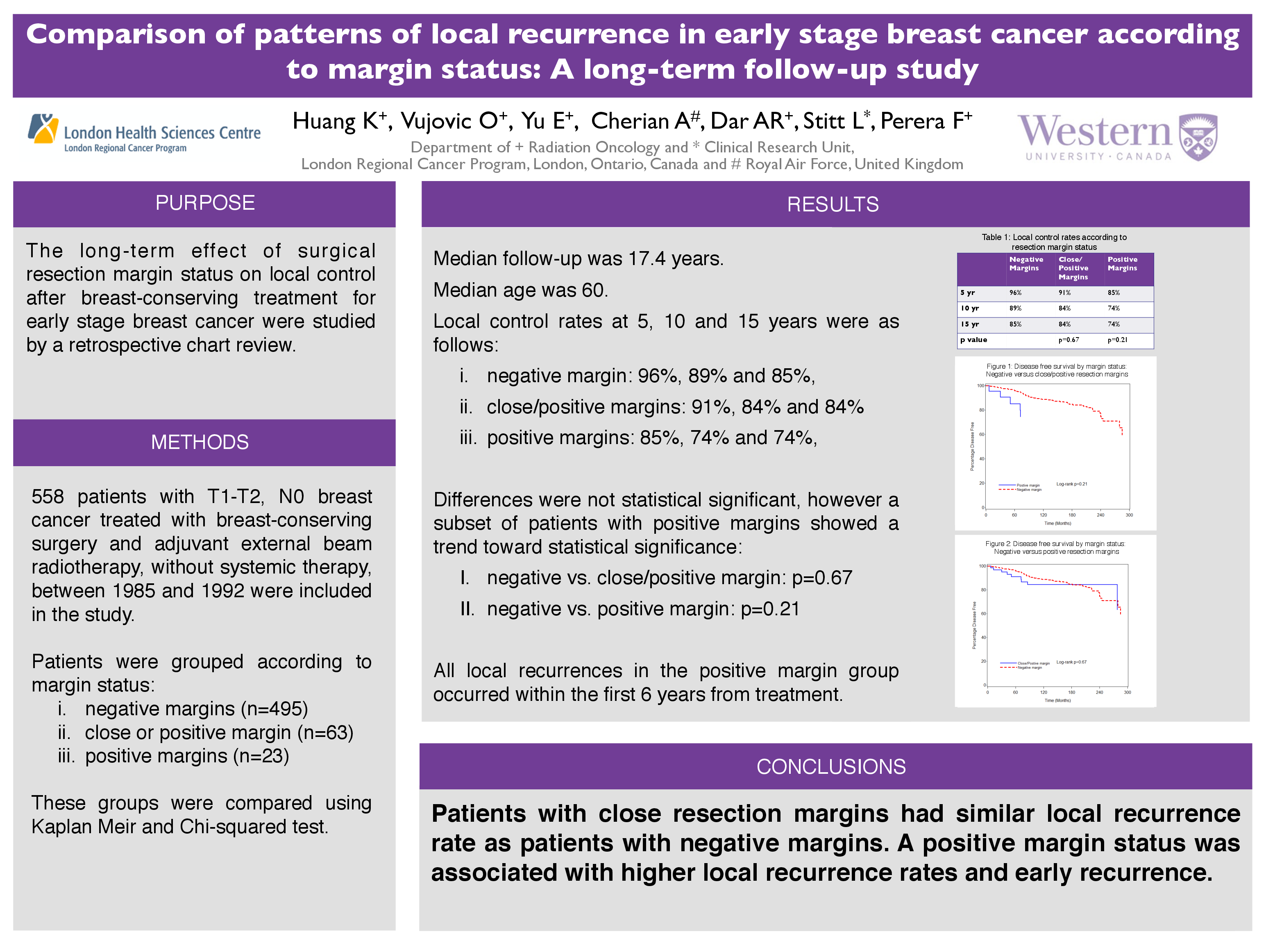
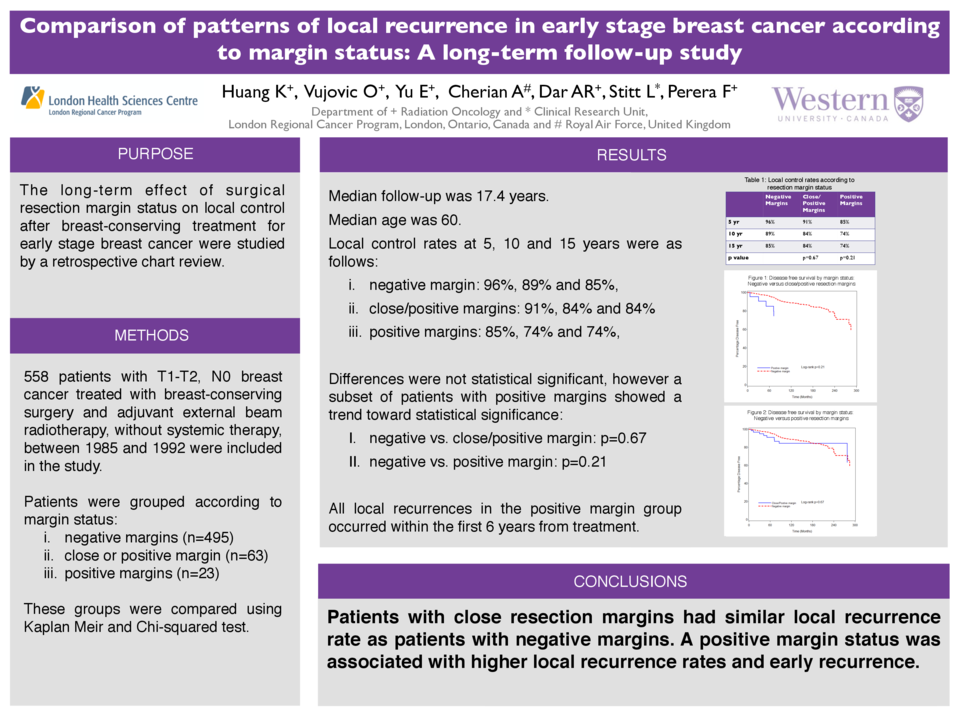
Purpose: The long-term effect of surgical resection margin status on local control after breast-conserving treatment for early stage breast cancer were studied by a retrospective chart review.
Materials and Methods: Five hundred and fifty-eight patients with T1-T2, N0 breast cancer treated with breast-conserving therapy without systemic therapy between 1985 and 1992 were included in the study. Patients were grouped according to margin status: 1) negative margins (n=495); 2) close or positive margin (n=63); and 3) positive margins (n=23), and these groups were compared using Kaplan Meir and Chi-squared test.
Results: Median follow-up was 17.4 years. Median age was 60. Local control rates at five, 10 and 15 years among the comparison groups were as follows: 1) negative margin: 96%, 89%, and 85%; 2) close/positive margins: 91%, 84%, and 84%; and 3) positive margins: 85%, 74%, and 74%, respectively. These differences were not statistical significant; however, a subset of patients with positive margins showed a trend toward statistical significance (negative versus close/positive margin: p=0.67 and negative versus positive margin: p=0.21). All local recurrences in the positive margin group occurred within the first six years from treatment.
Conclusions: Patients with close resection margins had similar local recurrence rates as patients with negative margins. A positive margin status was associated with higher local recurrence rates and early recurrence.