Abstract
Laurence Masson-Côté, Annie Ebacher, Vincent Hubert-Tremblay, David Fortin, David Mathieu
Unversité de Sherbrooke, Sherbrooke, QC
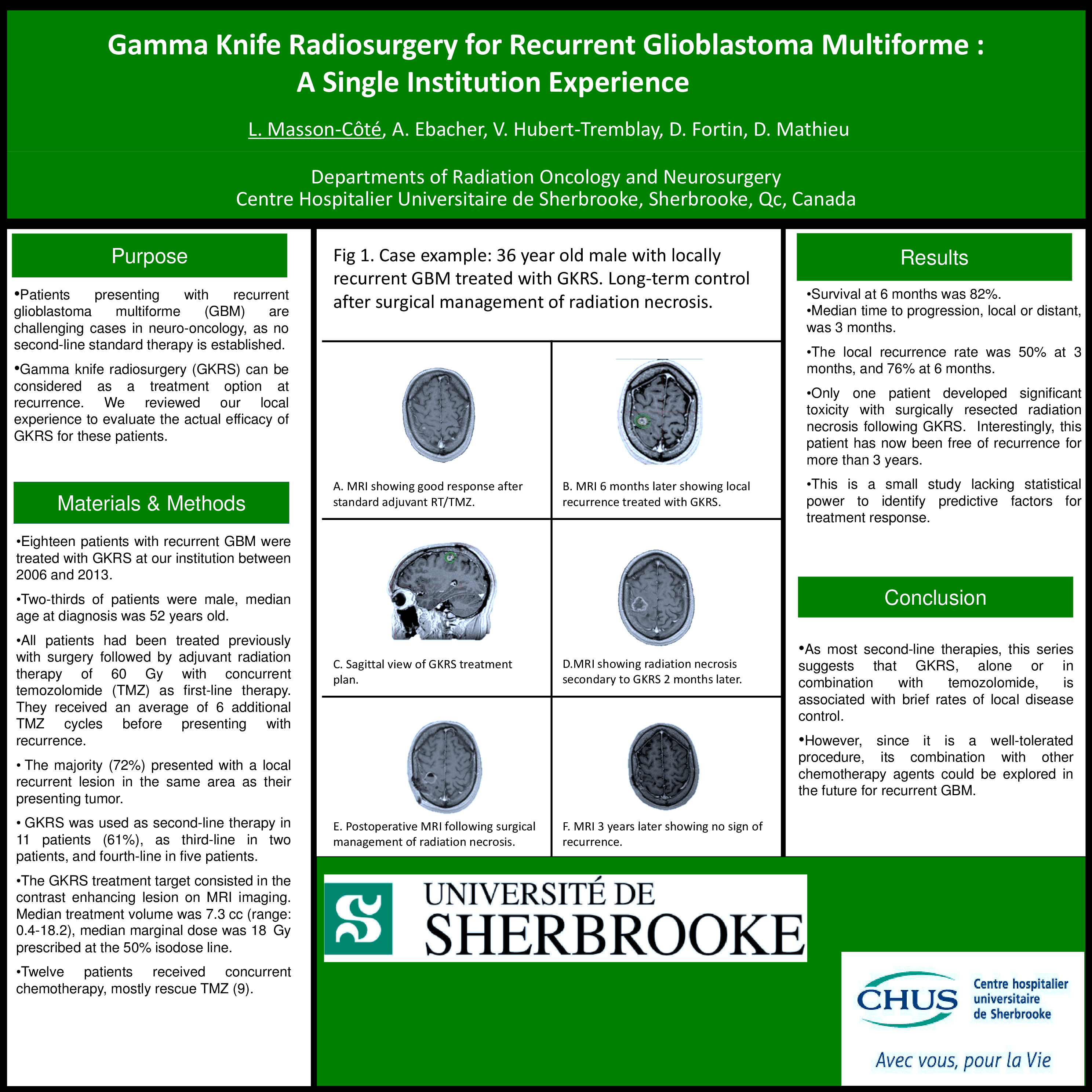
Purpose: Patients presenting with recurrent glioblastoma multiforme (GBM) are challenging cases in neuro-oncology, as no second-line standard therapy is established. Gamma knife radiosurgery (GKRS) can be considered as a treatment option at recurrence. We reviewed our local experience to evaluate the actual efficacy of GKRS for these patients.
Materials and Methods: Eighteen patients with recurrent GBM were treated with GKRS at our institution between 2006 and 2013. Two-thirds of patients were male, median age at diagnosis was 52 years old. All patients had been treated previously with surgery followed by adjuvant radiation therapy of 60 Gy with concurrent temozolomide (TMZ) as first-line therapy. They received an average of 6 additional TMZ cycles before presenting with recurrence. The majority (72%) presented with a local recurrent lesion in the same area as their presenting tumour. GKRS was used as second-line therapy in 11 patients (61%), as third-line in two patients, and fourth-line in five patients. The GKRS treatment target consisted in the contrast enhancing lesion on MRI imaging. Median treatment volume was 7.3 cc (range: 0.4-18.2), median marginal dose was 18 Gy prescribed at the 50% isodose line. Twelve patients received concurrent chemotherapy, mostly rescue TMZ (9).
Results: Survival at six months was 82%. Median time to progression, local or distant, was three months. The local recurrence rate was 50% at three months, and 76% at six months. Only one patient developed significant toxicity with surgically resected radiation necrosis following GKRS. Interestingly, this patient has now been free of recurrence for more than three years. This is a small study lacking statistical power to identify predictive factors for treatment response.
Conclusions: As most second-line therapies, this series suggests that GKRS, alone or in combination with temozolomide, is associated with brief rates of local disease control. However, since it is a well-tolerated procedure, its combination with other chemotherapy agents could be explored in the future for recurrent GBM