Abstract
Mark Barnes1, Manpreet Tiwana1, Stacy Miller1, Ivo Olivotto2, Andrew Kiraly3, Rob Olson1
1British Columbia Cancer Agency, Centre for the North, Prince George, BC
2British Columbia Cancer Agency, Vancouver Cancer Centre, Vancouver, BC
3University of Northern British Columbia, Prince George, BC
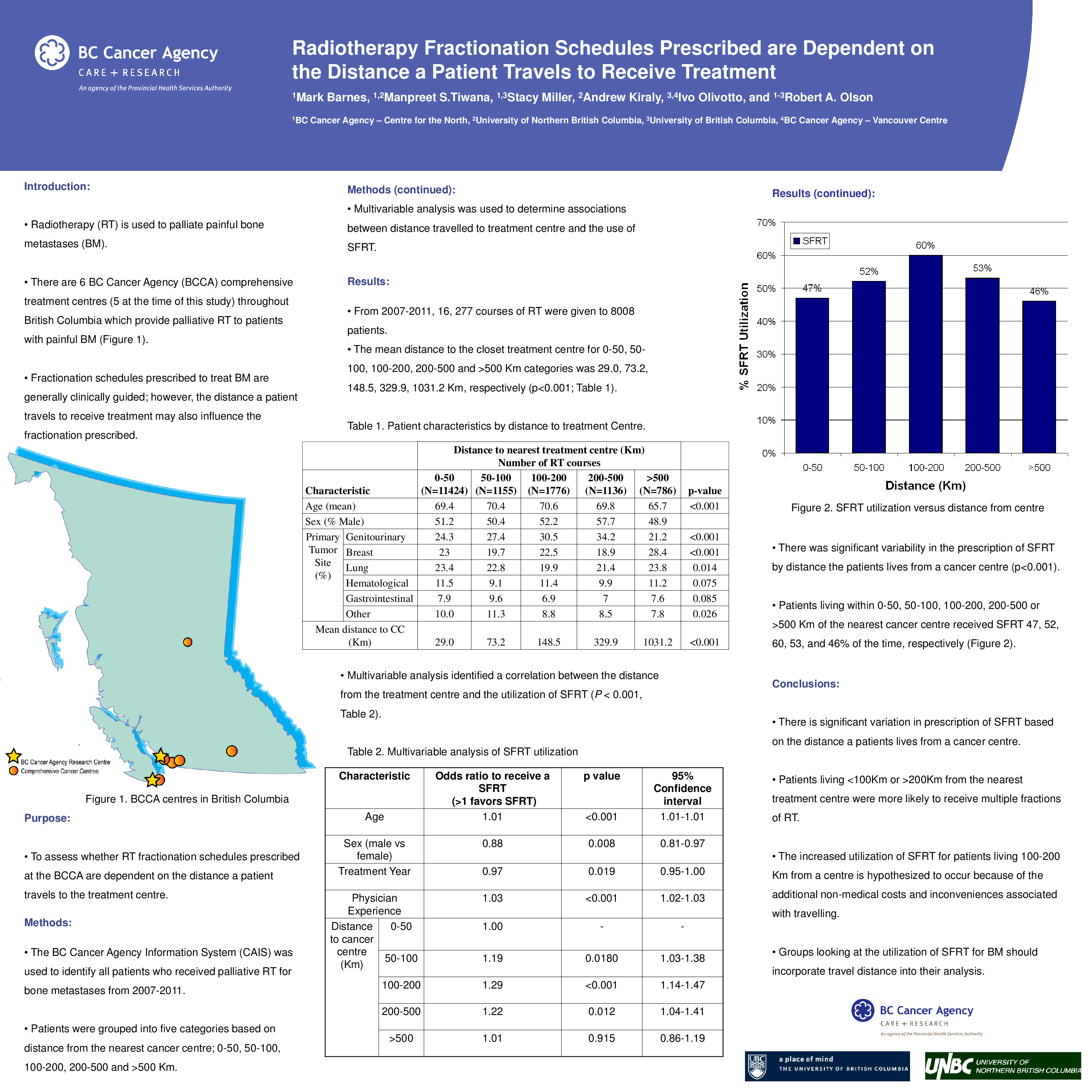
Purpose: This study assesses whether prescribed radiotherapy (RT) fractionation schedules are dependent on the distance the patient travels to the treatment centre.
Matherials and Methods: All courses of RT for bone metastases from 2007-2011 for patient living in British Columbia were included. Patients were grouped into five categories based on distance from the nearest treatment centre; 0-50, 50-100, 100-200, 200-500 and >500 Km. Associations between distance travelled to treatment centre and the use of single fraction (SF) RT were determined.
Results: From 2007-2011, 8008 patients were treated with 16,277 courses of RT; 51.6% of RT courses were prescribed to male patients. Genitourinary malignancies were observed most frequently (25%). The proportion of patients living within 0-50, 50-100, 100-200, 200-500 or >500 Km of the treatment centre were 69.7, 7.4, 11.0, 7.9 and 4.9%, respectively (p<0.001). There was significant variability in the prescription of SFRT by distance the patients lives from a cancer centre (p<0.001), which was normally distributed with a peak at an intermediate group; patients living within 0-50, 50-100, 100-200, 200-500 or >500 Km of the nearest cancer centre received SFRT 47.0, 52.9, 60.0, 53.3, and 46.0% of the time, respectively.
Conclusions: There is a significant variability in prescription of SFRT based on the distance a patients lives from a cancer centre. Patients living <50Km or >500 Km from the nearest treatment centre were most likely to receive multiple fraction RT (MFRT). The similar use of patients livings >500 Km, to those living <50Km is hypothesized to occur because these patients fly to the cancer centre, and subsequently are willing to stay near the centre for a MFRT course. Conversely, the higher utilization of SFRT for patients living 100-200 Km from a centre is hypothesized to occur because they would commute via car daily, and prefer to have only one treatment over a course. This data suggests that groups looking at the utilization of SFRT for bone metastases should incorporate travel distance into their analysis