Abstract
SH Huang, John Waldron, W Xu, L Tong, J Ringash, A Bayley, A Hope, J Kim, J Cho, M Giuliani, B Perez-Ordonez, L Weinreb, E Chen, D Goldstein, B O'Sullivan
Princess Margaret Cancer Centre, Toronto, ON
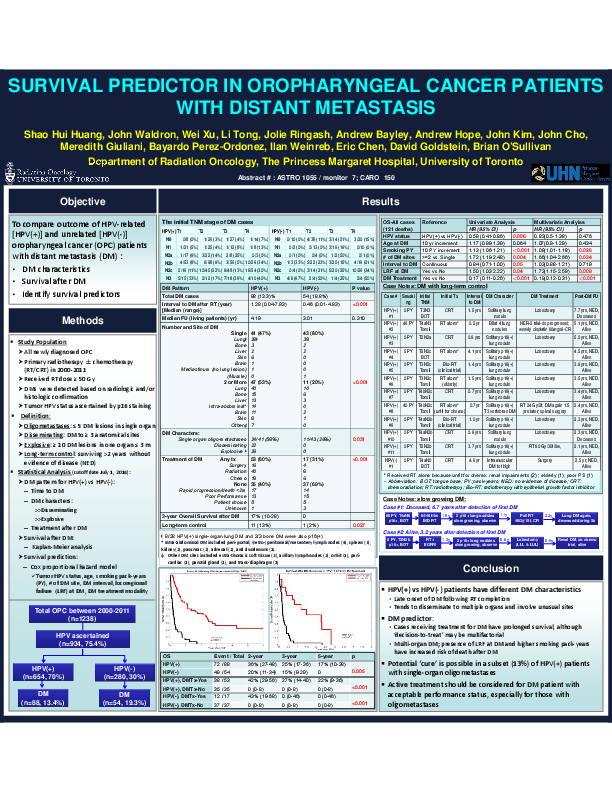
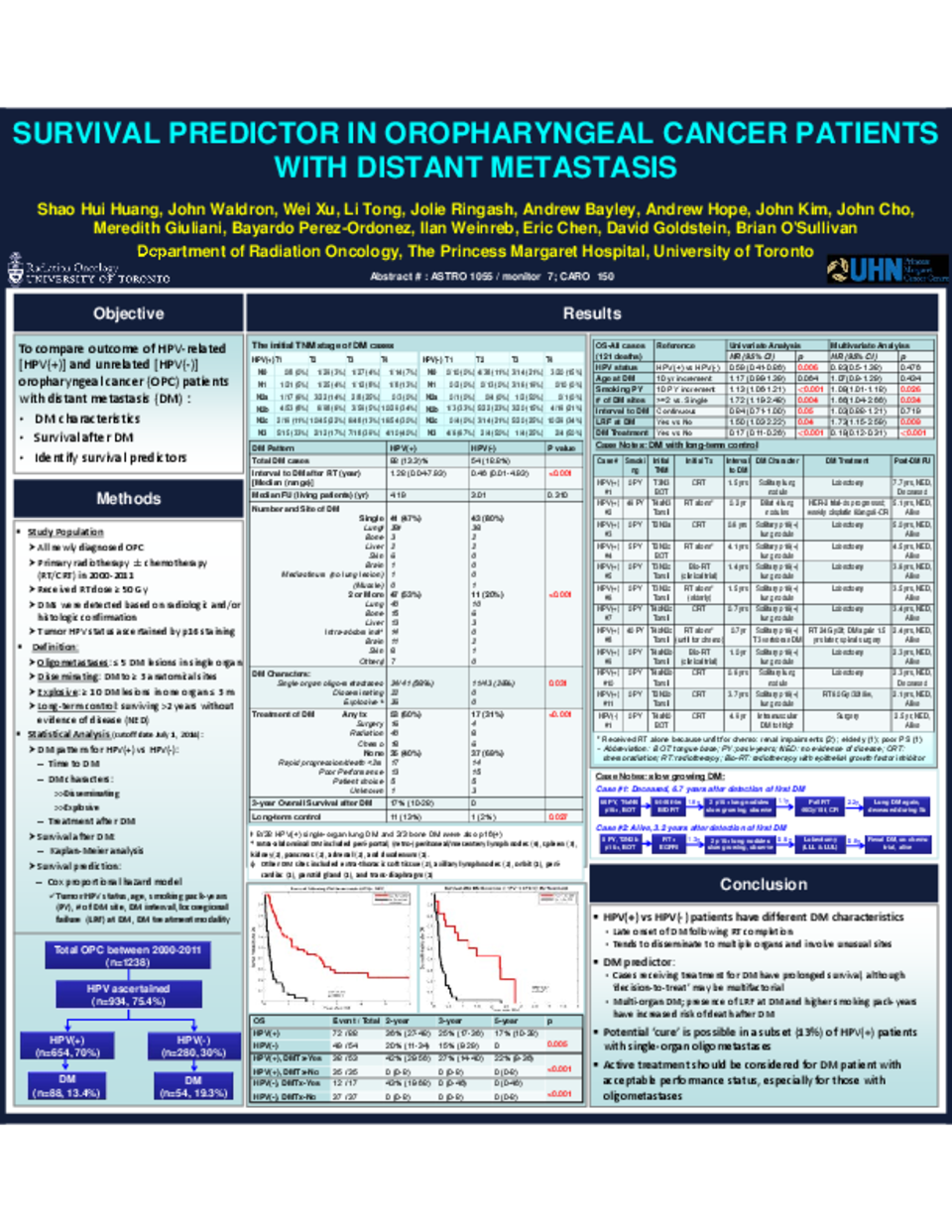
Purpose: To identify survival predictors for HPV-related [HPV(+)] and unrelated [HPV(-)] oropharyngeal cancer (OPC) patients with distant metastasis (DM) following primary radiotherapy+/- chemotherapy (RT/CRT).
Materials and Methods: All HPV status confirmed (by p16 staining) OPC cases managed with RT/CRT between 2000-2011 were included. DM characteristics and survival after DM were compared between HPV(+) and HPV(-) cohorts. Cox regression models identified survival predictors.
Results: HPV status was ascertained in 934/1238 (75%) consecutive OPC cases. DMs were detected in 138/934 (15%) including 87 HPV(+) and 51 HPV(-) cases at a median 1.42 versus 0.69 years following RT (p<0.001). Lung was the most common DM site [HPV(+) 68 (78%) versus HPV(-) 46 (90%)]. Multi-organ (>=2) DMs occurred in 46 (53%) HPV(+) versus 10 (20%) HPV(-) cases (p<0.001). HPV(+) single-organ DM were more likely to be oligometastases (defined as 1-5 lesions confined to one organ) (25/41, 61%) versus HPV(-) (11/41, 27%) (p=0.002). More HPV(+) than HPV(-) patients received treatment for DM (60% versus 31%, p<0.001) . Median FU after DM for surviving patients was 1.86 years. HPV(+) DM patient had longer OS versus HPV(-): 26% versus 16% and 17% versus 0% at two- and three-years respectively (p=0.01). Potential cure (NED at last follow up, 1.9-7.7 years post-DM) was seen in 9/25 (36%) HPV(+) (seven surgery, one RT, one chemo) and 1/11 (10%) HPV(-) (surgery) case, all with lung oligometastases. Multivariate analysis identified untreated DM (HR 4.8, p<0.001), presence of concurrent locoregional failure (HR 1.61, p=0.03), multi-organ DM (HR 1.91, p=0.01), and smoking pack-years (HR 1.09, p=0.03) as adverse predictors for survival. HPV status, age at DM, and interval to DM did not predict survival.
Conclusions: This study confirms that HPV(+) versus HPV(-) patients have different DM characteristics. The majority of HPV(+) DM involved more than two organs. Multi-organ DM and presence of LRF reduces survival. Patients who received treatment for DM have prolonged survival, although decision-to-treatment may be multi-factorial. Potential ‘cure’ is possible in a subset (9/25, 36%) of HPV(+) patients with single-organ oligometastases. Active treatment should be considered for DM patient with acceptable performance status, especially for those with oligometastases.