Abstract
Purpose
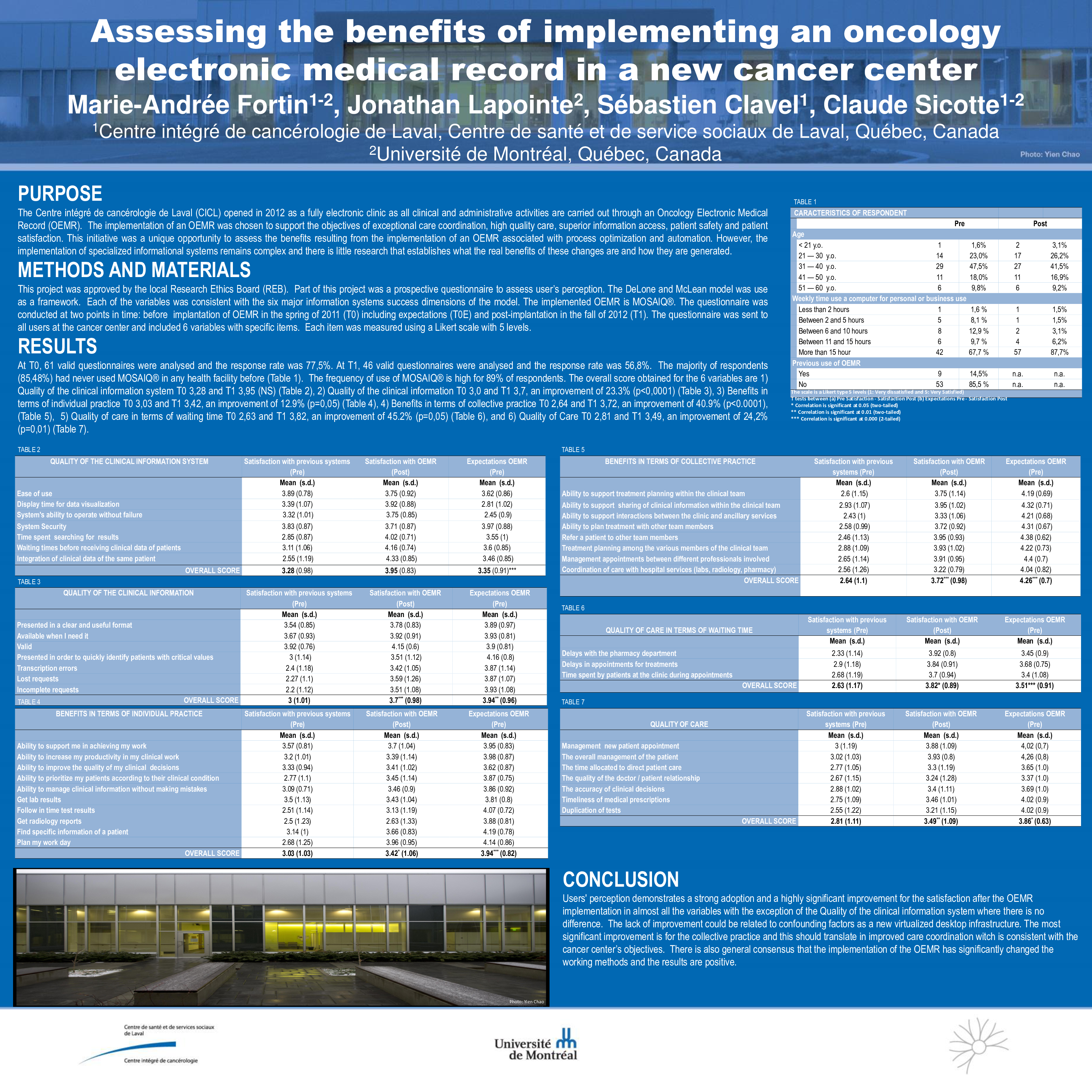
The Centre intégré de cancérologie de Laval (CICL) opened in 2012 as a fully electronic clinic as all clinical and administrative activities are carried out through an Oncology Electronic Medical Record (OEMR). The implementation of an OEMR was chosen to support the objectives of exceptional care coordination, high quality care, superior information access, patient safety and patient satisfaction. This initiative was a unique opportunity to assess the benefits resulting from the implementation of an OEMR associated with process optimization and automation. However, the implementation of specialized informational systems remains complex and there is little research that establishes what the real benefits of these changes are and how they are generated.
Methods and Materials
This project was approved by the local Research Ethics Board (REB). Part of this project was a prospective questionnaire to assess user’s perception. The DeLone and McLean model was use as a framework. Each of the variables was consistent with the six major information systems success dimensions of the model. The implemented OEMR is MOSAIQ®. The questionnaire was conducted at two points in time: before implantation of OEMR in the spring of 2011 (T0) including expectations (T0E) and post-implantation in the fall of 2012 (T1). The questionnaire was sent to all users at the cancer center and included 6 variables with specific items. Each item was measured using a Likert scale with 5 levels.
Results
At T0, 61 valid questionnaires were analysed and the response rate was 77,5%. At T1, 46 valid questionnaires were analysed and the response rate was 56,8%. The majority of respondents (85,48%) had never used MOSAIQ® in any health facility before (Table 1). The frequency of use of MOSAIQ® is high for 89% of respondents. The overall score obtained for the 6 variables are 1) Quality of the clinical information system T0 3,28 and T1 3,95 (NS) (Table 2), 2) Quality of the clinical information T0 3,0 and T1 3,7, an improvement of 23.3% (p<0,0001) (Table 3), 3) Benefits in terms of individual practice T0 3,03 and T1 3,42, an improvement of 12.9% (p=0,05) (Table 4), 4) Benefits in terms of collective practice T0 2,64 and T1 3,72, an improvement of 40.9% (p<0.0001), (Table 5), 5) Quality of care in terms of waiting time T0 2,63 and T1 3,82, an improvement of 45.2% (p=0,05) (Table 6), and 6) Quality of Care T0 2,81 and T1 3,49, an improvement of 24,2% (p=0,01) (Table 7).
Conclusions
Users' perception demonstrates a strong adoption and a highly significant improvement for the satisfaction after the OEMR implementation in almost all the variables with the exception of the Quality of the clinical information system where there is no difference. The lack of improvement could be related to confounding factors as a new virtualized desktop infrastructure. The most significant improvement is for the collective practice and this should translate in improved care coordination witch is consistent with the cancer center’s objectives. There is also general consensus that the implementation of the OEMR has significantly changed the working methods and the results are positive.