Pineal Cysts - A Benign Consequence of Mild Hypoxia in a Near-Term Brain
Abstract
Introduction: High resolution MRI allows detailed studies on brain structures, including pineal gland. Small pineal cysts are found incidentally in healthy adults in 1.5%-10.8% (1). Large cysts may cause neurological problems due to pressure exertion on adjacent structures.
Purpose: To examine pineal cysts in adolescents who experienced neonatal hypoxia.
Material and methods: Prospective, observational study of inception cohort of 16 adolescents with mild (68.7%) to moderate HIE (31.3%): 7 girls (43.8%), 9 (56.3%) with mean GA of 35.75 weeks (SD=±3.80) was compared to 16 healthy students, matched by gender and age of 21.69 years (SD=±0.87). HIE was confirmed by presence of abnormal CTG and/or Apgar scores less than 7 at 5 minutes and/or need for resuscitation and/or cord pH less than 7,1, Adolescents were scanned with 3T Magnetom Trio Tim, Siemens, head coil 12 channels, regular and sagittal MPRAGE sequence, voxel size 1mm3.
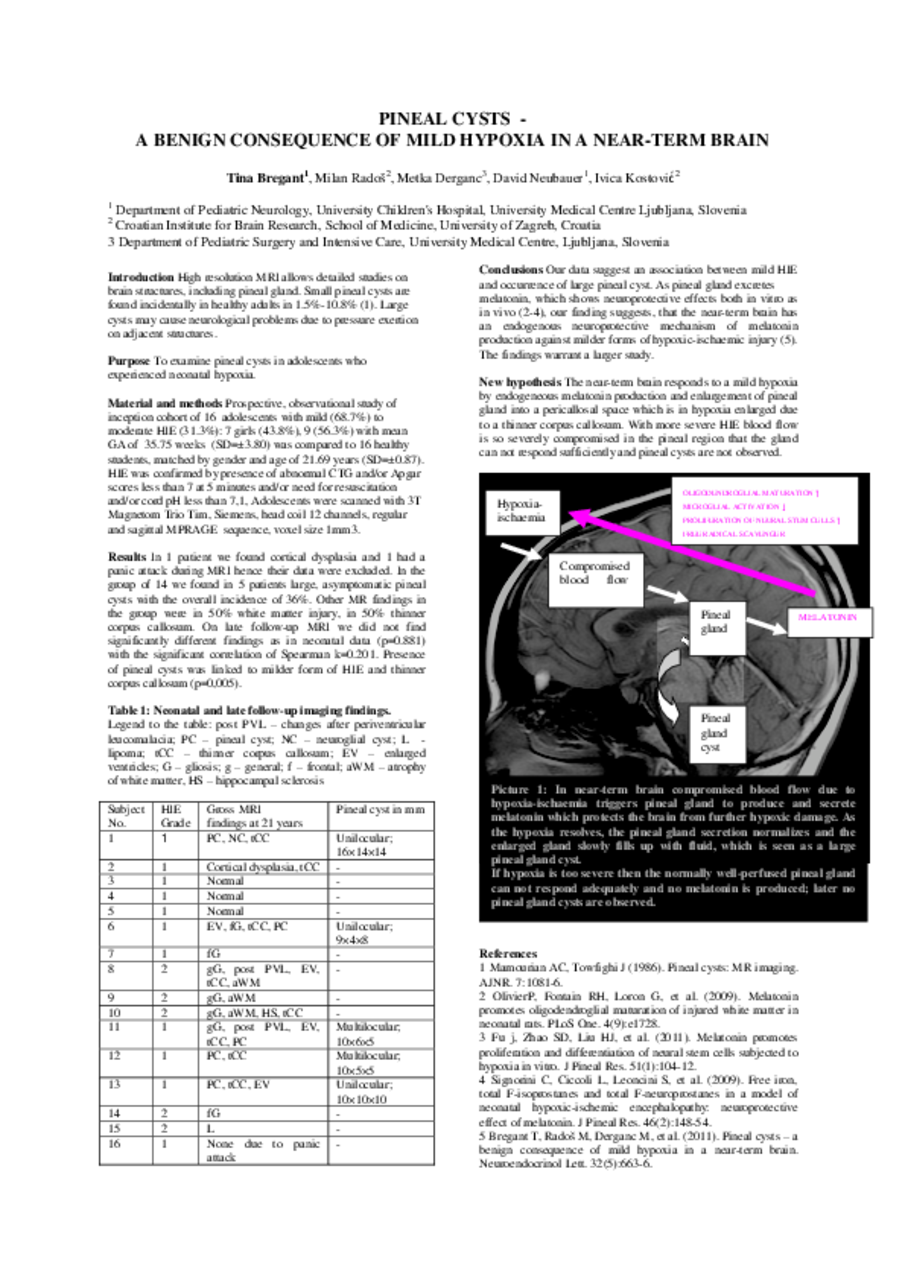
Results: In 1 patient we found cortical dysplasia and 1 had a panic attack during MRI hence their data were excluded. In the group of 14 we found in 5 patients large, asymptomatic pineal cysts with the overall incidence of 36%. Other MR findings in the group were in 50% white matter injury, in 50% thinner corpus callosum. On late follow-up MRI we did not find significantly different findings as in neonatal data (p=0.881) with the significant correlation of Spearman k=0.201. Presence of pineal cysts was linked to milder form of HIE and thinner corpus callosum (p=0,005).
Conclusions: Our data suggest an association between mild HIE and occurrence of large pineal cyst. As pineal gland excretes melatonin, which shows neuroprotective effects both in vitro as in vivo, our finding suggests, that the near-term brain has an endogenous neuroprotective mechanism of melatonin production against milder forms of hypoxic-ischaemic injury. The findings warrant a larger study.
Related articles