Role of Myosin II in Cytokinetic Contractile Ring Formation in Fission Yeast
Abstract
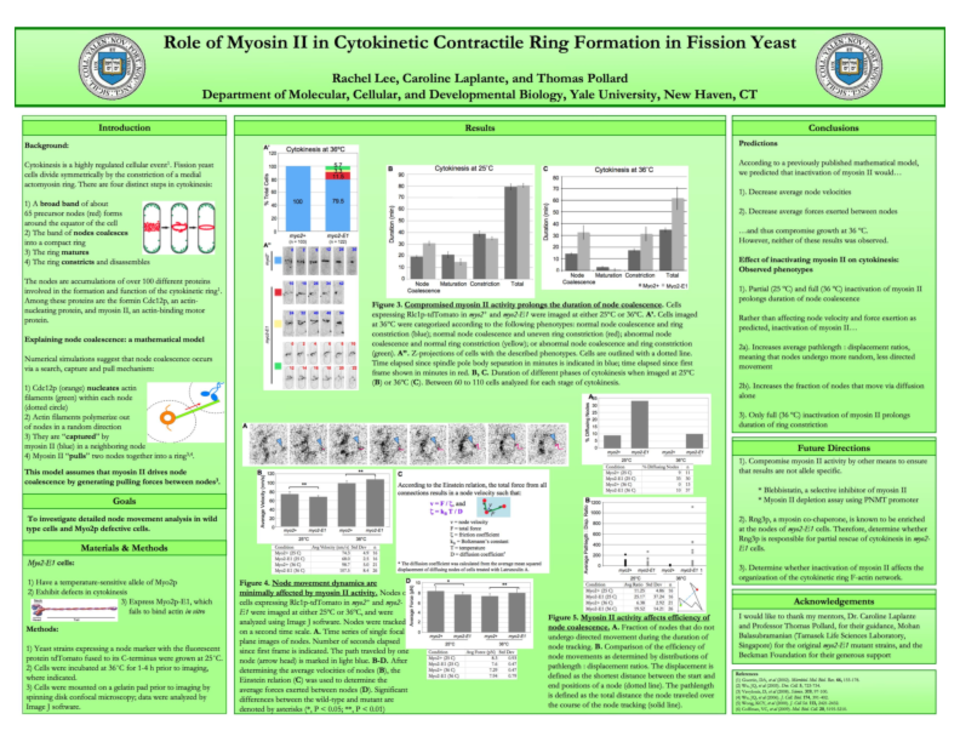
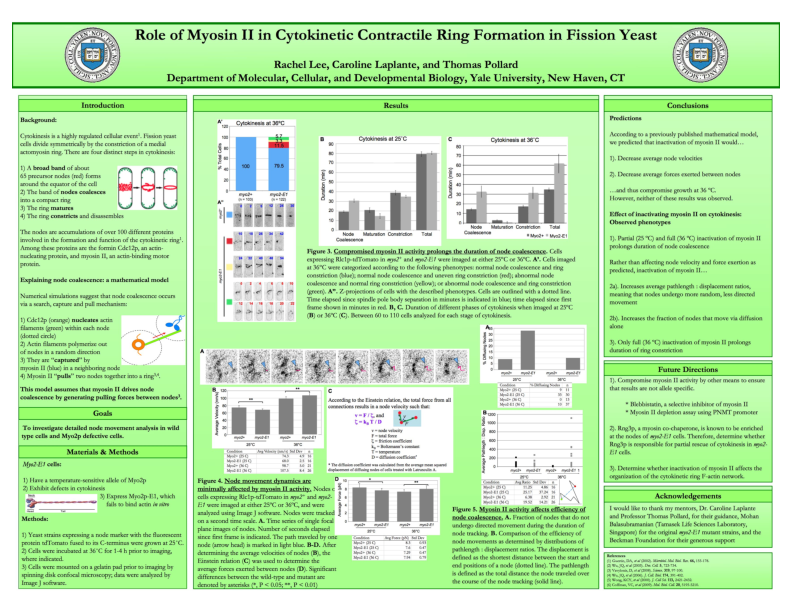
Cytokinesis, the physical separation of a cell, is the last step of the cell cycle and is a tightly regulated biological process. In most cells, cytokinesis occurs by the constriction of a ring made of actin and myosin II. Myosin II is an actin-binding ATPase motor protein that is essential for cytokinesis. In the fission yeast Schizosaccharomyces pombe the cytokinetic ring assemble via the coalescence of a broad band of protein assemblies named precursor nodes. The nodes contain actin binding and regulating proteins such as myosin II and the actin filament elongating protein Cdc12. A leading mathematical model to explain the mechanism of contractile ring formation postulates that actin filaments are nucleated from each node and “captured” by myosin II of neighboring nodes. Myosin II then generates the force to
pull the nodes together into a compact contractile ring. I studied the precise role of myosin II during contractile ring formation by analyzing node dynamics in myo2-E1 mutants yeast cells. Surprisingly, my results indicate that the nodes in both wild type and mutant cells travel at comparable speeds. Furthermore, the magnitudes of the forces exerted on the nodes of both strains are also similar. By contrast, while the nodes of wild type strains exhibited efficient, directed movements, the nodes of mutant strains exhibited significantly more random movements. Thus, the myo2-E1 mutation appears to decrease the efficiency of node movements, but does not reduce the force required for cytokinetic contractile ring formation.
Related articles