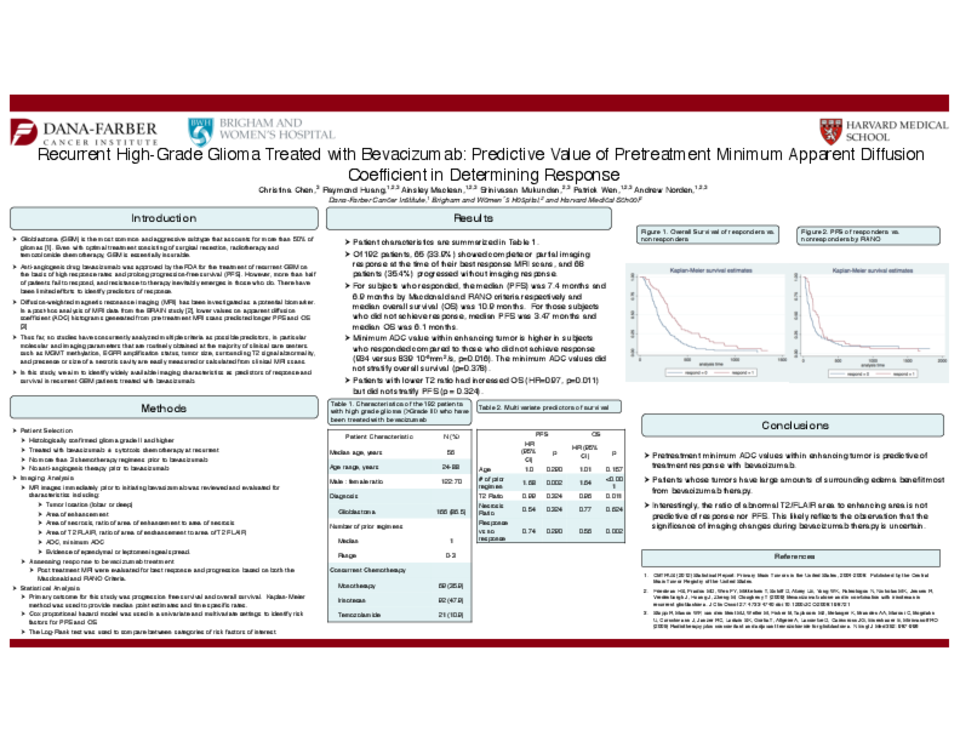
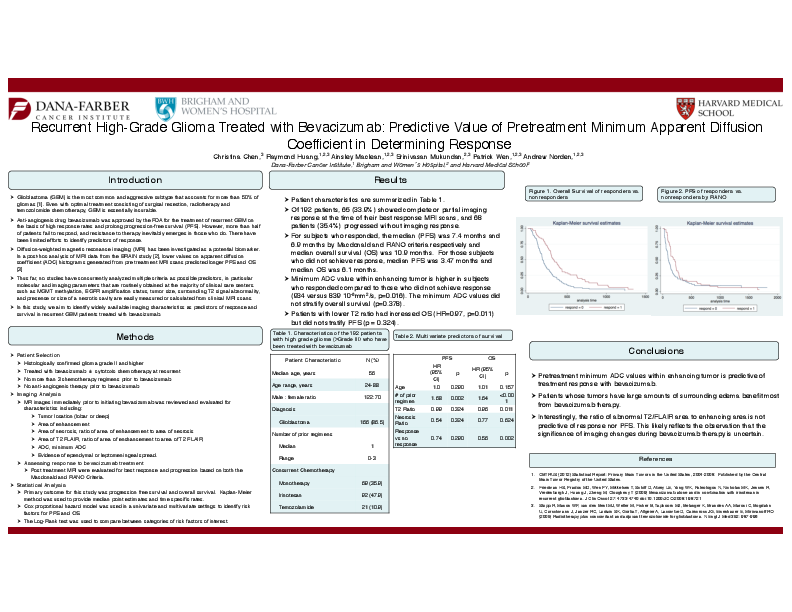
Recurrent High-Grade Glioma Treated with Bevacizumab: Predictive Value of Biomarkers and Pretreatment MRI in Determining Response and Survival
Abstract
OBJECTIVE: In patients with recurrent high-grade glioma treated with bevacizumab in our center, we assessed baseline magnetic resonance imaging (MRI) and tissue biomarkers as potential predictors of response and survival.
BACKGROUND: Although bevacizumab represented an important advance in treatment of high-grade glioma, responses occur in fewer than half of patients and are short-lived. There have been limited efforts to identify predictors of response to bevacizumab treatment in this population, and there are no validated biomarkers for anti-angiogenic therapy that are available for routine clinical use.
METHODS: MRI scans from 192 patients with recurrent high-grade glioma obtained immediately prior to initiating bevacizumab were reviewed for area of enhancement, area of necrosis, area of T2/FLAIR abnormality, average and minimum ADC values, and evidence of ependymal or leptomeningeal spread. Serial MRI scans following the initiation of bevacizumab were evaluated for response and progression using RANO criteria. Non-radiographic predictors included sex, histology, EGFR status, MGMT promoter methylation status, number of prior regimens, and bevacizumab use as monotherapy or with cytotoxic chemotherapy.
RESULTS: 65 of 192 patients (33.9%) showed complete or partial imaging response at the time of their best response MRI scans, and 68 patients (35.4%) progressed without imaging response. For subjects who responded, the median progression free survival (mPFS) was 6.9 months and median overall survival (mOS) was 10.9 months. For the group without response, mPFS was 3.47 months and mOS was 6.1 months. The minimum ADC values within enhancing tumor were higher in subjects who responded (934 versus 839 10-6mm2/s, p=0.016). On multivariate survival analysis, ratio of T2/FLAIR to enhancing area was the only significant predictor of overall survival (hazard ratio= 0.961, p = 0.01).
CONCLUSIONS: Baseline minimum ADC value within enhancing tumor is predictive of treatment response with bevacizumab, while the ratio of T2/FLAIR to enhancing area is predictive of overall survival.
Related articles