What Northern Finnish Mothers and Fathers Find Most Straining in their Young Children´s Behaviour?
Abstract
Background: Problems in children´s behaviour may cause stress to their parents. Parents experience those problems differently depending on, e.g., their own history and concurrent state. Aim: Was to explore what kind of problematic behaviour of young children burdens their parents.
Methods: Original data consists of 199 children at 18 month´s age who lived in city of Oulu in Northern Finland during years 2008-2009, and 217 children at 12 month´s age who lived in Oulu in years 2010-11. Children´s symptoms were evaluated by the Brief Infant-Toddler Social Emotional Assessment (BITSEA) and parental stress was measured by the Parenting Stress Inventory (PSI). Nurses in all child health care centers in Oulu administered BITSEA and PSI questionnaires to parents in children´s 12 or 18 months´ checkout visit. Parents sent filled forms back to researchers.
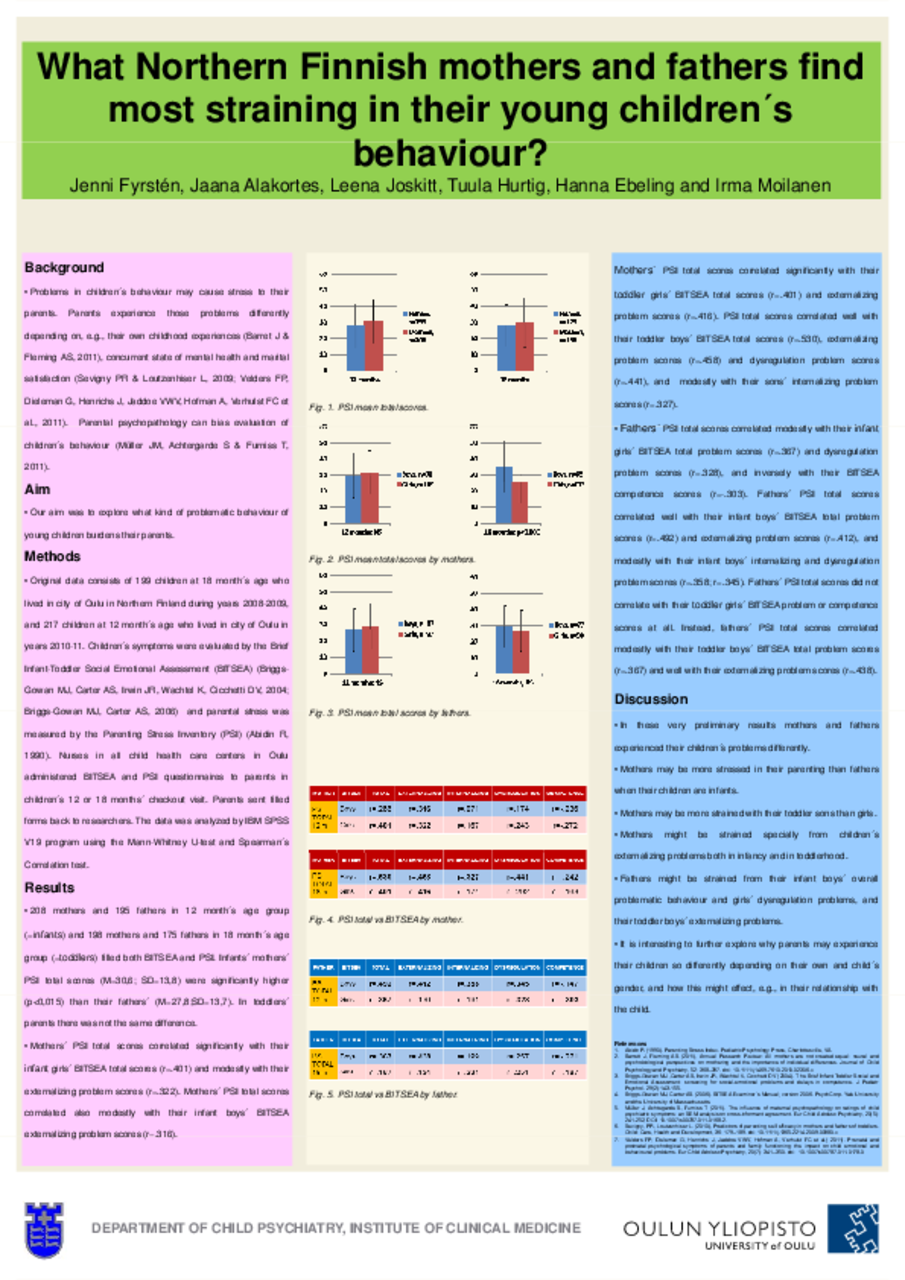
Results: 208 mothers and 195 fathers in 12 month´s age group (=infants) and 198 mothers and 175 fathers in 18 month´s age group (=toddlers) filled both BITSEA and PSI. Infants´ mothers´ PSI total scores were significantly higher than their fathers´. In toddlers´ parents there was not the same difference. Mothers´ PSI total scores correlated significantly with their infant girls´ BITSEA total scores and modestly with their externalizing problem scores. Mothers´ PSI total scores correlated also modestly with their infant boys´ BITSEA externalizing problem scores. Mothers´ PSI total scores correlated significantly with their toddler girls´ BITSEA total scores and externalizing problem scores. PSI total scores correlated well with their toddler boys´ BITSEA total scores, externalizing problem scores and dysregulation problem scores, and modestly with their sons´ internalizing problem scores. Fathers´ PSI total scores correlated modestly with their infant girls´ BITSEA total problem scores and dysregulation problem scores, and inversely with their BITSEA competence scores. Fathers´ PSI total scores correlated well with their infant boys´ BITSEA total problem scores and externalizing problem scores, and modestly with their infant boys´ internalizing and dysregulation problem scores. Fathers´ PSI total scores did not correlate with their toddler girls´ BITSEA problem or competence scores at all. Instead, fathers´ PSI total scores correlated modestly with their toddler boys´ BITSEA total problem scores and well with their externalizing problem scores.
Discussion: In these very preliminary results mothers and fathers experienced their children´s problems differently. Mothers may be more stressed in their parenting than fathers when their children are infants, and they might be more strained with their toddler sons than girls. Mothers might be strained specially from children´s externalizing problems. Fathers might be strained from their infant boys´ overall problematic behaviour and girls´ dysregulation problems, and from their toddler boys´ externalizing problems. It is interesting to further explore why parents may experience their children so differently depending on their own and child´s gender, and how this might effect, e.g., in their relationship with the child.
Related articles