Acute Hematologic Toxicity in Patients Receiving Pelvic IMRT and Concurrent Chemotherapy
Abstract
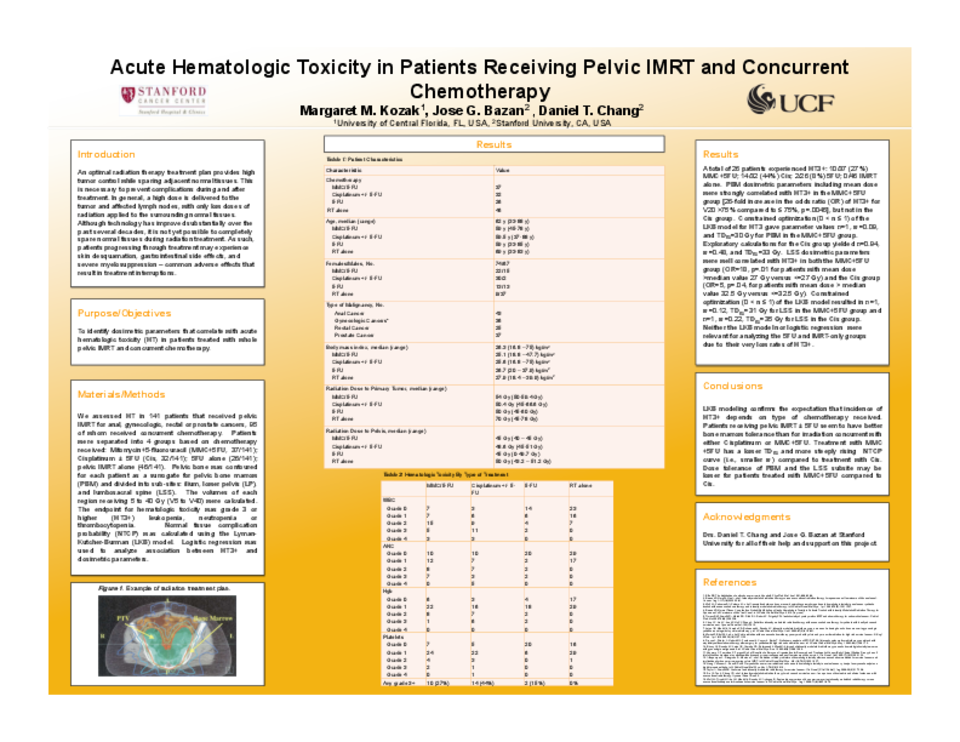
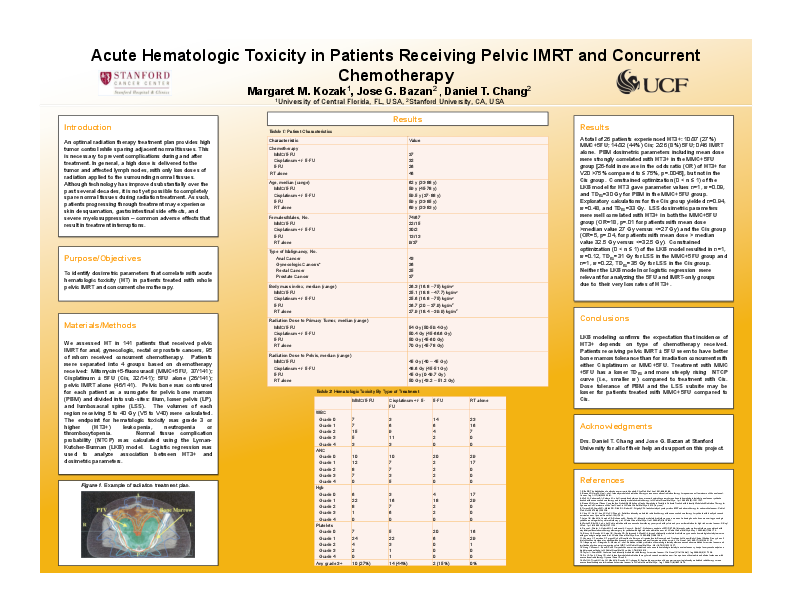
Purpose/Objective(s):To identify dosimetric parameters that correlate with acute hematologic toxicity (HT) in patients treated with whole pelvic IMRT and concurrent chemotherapy.
Materials/Methods: We assessed HT in 141 patients that received pelvic IMRT for anal, gynecologic, rectal or prostate cancers, 95 of whom received concurrent chemotherapy. Patients were separated into 4 groups based on chemotherapy received: Mitomycin+5-fluorouracil (MMC+5FU, 37/141); Cisplatinum ± 5FU (Cis, 32/141); 5FU alone (26/141); pelvic IMRT alone (46/141). Pelvic bone was contoured for each patient as a surrogate for pelvic bone marrow (PBM) and divided into sub-sites: ilium, lower pelvis (LP), and lumbosacral spine (LSS). The volumes of each region receiving 5 to 40 Gy (V5 to V40) were calculated. The endpoint for hematologic toxicity was grade 3 or higher (HT3+) leukopenia, neutropenia or thrombocytopenia. Normal tissue complication probability (NTCP) was calculated using the Lyman-Kutcher-Burman (LKB) model. Logistic regression was used to analyze association between HT3+ and dosimetric parameters.
Results: A total of 26 patients experienced HT3+: 10/37 (27%) MMC+5FU; 14/32 (44%) Cis; 2/26 (8%) 5FU; 0/46 IMRT alone. PBM dosimetric parameters including mean dose were strongly correlated with HT3+ in the MMC+5FU group [26-fold increase in the odds ratio (OR) of HT3+ for V20 >75% compared to ≤ 75%, p=.0045], but not in the Cis group. Constrained optimization (0 < n ≤ 1) of the LKB model for HT3 gave parameter values n=1, m=0.09, and TD50=30 Gy for PBM in the MMC+5FU group. Exploratory calculations for the Cis group yielded n=0.94, m=0.48, and TD50=33 Gy. LSS dosimetric parameters were well correlated with HT3+ in both the MMC+5FU group (OR=18, p=.01 for patients with mean dose >median value 27 Gy versus <=27 Gy) and the Cis group (OR=5, p=.04, for patients with mean dose > median value 32.5 Gy versus <=32.5 Gy). Constrained optimization (0 < n ≤ 1) of the LKB model resulted in n=1, m=0.12, TD50=31 Gy for LSS in the MMC+5FU group and n=1, m=0.22, TD50=35 Gy for LSS in the Cis group. Neither the LKB model nor logistic regression were relevant for analyzing the 5FU and IMRT-only groups due to their very low rates of HT3+.
Conclusion: LKB modeling confirms the expectation that incidence of HT3+ depends on type of chemotherapy received. Patients receiving pelvic IMRT ± 5FU seem to have better bone marrow tolerance than for irradiation concurrent with either Cisplatinum or MMC+5FU.
Related articles