Thoracolumbar Spine Injuries in the Elderly Involved in Motor Vehicle Collisions: A Study of 661 Elderly Subjects
Abstract
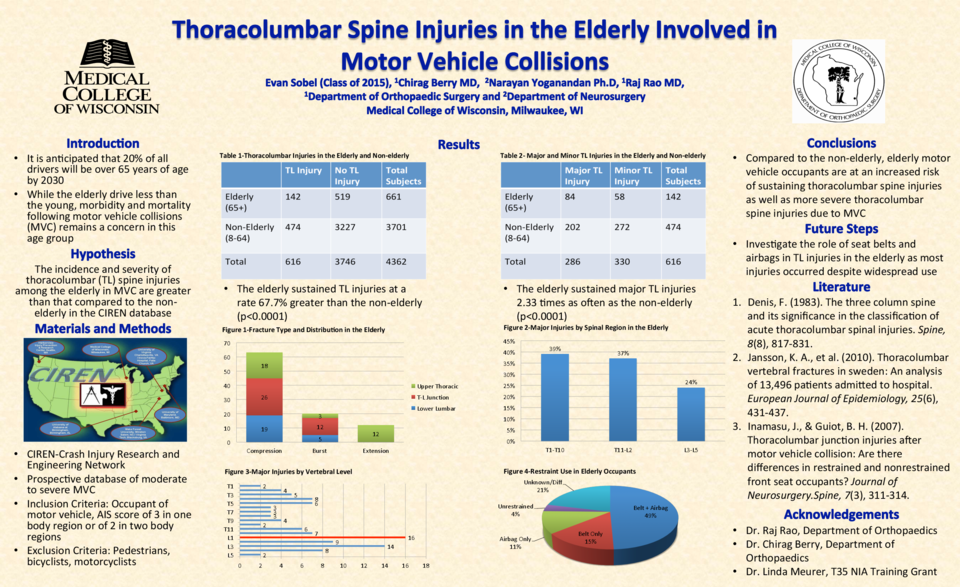
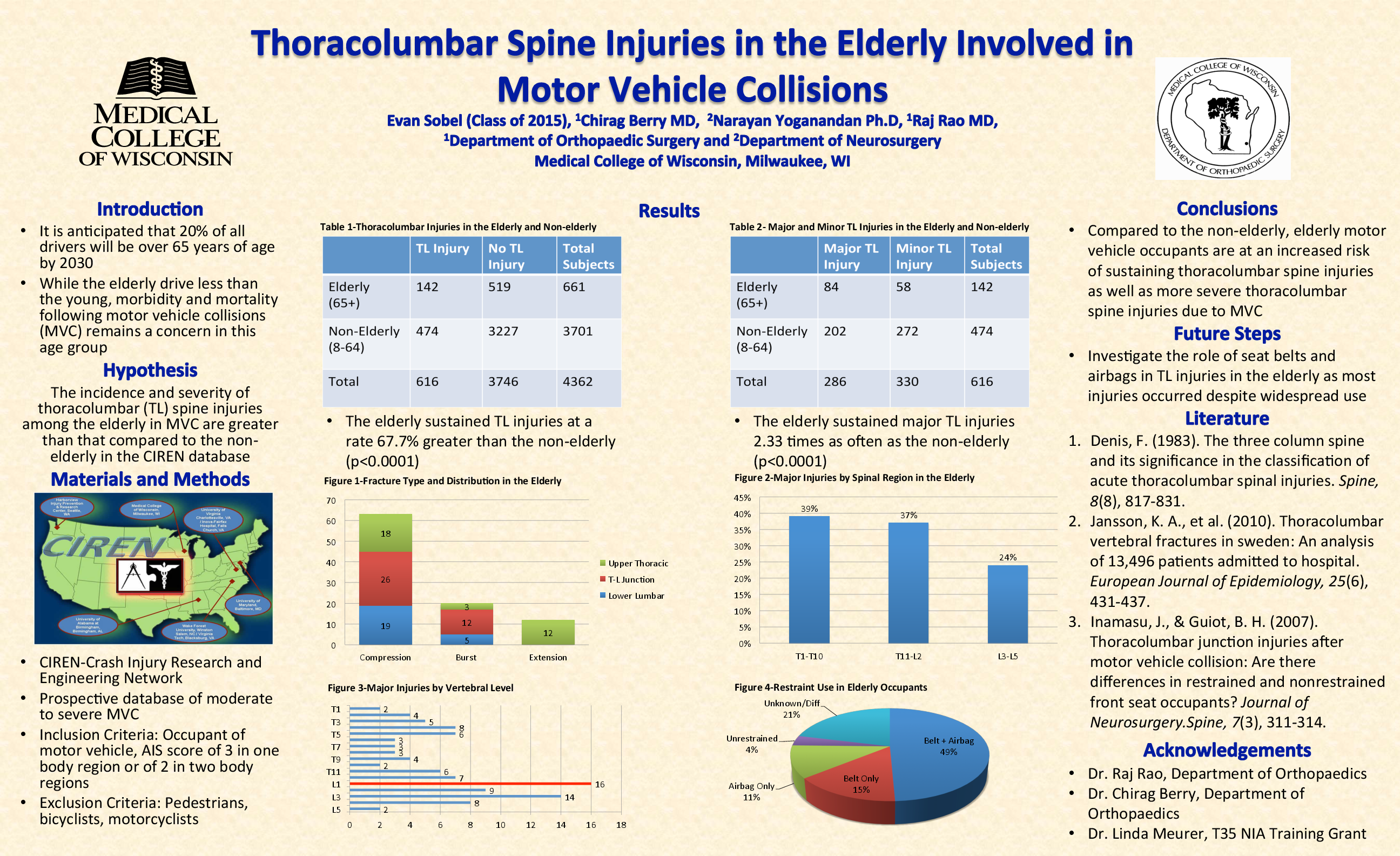
Background: It is anticipated that 20% of all licensed drivers will be over 65 by 2030. Despite the fact that the elderly drive less than the young, morbidity and mortality following motor vehicle collisions (MVC) remains a concern in this age group. Notwithstanding safety features specifically designed to reduce the incidence of injury, 16.7-57.5% of all thoracolumbar (TL) injuries result from MVC.
Purpose: The Crash Injury Research and Engineering Network (CIREN) is a prospectively maintained multi-centered database that enrolls occupants of motor vehicle collisions who sustain moderate to severe injuries that present at a Level I trauma center. The collaboration of multidisciplinary teams of engineers and trauma surgeons allows for an unrivaled environment in which MVC can be detailed both clinically and biomechanically in order to recreate a precise picture of vehicular crash characteristics and injury patterns seen in each occupant.
Scope of the study: This study aimed to investigate the incidence and pattern of thoracolumbar spine injuries among the elderly in motor vehicle collisions.
Hypothesis: The incidence and severity of thoracolumbar spine injuries among the elderly in MVC are greater than that compared to the non-elderly in the CIREN database.
Specific aims of the study: Incidence and severity of TL injury was calculated in those 65 years and older and compared to occupants between 8 and 64 years of age to determine if there was a difference between the age groups. Those younger than 8 years of age were excluded from the comparison, as this age group was likely to be restrained by specific child safety seats.
Study methods: Since 1996 CIREN has enrolled 4,595 patients who have been occupants in MVC. Injuries to pedestrians, motorcyclists, bicyclists and crashes involving vehicles made greater than 10 years prior to the MVC are excluded. Motor vehicle occupants who sustain an AIS score of 3 in one body region or of 2 in two body regions are eligible for inclusion. The CIREN database was queried for thoracic and/or lumbar spine injuries in two distinct age groups who were in motor vehicle collisions between 1996 and 2011. Major TL injuries were categorized using a modified Denis Classification system.
Results: The elderly sustained TL injuries at a rate 67.7% (p<0.0001) greater than that of their younger counterparts as 142 of 661(21.48%) elderly occupants sustained TL injuries compared to 474 of 3,701(12.81%) non-elderly occupants. Additionally, the elderly sustained major TL injuries more than 2.3 (p<0.0001) times as often as the non-elderly. In the elderly an equal number of injuries occurred in the thoracic spine and thoracolumbar junction, while less occurred in the lumbar spine. Of the 105 major injuries in the elderly, there were 63 compression, 20 burst and 12 extension fractures. Compression and burst fractures occurred predominantly at the TL junction, while extension fractures occurred exclusively in the thoracic spine. Major injuries occurred despite the use of 3-point seat belts and/or airbags.
Conclusions: Research into the CIREN database revealed that compared to the non-elderly, elderly motor vehicle occupants are at an increased risk of sustaining thoracolumbar spine injuries as well as more severe thoracolumbar spine injuries due to MVC.
The next steps: High rates of mortality and morbidity observed in this age group call for future research to identify the ideal vehicle safety features that reduce thoracolumbar spine injuries in the elderly.
Related articles