Feasibility Study to Describe the Dependency Levels of People Living in Retirement Villages in Auckland, New Zealand
Abstract
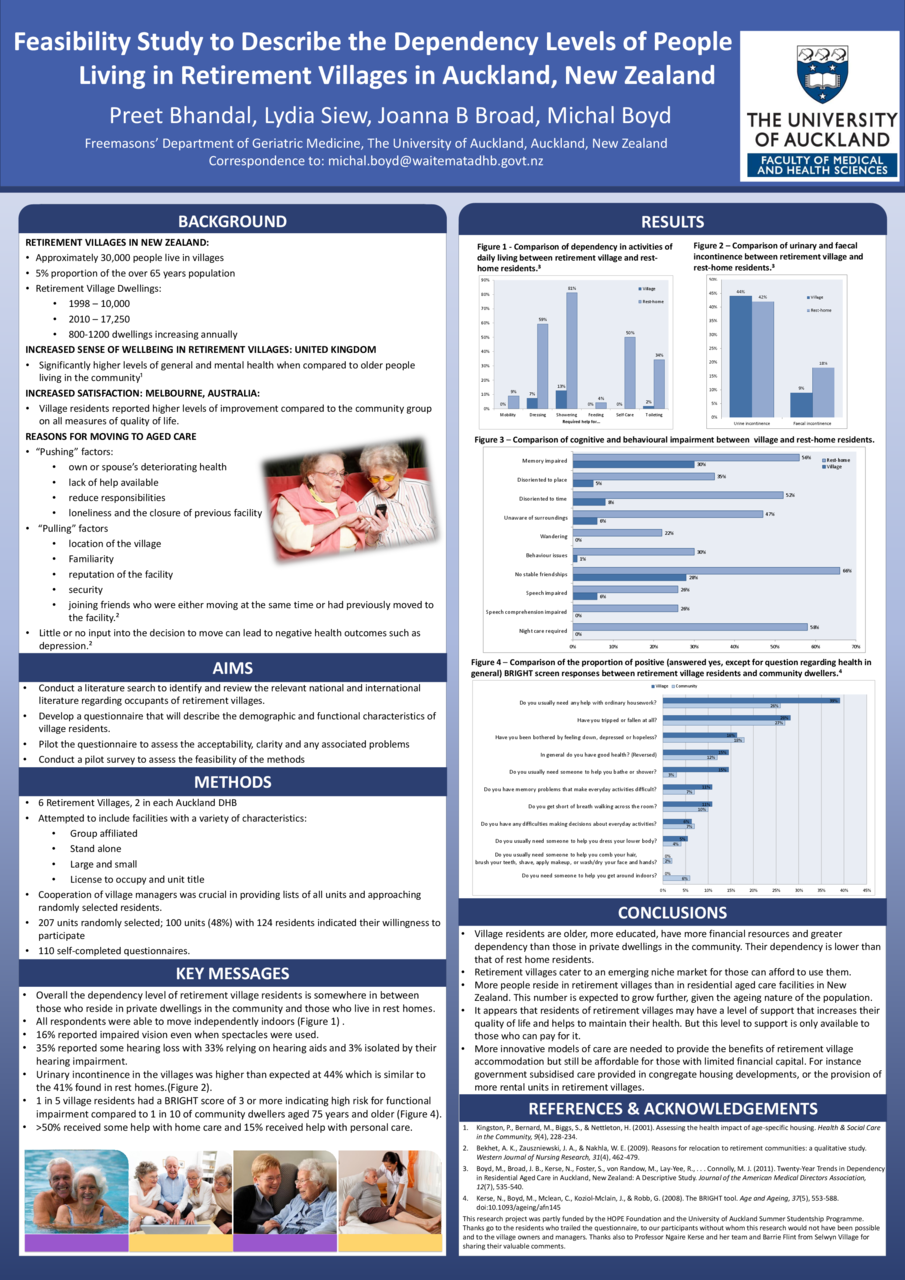
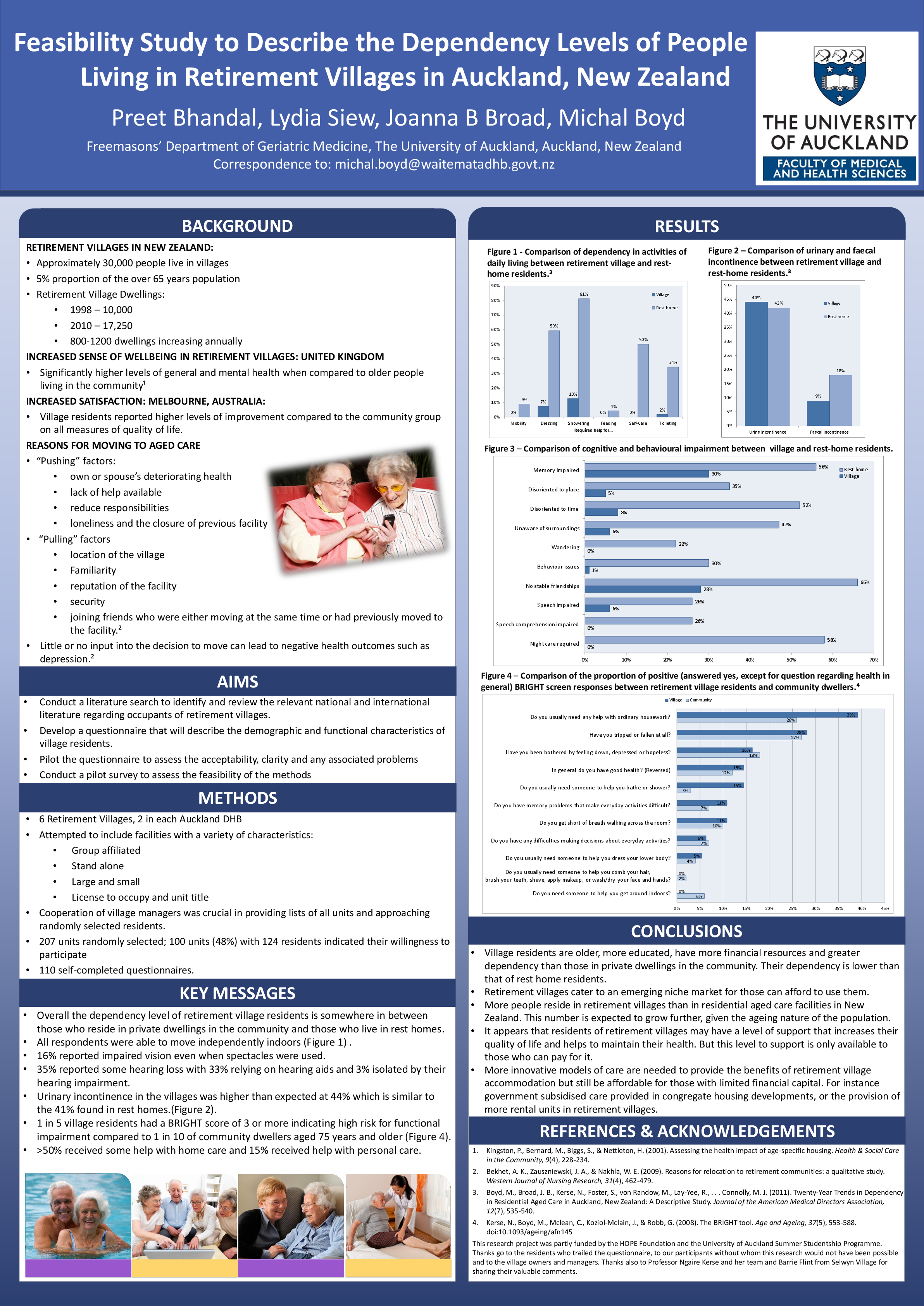
Aims - The retirement village sector has experienced exponential growth in New Zealand and elsewhere, yet little is known about the function and dependency of village residents. People with residential care level dependency may now choose to live in retirement villages as an alternative. This abstract reports findings from a feasibility study to describe resident characteristics.
Methods - A list of villages (n=81) in Auckland was compiled from various internet sources. Two villages were purposively selected from each of three DHBs, balancing size, ownership type and care services available. Managers provided village information, then units were randomly selected to recruit ~20 residents from each village. Management initially wrote to residents to invite participation. The questionnaire was adapted from the 2008 Auckland Long Term Care Study and self-completed by participants after formal consent.
Results - Of the 576 units in selected facilities, 100 of 207 (48%) selected units replied, 110 of 124 residents in those units participated. Data collection required two research assistants for three weeks. Mean age was 83 years, 36% male, 43% partnered. 29% used a stick or walker indoors, 15% needed help with bathing, 44% reported urinary incontinence, 8% faecal incontinence, 28% fell in the past 3 months.
Conclusions - This study demonstrates the methodology is feasible, though village managers’ involvement is crucial in facilitating recruitment particularly in larger villages. Direct involvement of research assistants during questionnaire completion was necessary. The literature and these results indicate that physical function of residents lies between people living in unsupported environments and rest-home care.
Related articles