Persistent Bilateral Sciatic Artery: A Rare Discovery at Alfaisal University
Abstract
Persistent Bilateral Sciatic Artery: A Rare Discovery at Alfaisal University
Karam Hamweyah, Mohamed Diya Sabbagh, Bakr Swaid, AbdulAziz Al-Kattan, Dr. Paul Ganguly and Ms. Michelè Cowan
Location: KSA, Riyadh, Alfaisal University, College of Medicine
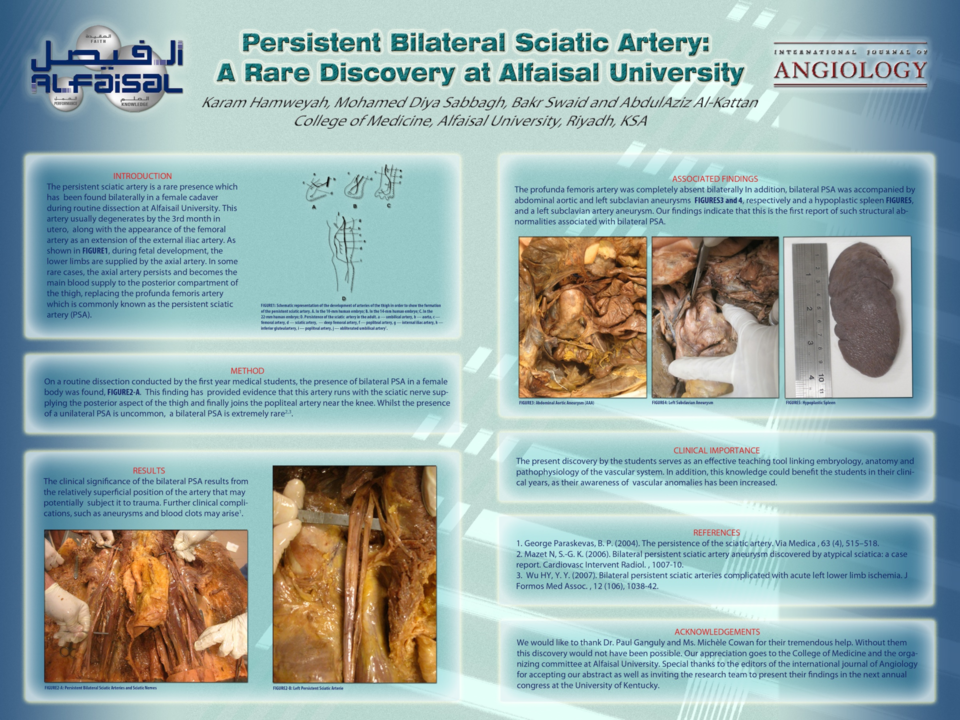
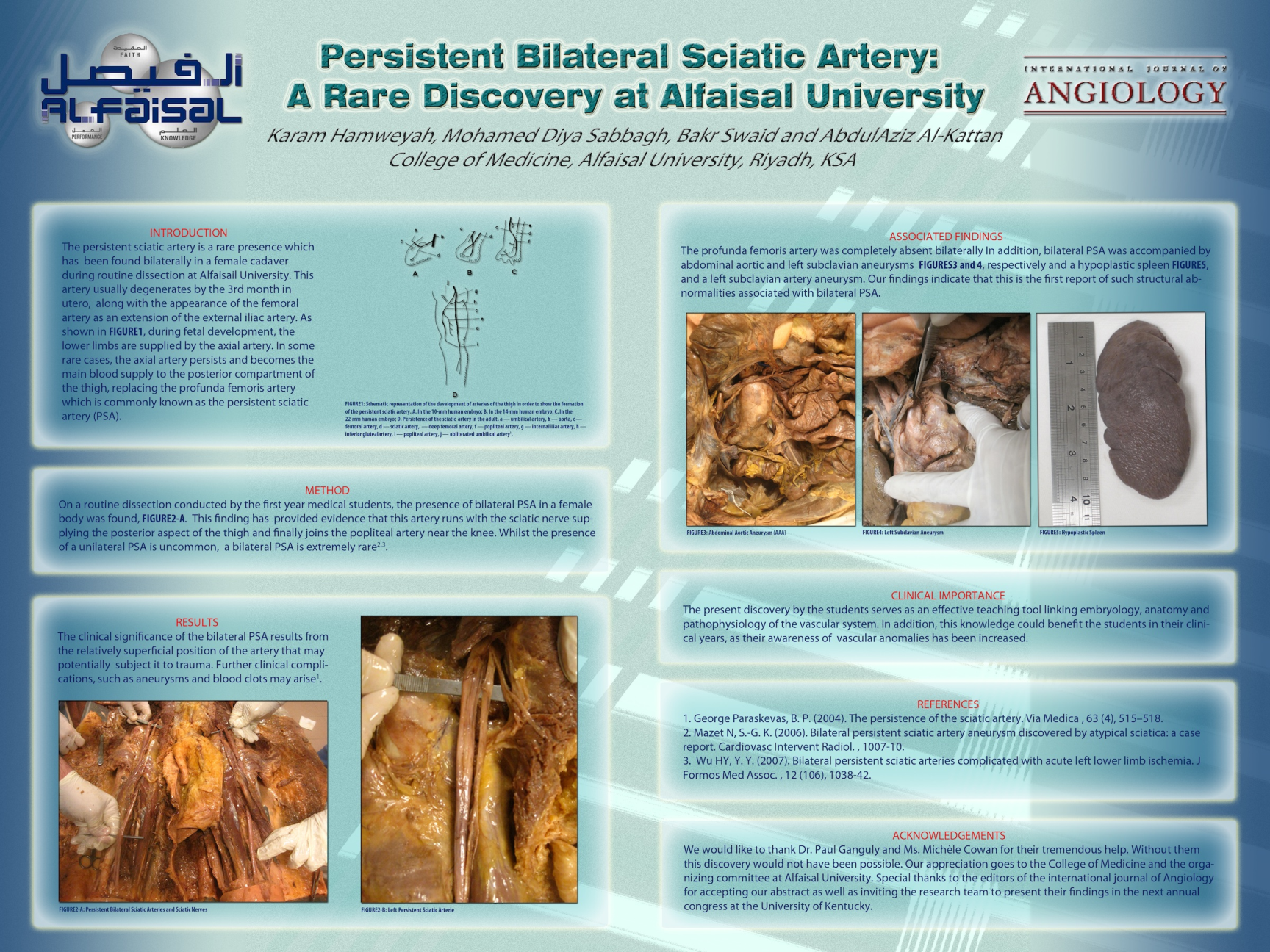
Abstract: INTRO: During fetal development, the lower limbs are supplied by the axial artery. This artery usually degenerates by the 3rd month in utero, along with the appearance of the femoral artery as an extension of the external iliac artery. In some rare cases, the axial artery persists and becomes the main blood supply to the posterior compartment of the thigh, replacing the profunda femoris artery which is commonly known as the persistent sciatic artery (PSA). Existence of bilateral PSA is extremely rare as PSA is usually unilateral. On a routine dissection conducted by the first year medical students, the presence of bilateral PSA in both thighs of a female body was found. It provided evidence that this artery runs along with the sciatic nerve supplying the back of the thigh and finally joins the popliteal artery near the knee. The profunda femoris artery was completely absent bilaterally. In addition, bilateral PSA was accompanied with an abdominal aortic aneurysm, a hypoplastic spleen, and a left subclavian artery aneurysm. To our knowledge this is the first report indicating such structural abnormalities associated with the bilateral PSA. The clinical significance of the bilateral PSA results from the relatively superficial position of the artery subjecting it to trauma. This may result in many clinical complications such as aneurysms and blood clots. The present discovery by the students served as a great teaching tool linking embryology, anatomy, and pathophysiology of the vascular system.
Related articles