Alfaisal University & Stress Levels: A Comparative Study
Abstract
Alfaisal University & Stress Levels: A Comparative Study
Abdallah Al-Ahaideb, Saeb Hashish, Nasir Nisar Arain, Mohammed Dahlawi , Amr Elhossainy, and Asem Elhossainy;
M. Hasan Rajab, PhD, Research Mentor, College of Medicine, Alfaisal University
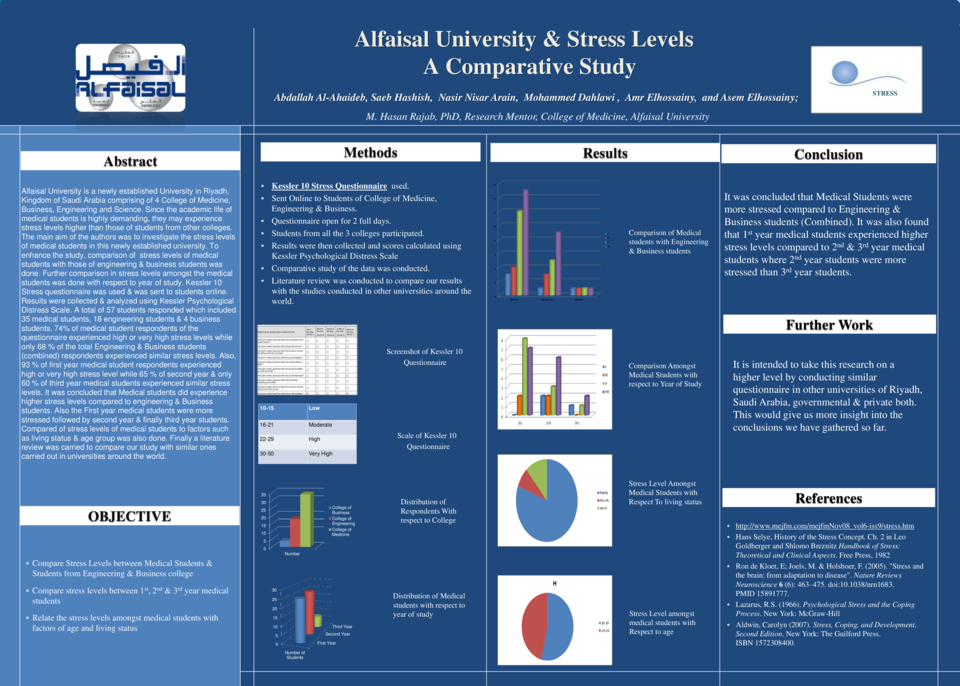
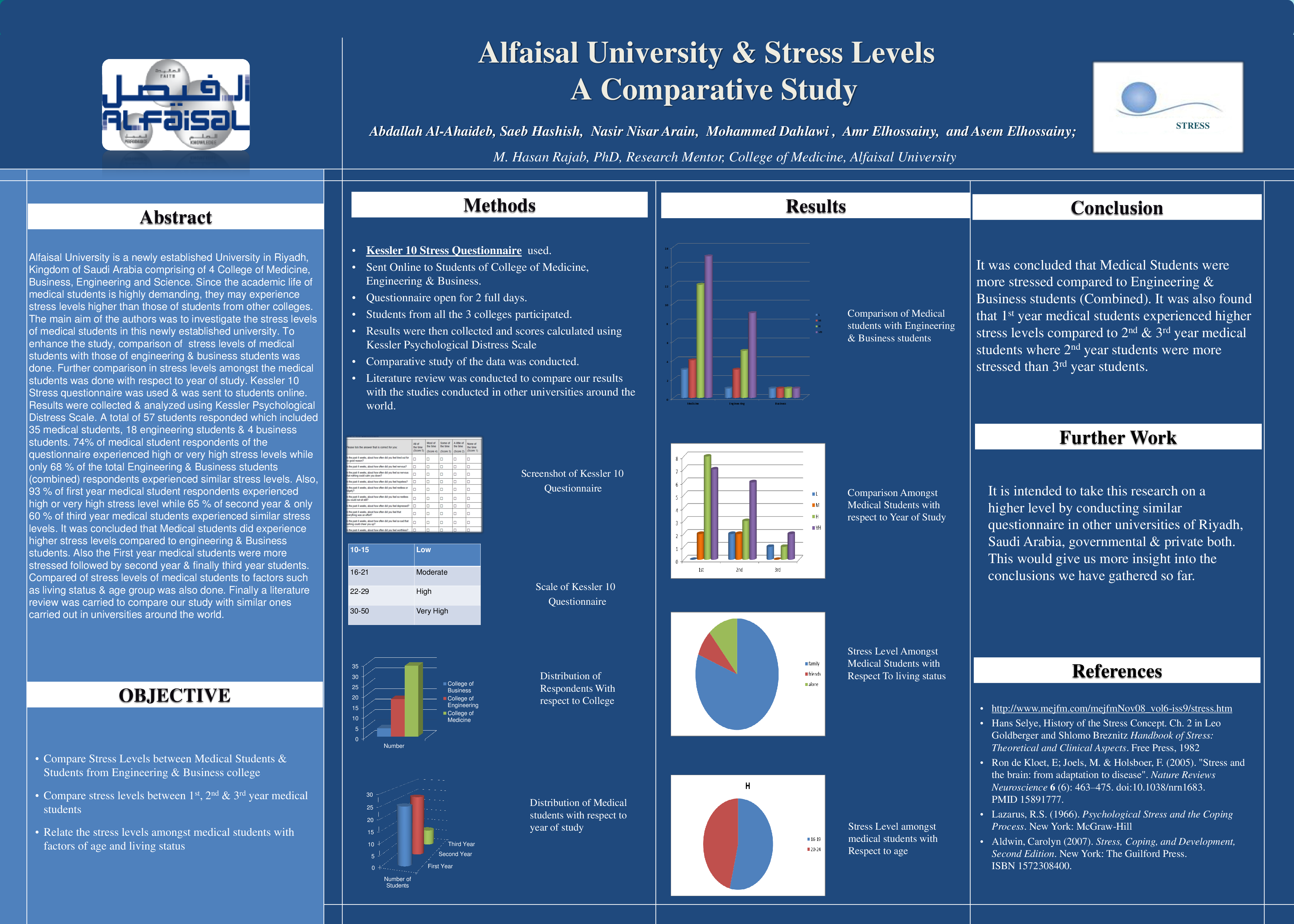
Alfaisal University is a newly established University in Riyadh, Kingdom of Saudi Arabia comprising of 4 College of Medicine, Business, Engineering and Science. Since the academic life of medical students is highly demanding, they may experience stress levels higher than those of students from other colleges. The main aim of the authors was to investigate the stress levels of medical students in this newly established university. To enhance the study, comparison of stress levels of medical students with those of engineering & business students was done. Further comparison in stress levels amongst the medical students was done with respect to year of study. Kessler 10 Stress questionnaire was used & was sent to students online. Results were collected & analyzed using Kessler Psychological Distress Scale. A total of 57 students responded which included 35 medical students, 18 engineering students & 4 business students. 74% of medical student respondents of the questionnaire experienced high or very high stress levels while only 68 % of the total Engineering & Business students (combined) respondents experienced similar stress levels. Also, 93 % of first year medical student respondents experienced high or very high stress level while 65 % of second year & only 60 % of third year medical students experienced similar stress levels. It was concluded that Medical students did experience higher stress levels compared to engineering & Business students. Also the First year medical students were more stressed followed by second year & finally third year students. Compared of stress levels of medical students to factors such as living status & age group was also done. Finally a literature review was carried to compare our study with similar ones carried out in universities around the world.
Related articles