What Language Of Instruction Would Contribute Most To The Education Of Medical Doctors In The Arab World: English Or Arabic?
Abstract
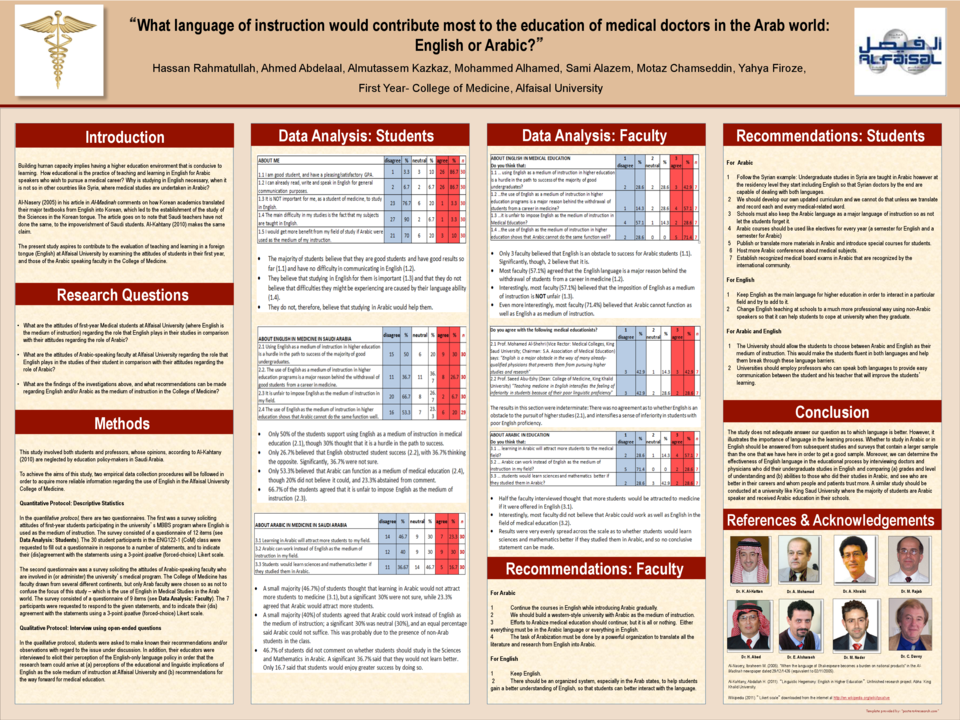
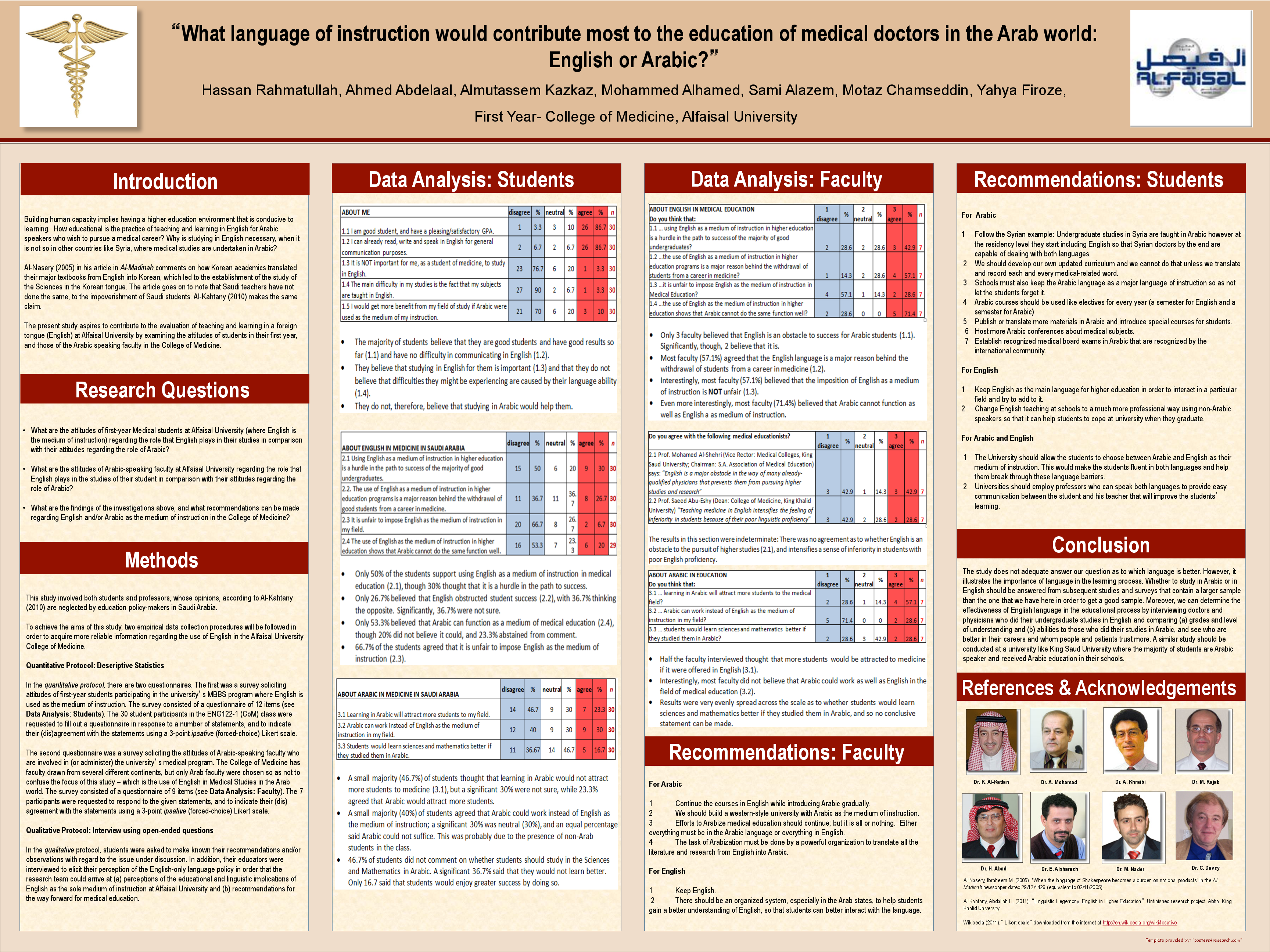
What language of instruction would contribute most to the education of medical doctors in the Arab world: English or Arabic?
Hassan Rahmatullah, Ahmed Abdelaal, Almutassem Kazkaz, Mohammed Alhamed, Sami Alazem, Motaz Chamseddin, Yahya Firoze
First Year- College of Medicine, Alfaisal University
Introduction:
Building human capacity implies having a higher education environment that is conducive to learning. How educational is the practice of teaching and learning in English for Arabic speakers who wish to pursue a medical career? Why is studying in English necessary, when it is not so in other countries like Syria, where medical studies are undertaken in Arabic?
Al-Nasery (2005) in his article in Al-Madinah comments on how Korean academics translated their major textbooks from English into Korean, which led to the establishment of the study of the Sciences in the Korean tongue. The article goes on to note that Saudi teachers have not done the same, to the impoverishment of Saudi students. Al-Kahtany (2010) makes the same claim.
The present study aspires to contribute to the evaluation of teaching and learning in a foreign tongue (English) at Alfaisal University by examining the attitudes of students in their first year, and those of the Arabic speaking faculty in the College of Medicine.
Methods:
This study involved both students and professors, whose opinions, according to Al-Kahtany
(2010) are neglected by education policy-makers in Saudi Arabia.
To achieve the aims of this study, two empirical data collection procedures will be followed in order to acquire more reliable information regarding the use of English in the Alfaisal University College of Medicine.
Quantitative Protocol: Descriptive Statistics
In the quantitative protocol, there are two questionnaires. The first was a survey soliciting attitudes of first-year students participating in the university’s MBBS program where English is used as the medium of instruction. The survey consisted of a questionnaire of 12 items (see Data Analysis: Students). The 30 student participants in the ENG122-1 (CoM) class were requested to fill out a questionnaire in response to a number of statements, and to indicate their (dis)agreement with the statements using a 3-point ipsative (forced-choice) Likert scale.
The second questionnaire was a survey soliciting the attitudes of Arabic-speaking faculty who are involved in (or administer) the university’s medical program. The College of Medicine hasfaculty drawn from several different continents, but only Arab faculty were chosen so as not to confuse the focus of this study – which is the use of English in Medical Studies in the Arab world. The survey consisted of a questionnaire of 9 items (see Data Analysis: Faculty). The 7 participants were requested to respond to the given statements, and to indicate their (dis) agreement with the statements using a 3-point ipsative (forced-choice) Likert scale.
Qualitative Protocol: Interview using open-ended questions
In the qualitative protocol, students were asked to make known their recommendations and/or observations with regard to the issue under discussion. In addition, their educators were interviewed to elicit their perception of the English-only language policy in order that the research team could arrive at (a) perceptions of the educational and linguistic implications of English as the sole medium of instruction at Alfaisal University and
(b) Recommendations for the way forward for medical education.
Conclusion:
The study does not adequate answer our question as to which language is better. However, it illustrates the importance of language in the learning process. Whether to study in Arabic or in English should be answered from subsequent studies and surveys that contain a larger sample than the one that we have here in order to get a good sample. Moreover, we can determine the effectiveness of English language in the educational process by interviewing doctors and physicians who did their undergraduate studies in English and comparing (a) grades and level of understanding and (b) abilities to those who did their studies in Arabic, and see who are better in their careers and whom people and patients trust more. A similar study should be conducted at a university like King Saud University where the majority of students are Arabic speaker and received Arabic education in their schools.
Related articles