Sleep Environment Determines the Impact of Sleep-Dependent Memory Consolidation
Abstract
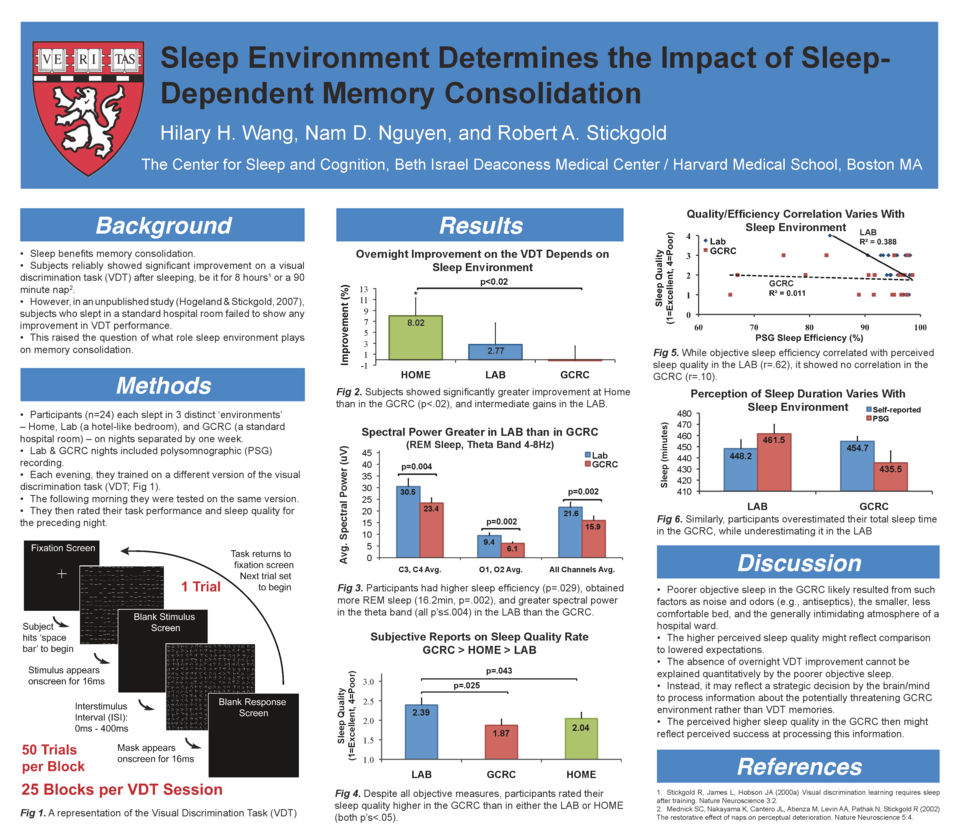
Introduction: Sleep research tends to be conducted in three traditional environments: the sleep laboratory, a hospital room, or the home. Our experiment examined the impact of the sleep environment on memory consolidation.
Methods: 24 healthy, college-aged subjects (16 male) participated in a three-part, repeated measures sleep study. Subjects arrived in the evening at Beth Israel Hospital and were trained on the visual discrimination task (VDT). They then slept in one of three locations in randomized order: a) at Home b) in a spacious sleep Laboratory, furnished to resemble a hotel room c) in a standard Hospital room; after an 8hr sleep opportunity, subjects were retested on the VDT. Polysomnographic (PSG) recordings were obtained in the Lab and Hospital conditions.
Results: VDT: Performance improved significantly (8%) overnight when subjects slept at Home, differing significantly from the Hospital night (-0.2%; Home vs. Hospital: p=0.017); VDT performance showed improvement in the Lab (3%), which was not significantly different from the Home or Hospital. PSG: Sleep efficiency was significantly higher for subjects sleeping in the Lab than in the Hospital (94.6 vs. 89.5%; p=0.025) and REM sleep was greatly diminished in the Hospital condition (p<0.01). Questionnaires: In contrast to PSG data, subjects largely reported better sleep quality in the Hospital than in the Lab (p=0.025).
Conclusion: Analyses of these data suggest that overnight sleep-dependent improvement is sensitive to sleep environment, and that this decrement in improvement may be related specifically to poorer objective measures of sleep, including sleep deficiency and REM sleep.
Related articles