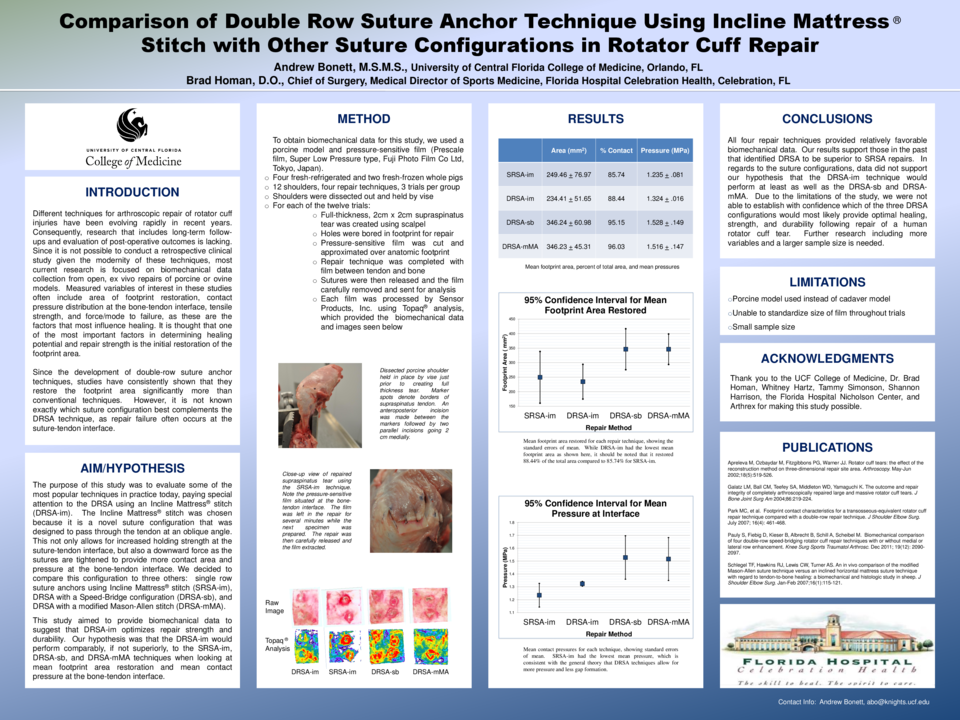
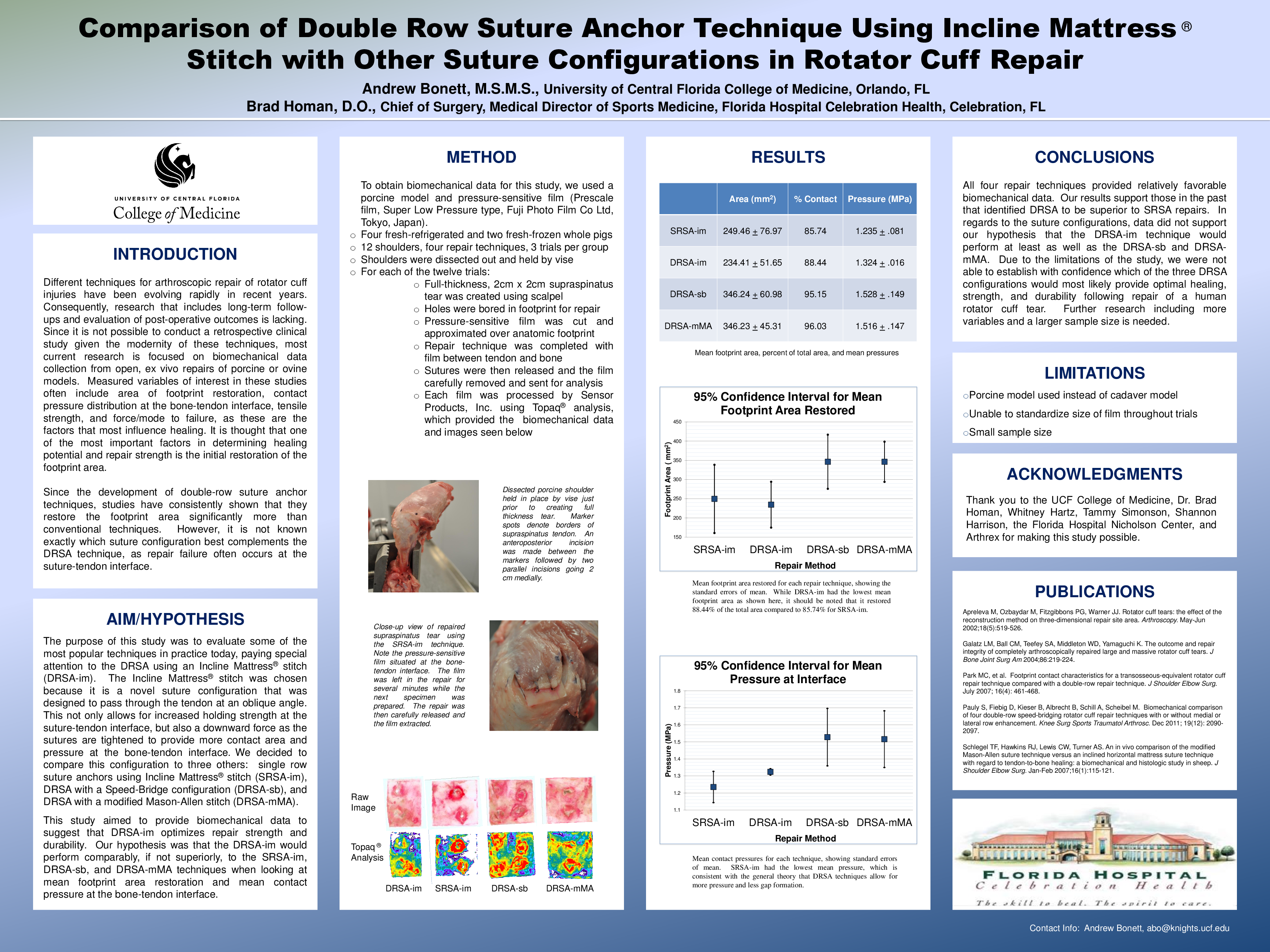
Comparison of Double Row Suture Anchor Technique Using Incline Mattress® Stitch with Other Suture Configurations in Rotator Cuff Repair
Abstract
The goal of this study was to identify the best technique available for repairing rotator cuff tears as evidenced by biomechanical data. We were primarily interested in comparing the double row suture anchor technique using cork screw anchors medially and the Incline Mattress® stitch (DRSA-im) with three other suture configurations; these included the Incline Mattress® stitch with only a single row of suture anchors (SRSA-im), and double row suture anchor techniques using other popular suture configurations – the Speed Bridge (DRSA-sb) and the modified Mason-Allen stitch (DRSA-mMA). We hypothesized that DRSA-im would provide favorable data. To perform this study, we used porcine models in which supraspinatus tears were created ex vivo and subsequently repaired. Pressure-sensitive film was used to quantify restored footprint area and characterize pressure distribution at the bone-tendon interface. DRSA-sb restored a mean surface area of 346.24 + 60.98 mm2, while DRSA-mMA restored a mean surface area of 346.23 + 45.31 mm2. These techniques restored more footprint area, on average, in comparison to those using the Incline Mattress® stitch. The DRSA-sb and DRSA-mMA also had favorable pressure outcomes of 1.53 + 0.15 MPa and 1.50 + 0.11 MPa, respectively, in comparison to the Incline Mattress® configurations. The SRSA-im and DRSA-im both performed comparably in respect to footprint area and pressure distribution. However, data from the DRSA-sb and DRSA-mMA configuration proved to be superior during this study. While the design of the Incline Mattress® stitch remains to appear advantageous in theory, we were not able to demonstrate that with biomechanical testing.
Related articles