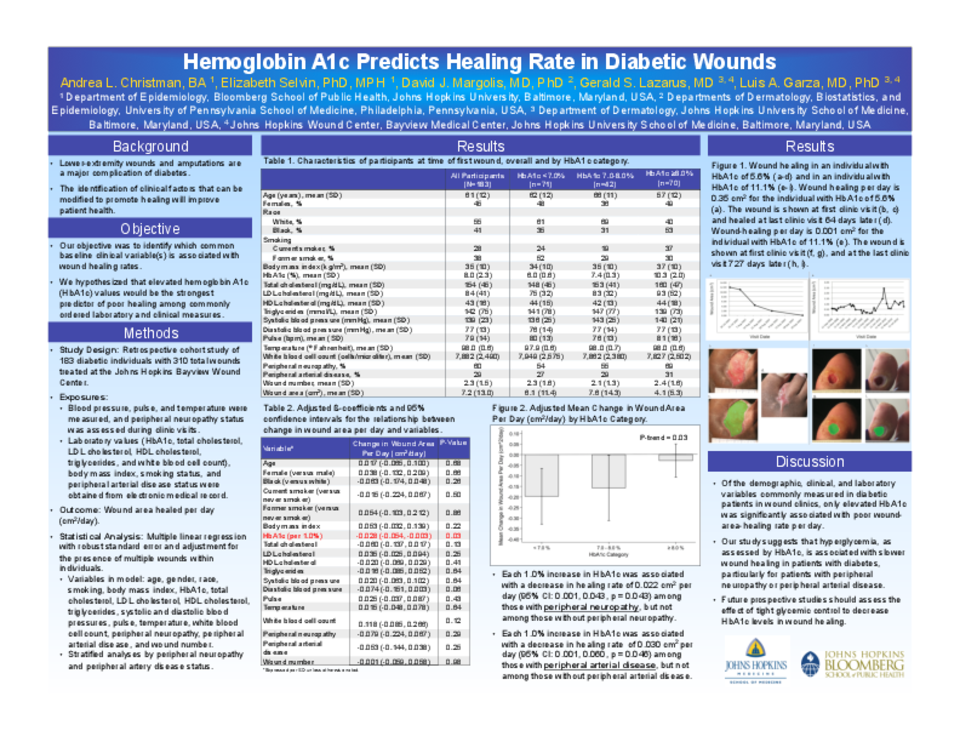
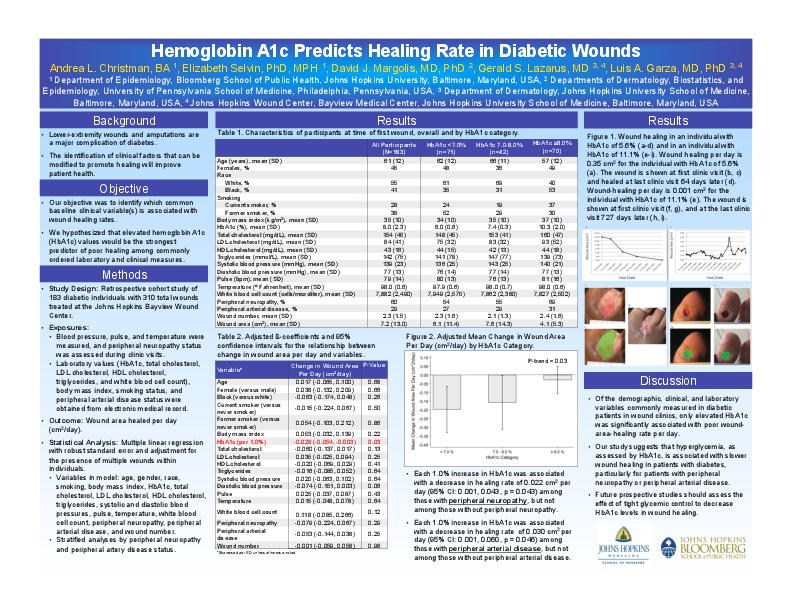
Hemoglobin A1c is a Predictor of Healing Rate In Diabetic Wounds
Abstract
Lower-extremity wounds are a major complication of diabetes. Hemoglobin A1c (HbA1c) reflects glycemia over 2-3 months and is the standard measure used to monitor glycemia in diabetic patients, but results from studies have not shown a consistent association of HbA1c with wound healing. We hypothesized that elevated HbA1c would be most associated with poor wound healing. To test this hypothesis we conducted a retrospective cohort study of 183 diabetic individuals treated at the Johns Hopkins Wound Center. Our primary outcome was wound-area healing rate (cm2/day). Calibrated tracings of digital images were used to measure wound area. We estimated coefficients for healing rate using a multiple linear regression model controlling for clustering of wounds within individuals and other common clinic variables. The study population was 45% female and 41% black with mean age of 61 years. Mean HbA1c was 8.0% and there were 2.3 wounds per individual (310 wounds total). Of all measures assessed, only HbA1c was significantly associated with wound-area healing rate. Specifically, for each 1.0% point increase in HbA1c, the daily wound-area healing rate decreased by 0.028 cm2/day (95% CI: 0.003, 0.0054, p=0.027). Our results suggest that glycemia, as assessed by HbA1c, may be an important biomarker in predicting wound healing rate in diabetic patients.
Related articles