Fractures Due To Gunshot Wounds: Do Retained Bullet Fragments Affect Union?
Abstract
Introduction: Although there is abundant literature on the treatment of high and low energy gunshot wounds, minimal clinical data is available pertaining to modern hollow point projectiles. This type of ammunition is designed to fragment into multiple smaller pieces that may be retained near the fracture site. This study was performed to examine the effect on time to union of retained bullet material near the fracture site in cases of gunshot injury.
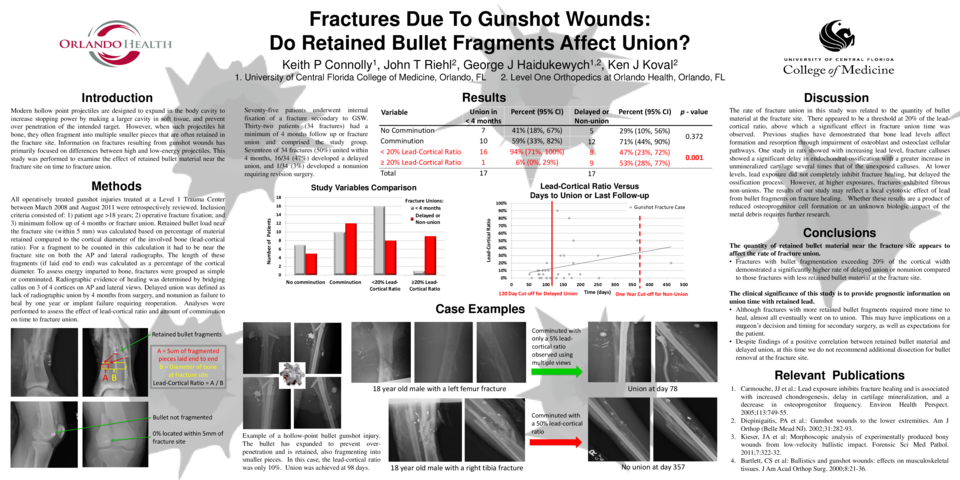
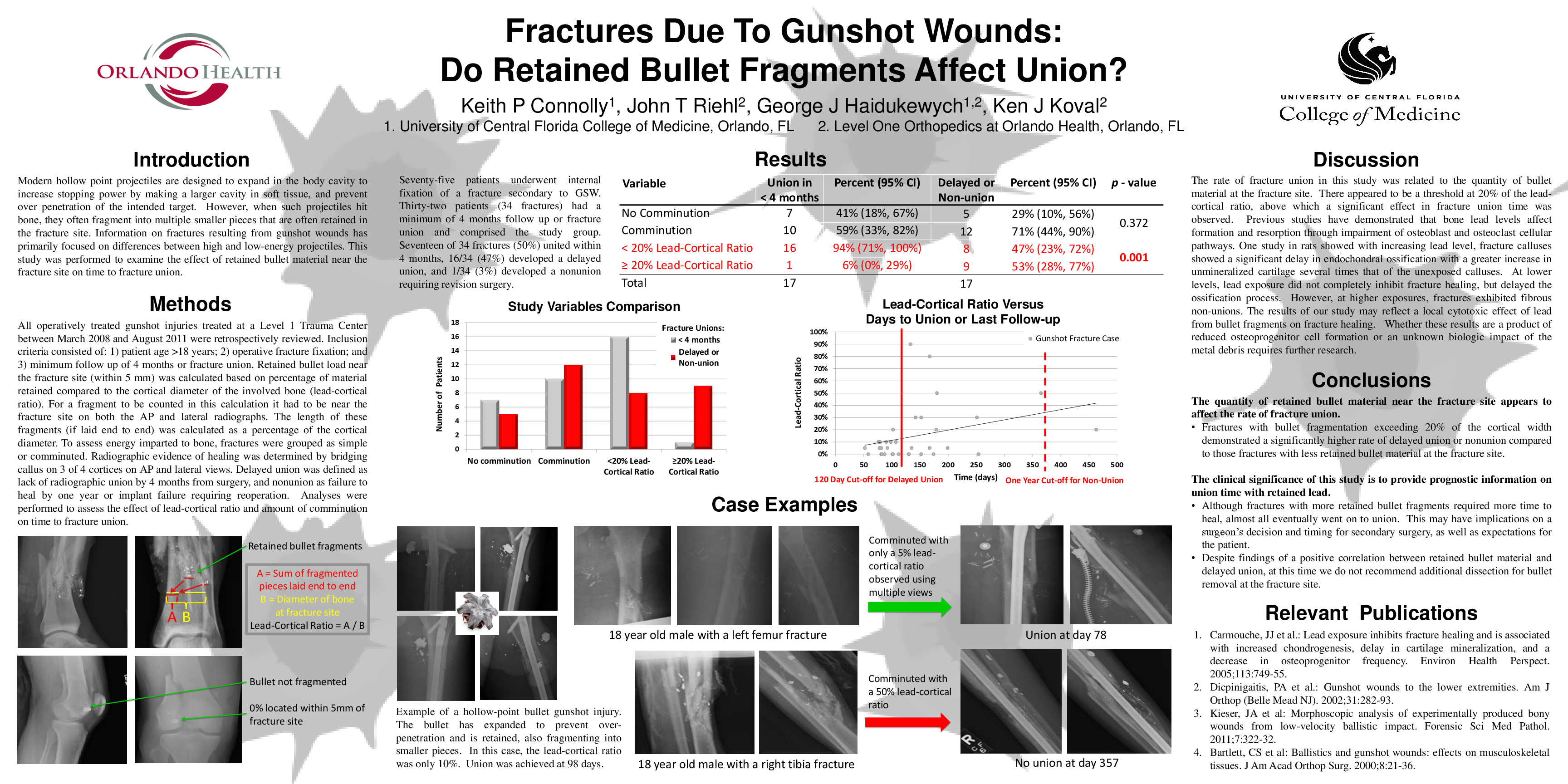
Methods: All operatively treated gunshot injuries treated at a Level 1 Trauma Center between March 2008 and August 2011 were retrospectively reviewed. Retained bullet load near the fracture site was calculated based on percentage of material retained compared to the cortical diameter of the involved bone. Analyses were performed to assess the effect of lead-cortical ratio and amount of osseous comminution on time to fracture union.
Results: Seventy-five patients underwent internal fixation of a fracture secondary to gunshot wounds; 32 patients (34 fractures) met the inclusion criteria. There were an equal number of comminuted (17) and non-comminuted fractures (17) in the study group. Seventeen of 34 fractures (50%) united within 4 months, 16/34 (47%) developed a delayed union, and 1/34 (3%) developed a nonunion requiring revision surgery. When the cumulative amount of bullet fragmentation retained near the fracture site was less than 20% of the cortical diameter, 16/17 fractures (94%) united by 4 months while only 1/17 (6%) united by 4 months when retained fragments near the fracture site was equal to or exceeding 20% of the cortical diameter (p = 0.001). Fracture comminution had no effect on time to fracture union (p = 0.372).
Conclusion: The quantity of retained bullet material near the fracture site was more predictive of the rate of fracture union than was comminution. Fractures with bullet fragmentation equal to or exceeding 20% of the cortical width demonstrated a significantly higher rate of delayed union/nonunion compared to those fractures with less retained bullet material at the fracture site. These results may indicate a local cytotoxic effect from lead on bone healing. As these fractures still tended to go on union, albeit at a slower pace, this finding may influence decisions on timing of secondary surgeries.
Related articles