The Effect of Pulsatile Flow on the Statistics of Particle �Distribution for a Left Ventricular Assist Device
Abstract
Left Ventricular Assist Devices (LVADs) are often used in the treatment of advanced heart failure. However, there is a high incidence of stroke due to thromboembolisms in the cranial arteries. A current study is being carried out by Dr. Alain Kassab at the UCF main campus to help reduce thromboembolisms flowing from the LVAD into the carotid and vertebral arteries.
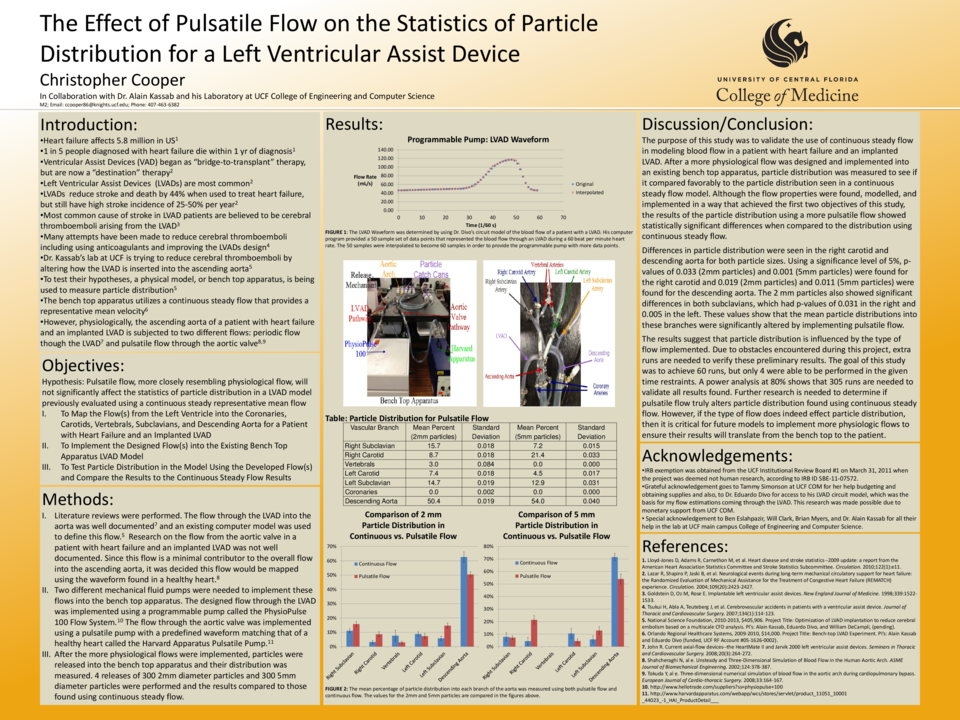
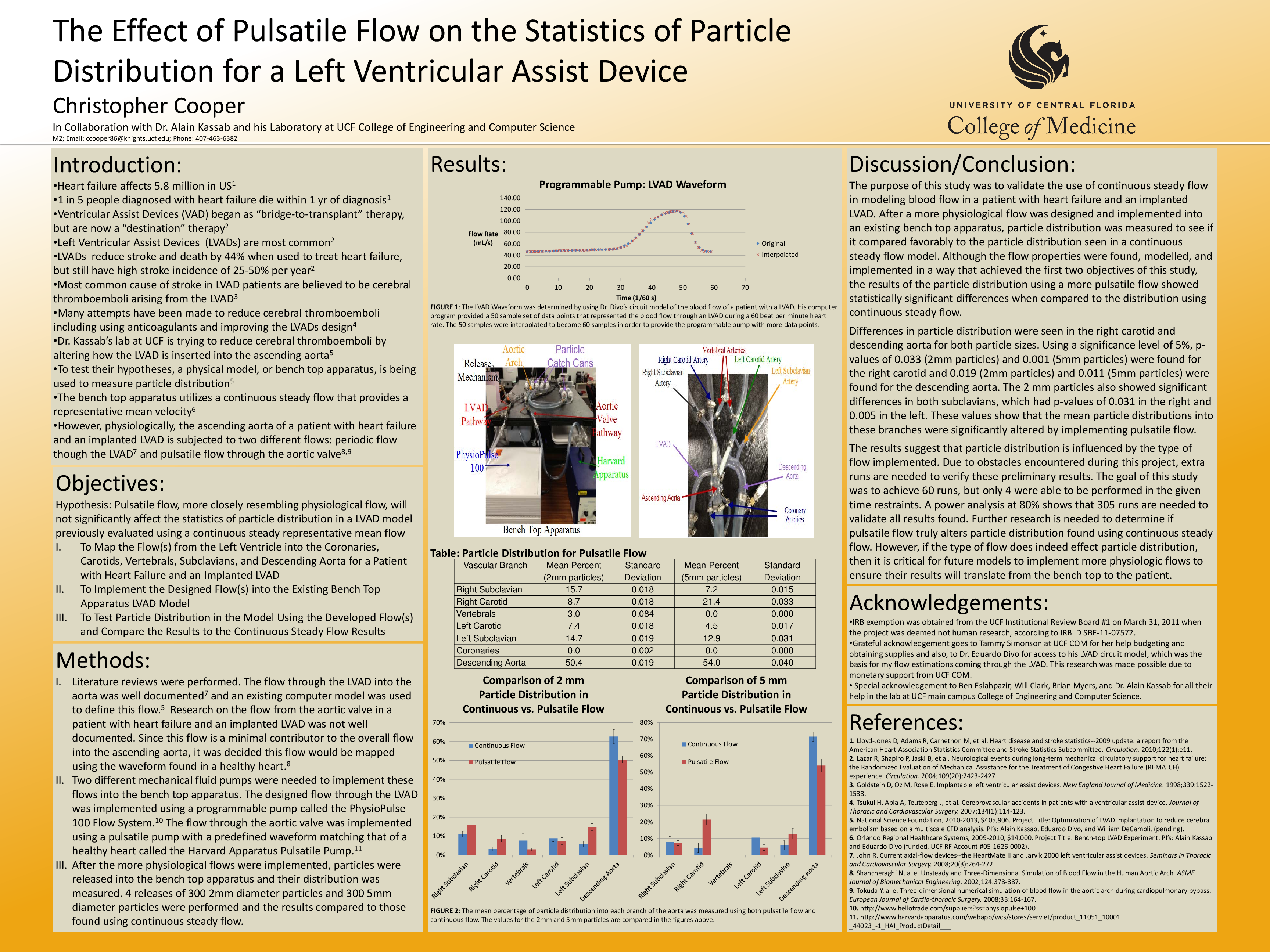
Dr. Kassab’s study utilizes a physical model of a LVAD implemented in a patient. The model, however, uses continuous steady fluid flow, set to a representative mean velocity. A more physiologically realistic model would implement a flow that more closely resembles the physiological flow of blood in a patient with a LVAD.
For this project a more realistic flow was designed and implemented. The same physical model used in Dr. Kassab’s study was tested using a combination of flows that better mimic the true physiology. A pulsatile flow to represent the blood flow coming from the left ventricle into the aorta and a continuous periodic flow to represent the blood flow coming from the LVAD into the aorta were implemented. Particle distribution into the branches of the aorta were measured to determine if the implemented flows produce results that are statistically significant when compared to the steady flow results Dr. Kassab’s lab obtained.
Related articles