Using ERP locking to interpret data
Abstract
Introduction:
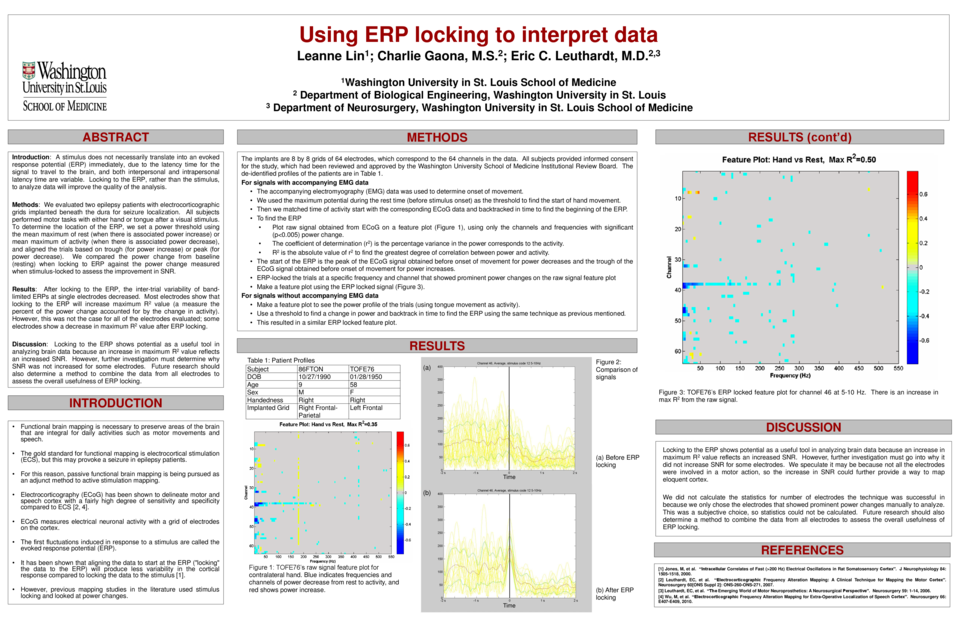
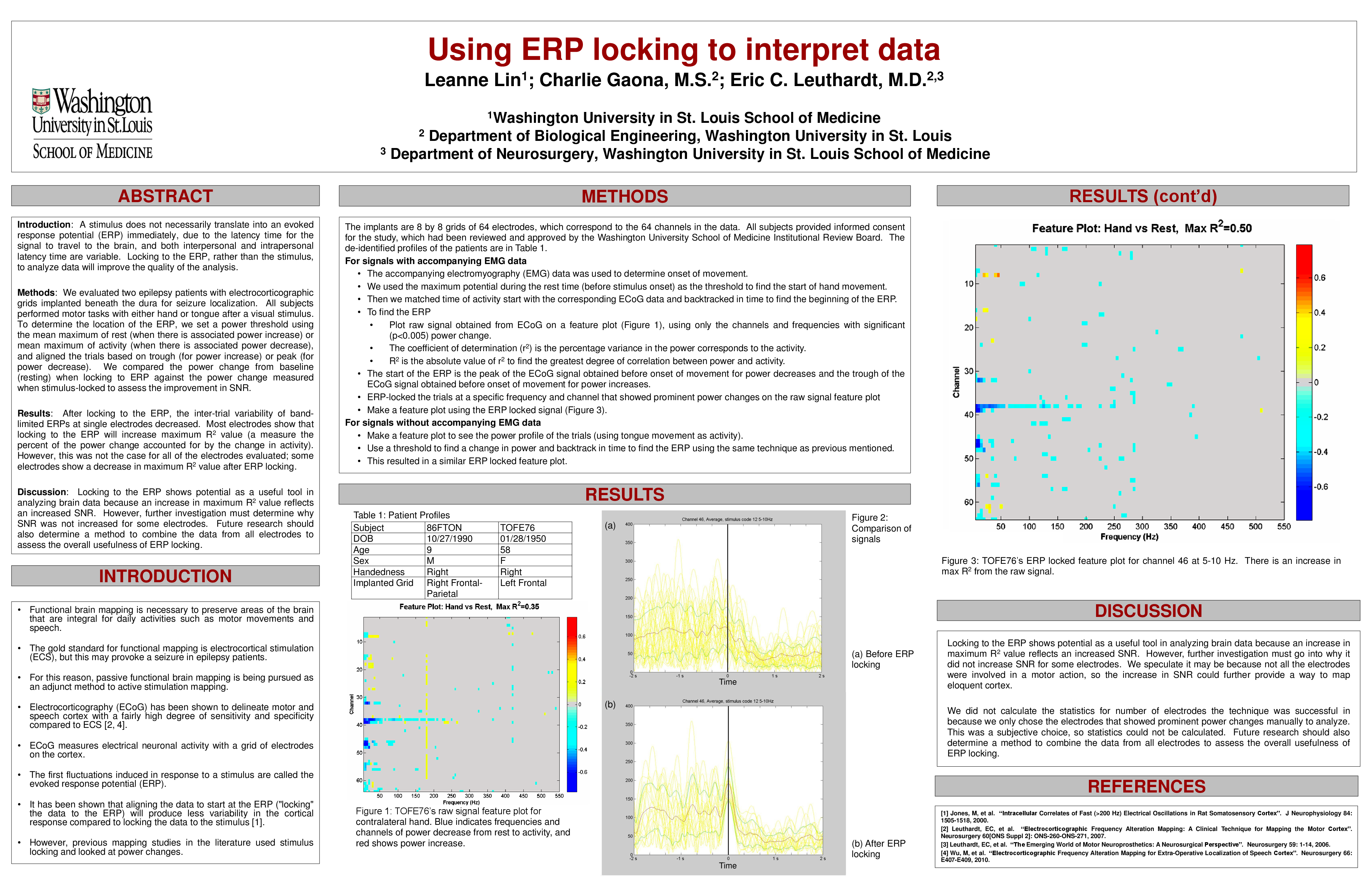
Aligning the signal to the stimulus (stimulus locking) is conventional in the analysis of electrical signals obtained from the brain. However, a stimulus does not necessarily translate into an evoked response potential (ERP) immediately, due to the latency time for the signal to travel to the brain. It has been known that both interpersonal and intrapersonal latency time is variable. It would make sense that locking to the ERP, rather than the stimulus, to analyze data will improve overall signal to noise ratio (SNR) and the quality of the analysis.
Methods:
We evaluated two epilepsy patients with electrocorticographic grids implanted beneath the dura for seizure localization. All subjects performed motor tasks with either hand or tongue after a visual cue (the stimulus). To determine the location of the ERP, we set a power threshold using the mean maximum of rest (when there is associated power increase) or mean maximum of activity (when there is associated power decrease), and aligned the trials based on trough (for power increase) or peak (for power decrease). We compared the power change from baseline (resting) when locking to ERP against the power change measured when stimulus-locked to assess the improvement in SNR.
Results:
After locking to the ERP, the inter-trial variability of band-limited ERPs at single electrodes decreased. Most electrodes show that locking to the ERP will increase maximum R2 value (a measure the percent of the power change accounted for by the change in activity). However, this was not the case for all of the electrodes evaluated; some electrodes show a decrease in maximum R2 value after ERP locking.
Discussion:
Locking to the ERP shows potential as a useful tool in analyzing brain data because an increase in maximum R2 value reflects an increased SNR. However, further investigation must determine why SNR was not increased for some electrodes. Future research should also determine a method to combine the data from all electrodes to assess the overall usefulness of ERP locking.
Related articles