Abstract
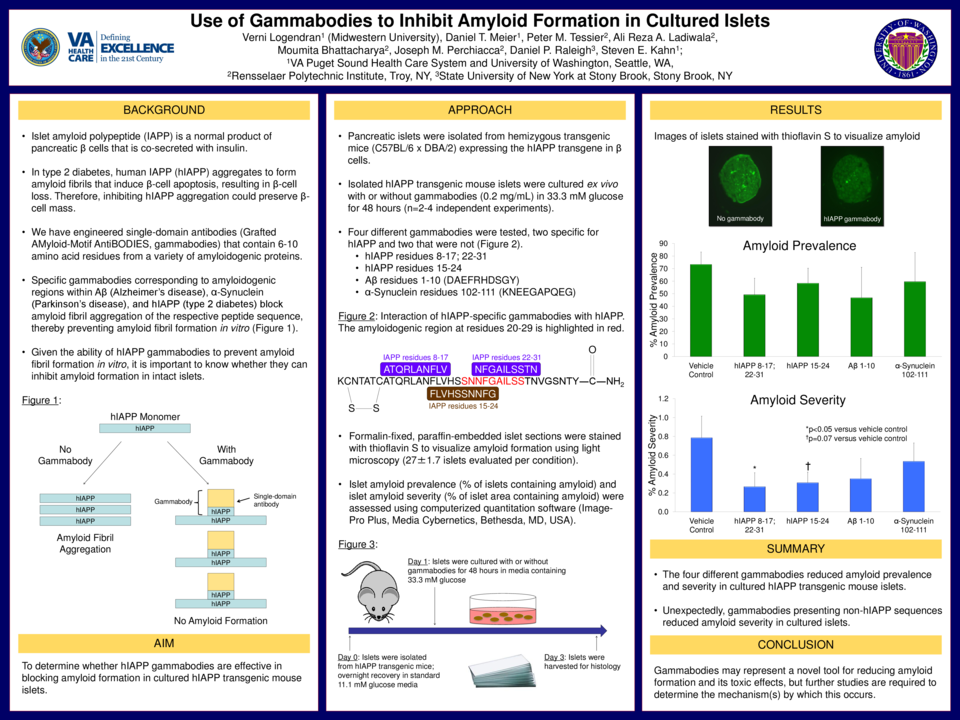
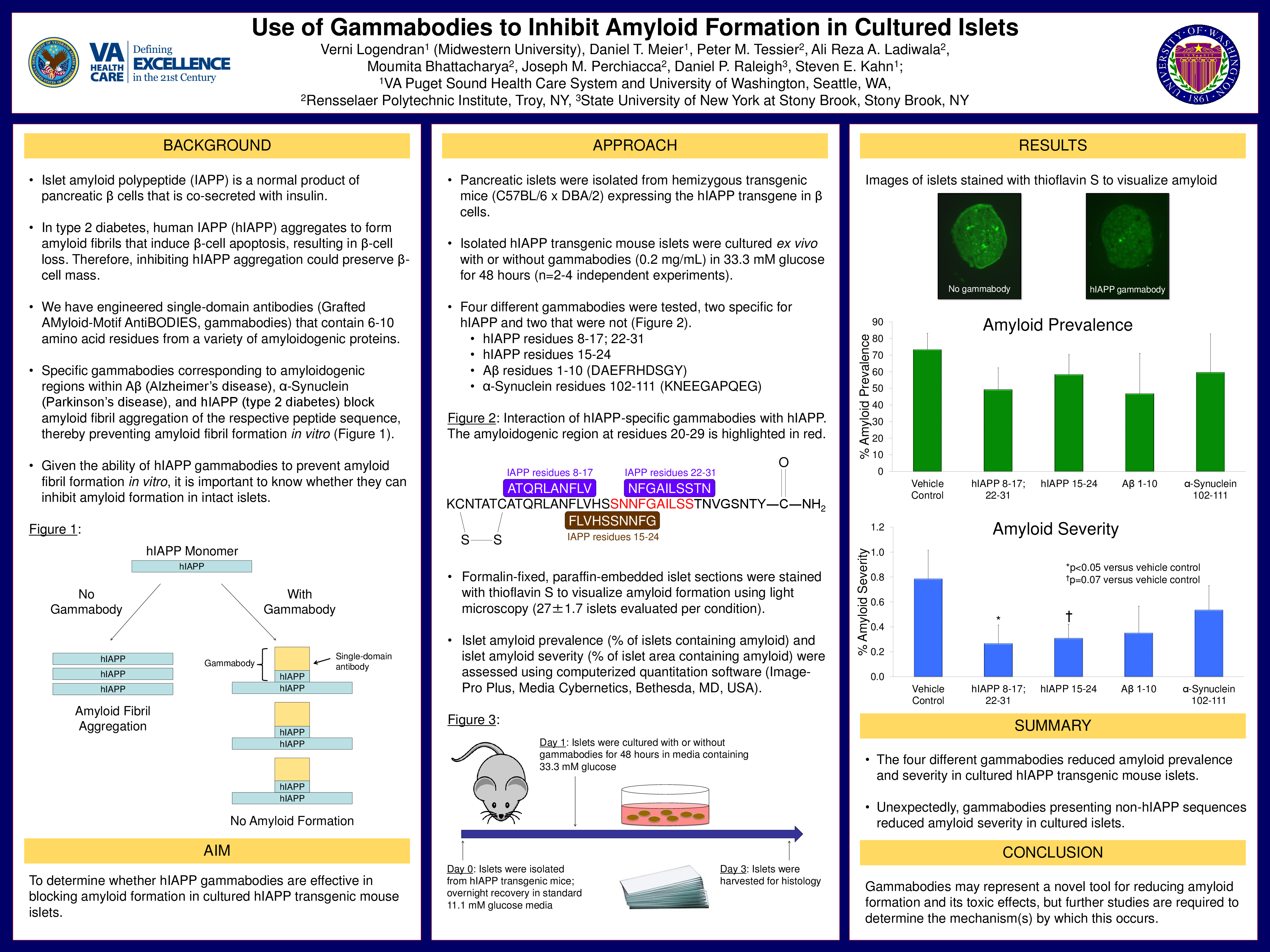
BACKGROUND: Islet amyloid polypeptide (IAPP) is a 37-residue polypeptide, normally co-secreted with insulin by pancreatic β cells. In type 2 diabetes, human IAPP (hIAPP) aggregates to form amyloid fibrils that promote β-cell apoptosis, resulting in loss of β-cell mass. Finding an approach to decrease aggregation of hIAPP and its toxic effects is, therefore, desirable. Engineered single-domain antibodies (Grafted AMyloid-Motif AntiBODIES, gammabodies) presenting 6-10 hydrophobic amino acid residues from amyloidogenic proteins Aβ (Alzheimer’s disease), α-Synuclein (Parkinson’s disease), and hIAPP (type 2 diabetes) have been shown to effectively inhibit amyloid fibril formation of the respective full-length amyloidogenic peptide in vitro. In order to study islet amyloid formation in a model that better reflects the process as it occurs in type 2 diabetes, we developed a culture system using isolated islets ex vivo from hIAPP transgenic mice. Amyloid deposition is induced in this system with culture in high glucose (e.g., 33.3 mM) for 48 hours, and this condition is associated with β-cell apoptosis.
AIM: To determine whether hIAPP gammabodies effectively inhibit islet amyloid formation in cultured hIAPP transgenic mouse islets.
METHODS: Pancreatic islets were isolated from hemizygous hIAPP transgenic mice (C57BL/6 x DBA/2) and incubated for 48 hours in media containing 33.3 mM glucose, with or without gammabodies (0.2 mg/mL; n=2-4). We tested four different gammabodies: (a) hIAPP residues 8-17 together with 22-31, (b) hIAPP residues 15-24, (c) Aβ residues 1-10, and (d) α-Synuclein residues 102-111. Following 48-hour culture, islets were fixed in neutral buffered formalin and embedded in paraffin. Islet sections were stained with thioflavin S to assess islet amyloid deposition. Islet amyloid prevalence (% of islets containing amyloid) and severity (% of islet area containing amyloid) were quantified in 27±1.7 islets per condition.
RESULTS: As expected, islets cultured without gammabodies developed amyloid (prevalence 73.4±9.9%, severity 0.79±0.23%). Islets incubated with hIAPP gammabodies resulted in reduced amyloid deposition (hIAPP 8-17 together with 22-31: prevalence 49.1±12.0%, severity 0.27±0.11%, n=4; and hIAPP 15-24: prevalence 58.3±13.2%, severity 0.31±0.15%, n=4). Unexpectedly, gammabodies not specific for hIAPP also reduced amyloid deposition (Aβ 1-10: prevalence 46.8±24.2%, severity 0.35±0.22%, n=2; and α-Synuclein 102-111: prevalence 59.6±23.2, severity 0.53±0.20, n=2).
CONCLUSION: Gammabodies presenting both hIAPP and other peptide sequences were effective in reducing amyloid prevalence and severity in cultured hIAPP transgenic islets. Our results suggest that gammabodies may represent a novel tool for reducing amyloid formation and its toxic effects, but further studies are required to determine the mechanism(s) by which this occurs.