A Crude Risk Estimator for Adrenal Tumor Functionality
Abstract
Introduction
Adrenal lesions are a common imaging finding with a prevalence rate approaching 10%. Though guideline recommendations include dedicated endocrine laboratory tests to rule out functionality, many patients never receive this work-up. This study investigates the use of patient demographics and clinical variables to create a crude risk estimator for adrenal tumor functionality that will identify patients at high risk for a functional adrenal tumor (FAT).
Methods
Patients who underwent adrenalectomy as their principle operation and had a postoperative diagnosis consistent with an adrenal lesion or disorder in the ACS-NSQIP 2005-2010 participant use file were identified. Patients were divided into two groups based on tumor functionality. Univariate analysis was performed to identify specific predictors of FAT as well as for the specific FAT syndromes: Cushing’s, Conn’s, or medulloadrenal hyperfunction. Multivariate logistic regression using all variables was performed and a reduced model was created for simplicity. Receiver operating characteristic curves and the Hosmer-Lemeshow (H-L) test were used to assess model quality.
Results
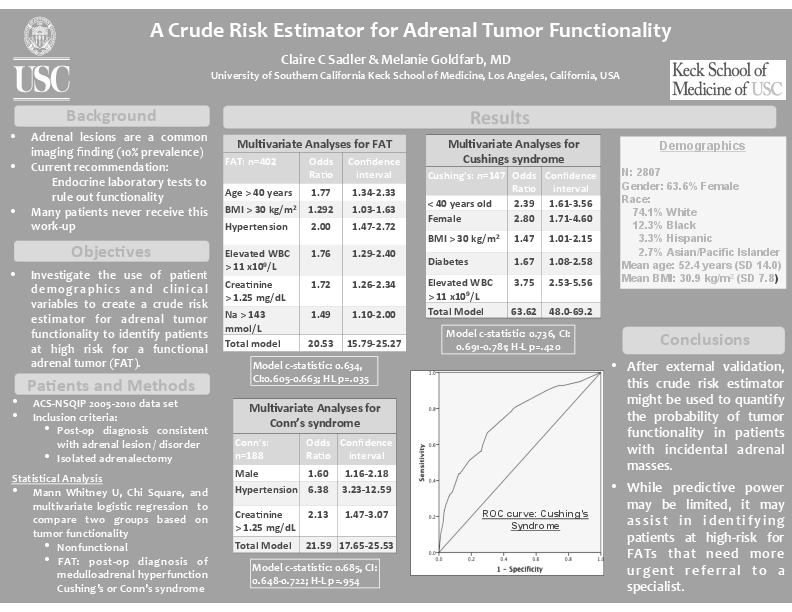
2807 patients underwent adrenalectomy for a primary adrenal tumor; 402 (13.2%) were FAT. Patients with FATs were younger (age<40, p<.01), overweight (BMI>30, p<.01), and hypertensive (p<.001), with elevations in white blood cell count (WBC>11, p<.001), serum creatinine (Cr>1.25, p<.001), and serum sodium (Na>143, p<.001). Logistic regression demonstrated that patients with these characteristics were 20.53 (CI:15.79-25.27) times more likely to have a FAT. The model demonstrated moderate discriminative ability but poor calibration (c-statistic=0.634, CI:0.605-0.663; H-L p=.035). Patients with Conn’s syndrome (n=188) were more likely male (p<.001), hypertensive (p<.001), and with higher Cr (p<.001). Logistic regression demonstrated that patients with these characteristics were 21.59 (CI:17.65-25.53) times more likely to have Conn’s. This model showed moderate discriminative ability and excellent calibration (c-statistic=0.685, CI:0.648-0.722; H-L p=.954). Patients with Cushing’s syndrome (n=147) were more likely younger (p<.001), female (p<.001), diabetic (p=.07), and overweight (p=.027) with an elevated WBC (p<.001) and lower Cr (p<.001). Logistic regression demonstrated that patients with these characteristics were 63.62 (CI 58.03-69.21) times likely to have Cushing’s. The model displayed both good discrimination and calibration (c-statistic=0.736, CI:0.691-0.781; H-L p=.420).
Conclusion
After external validation, this crude risk estimator might be used to quantify the probability of tumor functionality in patients with incidental adrenal masses. While predictive power may be limited, it may assist in identifying patients at high-risk for FATs that need more urgent referral to a specialist.
Related articles