Correspondence of microelectrode recordings and fiducial-based atlas registration for localization of deep brain stimulation contacts in the subthalamic nucleus
Abstract
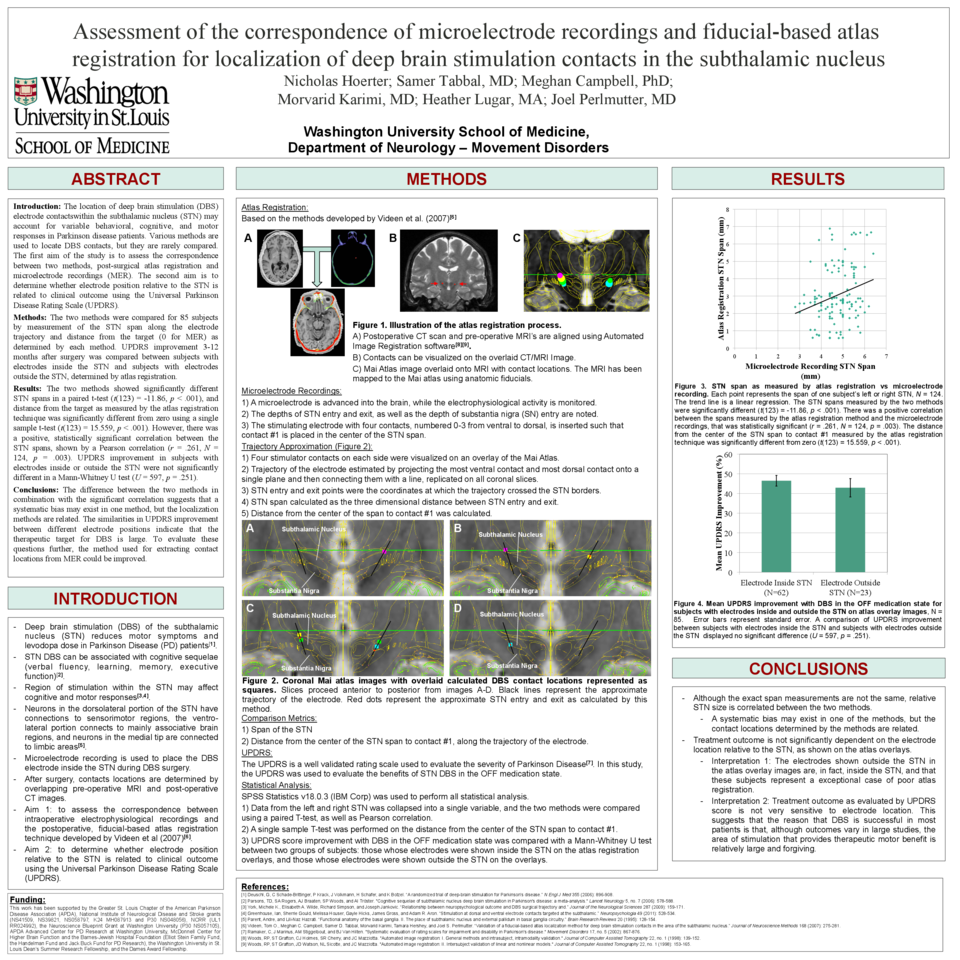
Introduction: The location of deep brain stimulation (DBS) electrode contacts within the subthalamic nucleus (STN) may account for variable behavioral, cognitive, and motor responses in Parkinson’s disease patients. Various methods are used to locate DBS contacts, but they are rarely compared. The first aim of the study is to assess the correspondence between two methods, post-surgical atlas registration and microelectrode recordings (MER). The second aim is to determine whether electrode position relative to the STN is related to clinical outcome using the Universal Parkinson Disease Rating Scale (UPDRS).
Methods: The two methods were compared for 85 subjects by measurement of the STN span along the electrode trajectory and distance from the target (0 for MER) as determined by each method. UPDRS improvement 3-12 months after surgery was compared between subjects with electrodes inside the STN and subjects with electrodes outside the STN, determined by atlas registration.
Results: The two methods showed significantly different STN spans in a paired t-test (t(123) = -11.86, p < .001), and distance from the target as measured by the atlas registration technique was significantly different from zero using a single sample t-test (t(123) = 15.559, p < .001). However, there was a positive, statistically significant correlation between the STN spans, shown by a Pearson correlation (r = .261, N = 124, p = .003). UPDRS improvement in subjects with electrodes inside or outside the STN were not significantly different in a Mann-Whitney U test (U = 597, p = .251).
Conclusions: The difference between the two methods in combination with the significant correlation suggests that a systematic bias may exist in one method, but the localization methods are related. The similarities in UPDRS improvement between different electrode positions indicate that the therapeutic target for DBS is large. To evaluate these questions further, the method used for extracting contact locations from MER could be improved.
Related articles