It’s Not a Coincidence: A Novel Mechanism for Processing Submillisecond Spike Timing Differences
Abstract
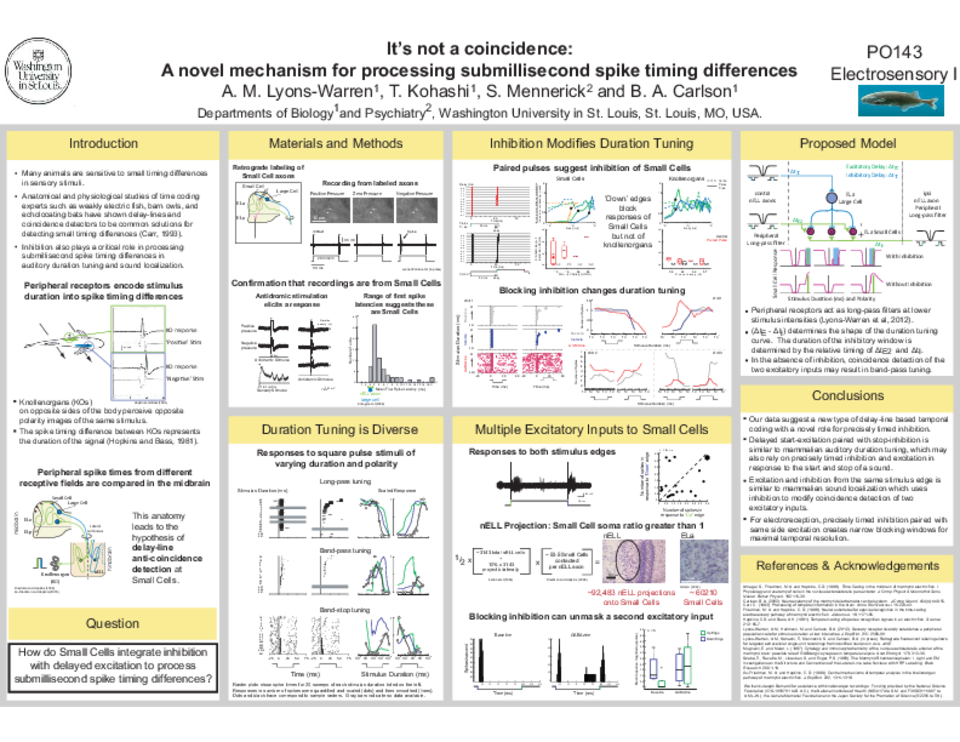
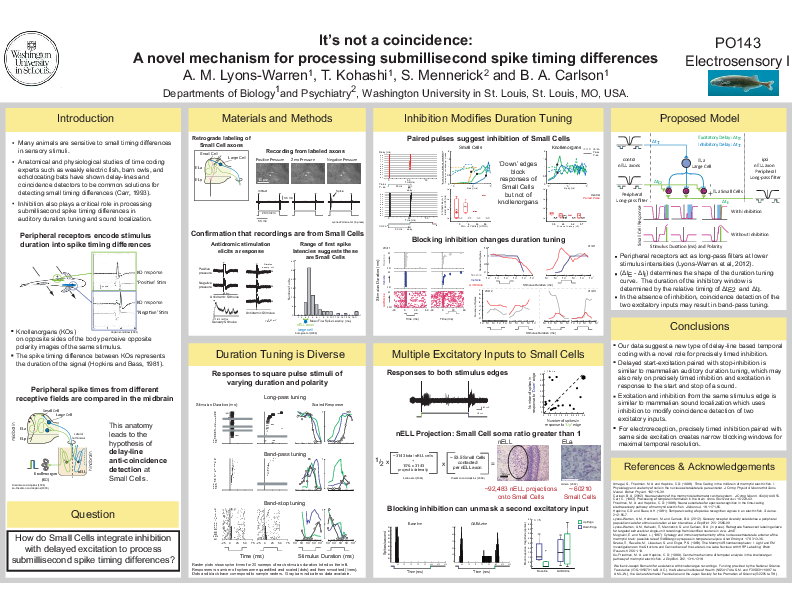
Inhibition plays a critical role in the sensory processing of submillisecond spike timing differences. In auditory systems, for example, inhibition can shift sensitivity to the behaviorally-relevant range of interaural time differences and generate tuning to sound duration. Here we demonstrate a novel role for precisely-timed inhibition in processing submillisecond spike timing differences in mormyrid weakly electric fish. Mormyrid fish communicate using species-specific electric organ discharges (EODs). Species recognition and mate choice rely on temporal features of EODs, particularly duration. Sensory receptors spike in response to the start or end of EODs, depending on their location relative to the signal. EOD duration is thereby encoded into spike timing differences between receptors. Multiple lines of evidence suggest that Small Cells within the midbrain anterior exterolateral nucleus are the time comparator neurons that process these spike timing differences to establish EOD duration tuning. Small Cells receive two precisely-timed synaptic inputs: inhibition from local interneurons and excitation that passes through axonal delay lines of variable length. However, Small Cells are particularly challenging to record from. Therefore, it remains unknown how these inputs are integrated to establish Small Cell duration tuning. Using a novel technique to guide electrodes towards fluorescently labeled Small Cell axons in vivo, we recorded single-unit extracellular action potentials in response to sensory stimulation with monophasic square pulses. Of 61 units, 22 (36%) responded with a time-locked spike to the ipsilateral-positive edge of the stimulus whereas 35 (57%) responded to the contralateral-positive edge. 4 units responded to both edges. We obtained complete duration tuning curves from 58 units, which revealed diverse patterns of duration tuning categorized as long-pass, band-pass, band-stop, and all-pass. We hypothesized that this diversity results from precisely-timed inhibition blocking responses to variably delayed excitation. To test the role of inhibition in establishing Small Cell duration tuning, we assessed possible interactions between excitatory and inhibitory responses to different stimulus edges using complex stimuli, as well as GABAzine to pharmacologically block GABAergic inhibition. First, we presented a short pulse that reliably elicited spikes when presented alone (durations ranged from 50 μs to 0.4 ms) at varying delays following the hypothesized inhibitory edge of a 50 ms pulse. In 9 of 10 units, the hypothesized inhibitory edge blocked responses to the subsequent short pulse at delays ranging from 200 μs to as long as 10 ms. Next, we measured duration tuning and responses to these paired-pulse stimuli before and after application of GABAzine. GABAzine application caused a significant increase in spontaneous spiking (t14= 2.28, p <0.05), which we confirmed was due to local actions on inhibitory circuitry within ELa, not upstream effects in the hindbrain. GABAzine application also caused an increase in stimulus-evoked responses at all durations and restored responses to the short pulse at all delays in the paired-pulse experiment. These results suggest a delay-line anti-coincidence detection mechanism in which a combination of precisely-timed inhibition and variably delayed excitation establish diverse patterns of tuning to submillisecond spike timing differences.
Related articles