Mechanical Ventilation Decreases Eph A3, A4 in the Lung of Chronically Ventilated Preterm Lambs
Abstract
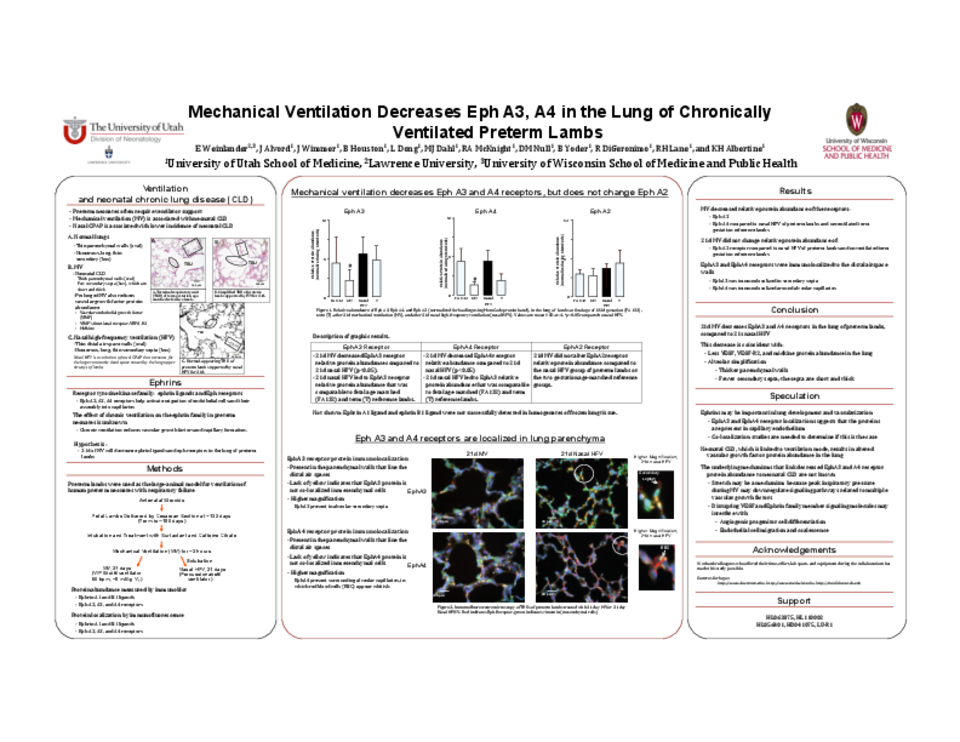
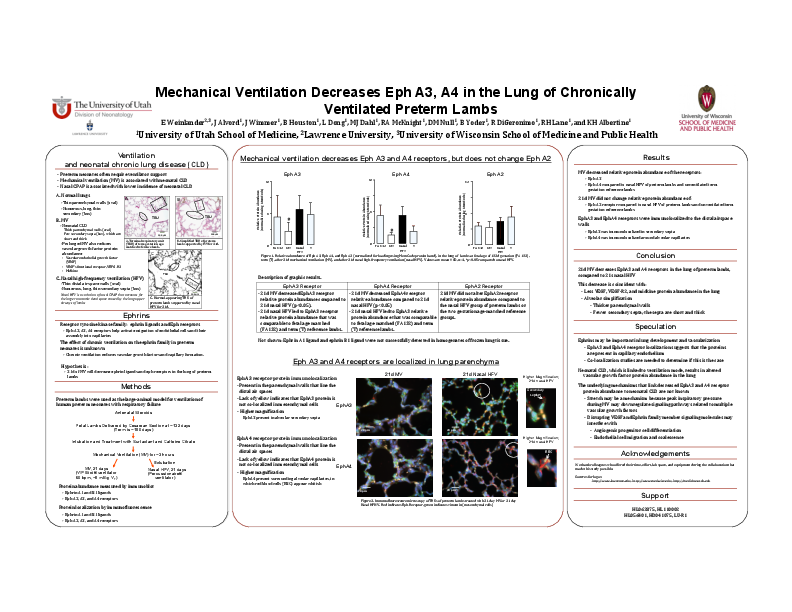
Purpose of Study: Prolonged mechanical ventilation (MV) of preterm neonates leads to alveolar simplification. An element of simplification is less alveolar capillary growth. Less capillary growth may reflect fewer angiogenic progenitor cells and/or fewer receptors on these cells. We recently showed that vascular endothelial growth factor (VEGF) and its functional receptor (R) in the lung, VEGF-R2, are reduced in the immature lung by prolonged MV. Another family of pro-angiogenic molecules is the ephrin family (ephrin ligands and eph receptors). Eph receptors are implicated in angiogenesis in the lung. EphA2 receptor, for example, affects angiogenesis by activating migration of endothelial cells and their assembly into capillaries. Whether the ephrin/eph family of receptor tyrosine kinase ligands/receptors is downregulated in the lung of chronically ventilated preterm neonates is not known. We hypothesized that prolonged MV decreases ephrin ligands and eph receptors in the lung of preterm lambs.
Methods Used: Preterm (PT) lambs, treated with antenatal steroids and postnatal surfactant, were managed by MV or nasal high-frequency ventilation (nasal HFV) (n=4 each) for 21d. We use nasal HFV as the positive gold standard for outcome. Frozen lung tissue was analyzed by immunoblot for ephrinA1 and B1 ligands as well as EphA2, A3, and A4 receptors.
Summary of Results: MV for 21d did not affect protein abundance of EphA2 receptor in the lung compared to nasal HFV for 21d. On the other hand, MV for 21d significantly reduced protein abundance of EphA3 (~50%; p<0.05) and A4 (~75%; p<0.05) receptors in the lung compared to nasal HFV for 21d. Eph receptors were immunolocalized in parenchymal cells in the walls of distal airspaces. EphrinA1 ligand and ephrinB1 ligand were not successfully detected in homogenates of frozen lung tissue.
Conclusions: We conclude that MV for 21d decreases Eph receptors in the lung of preterm lambs. Decreased amounts of angiogenic receptors (VEGFR2 and Ephs) may reflect fewer angiogenic progenitor cells. We speculate that replacement of angiogenic progenitor cells may be an approach to facilitate capillary growth in the lung of preterm neonates who require prolonged support by MV. (HL110002, HL062875, HL056401, HD41075, LU-R1)
Related articles