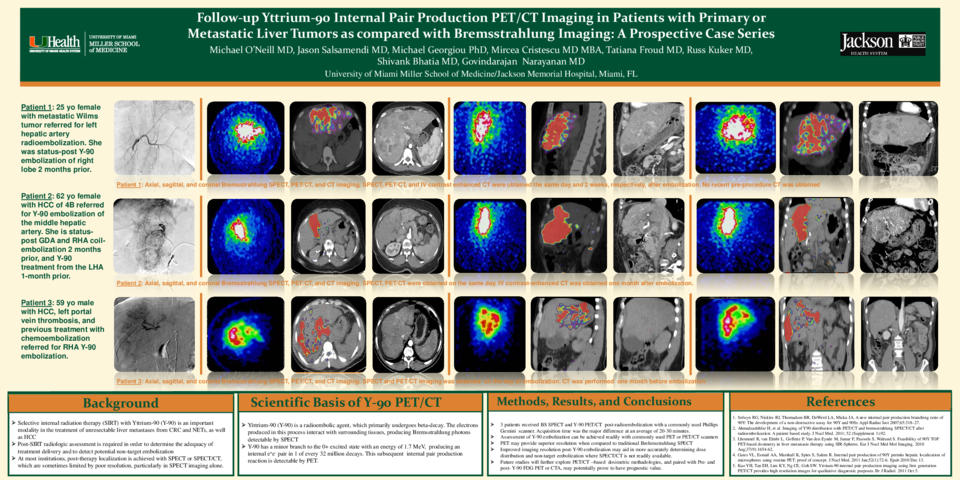
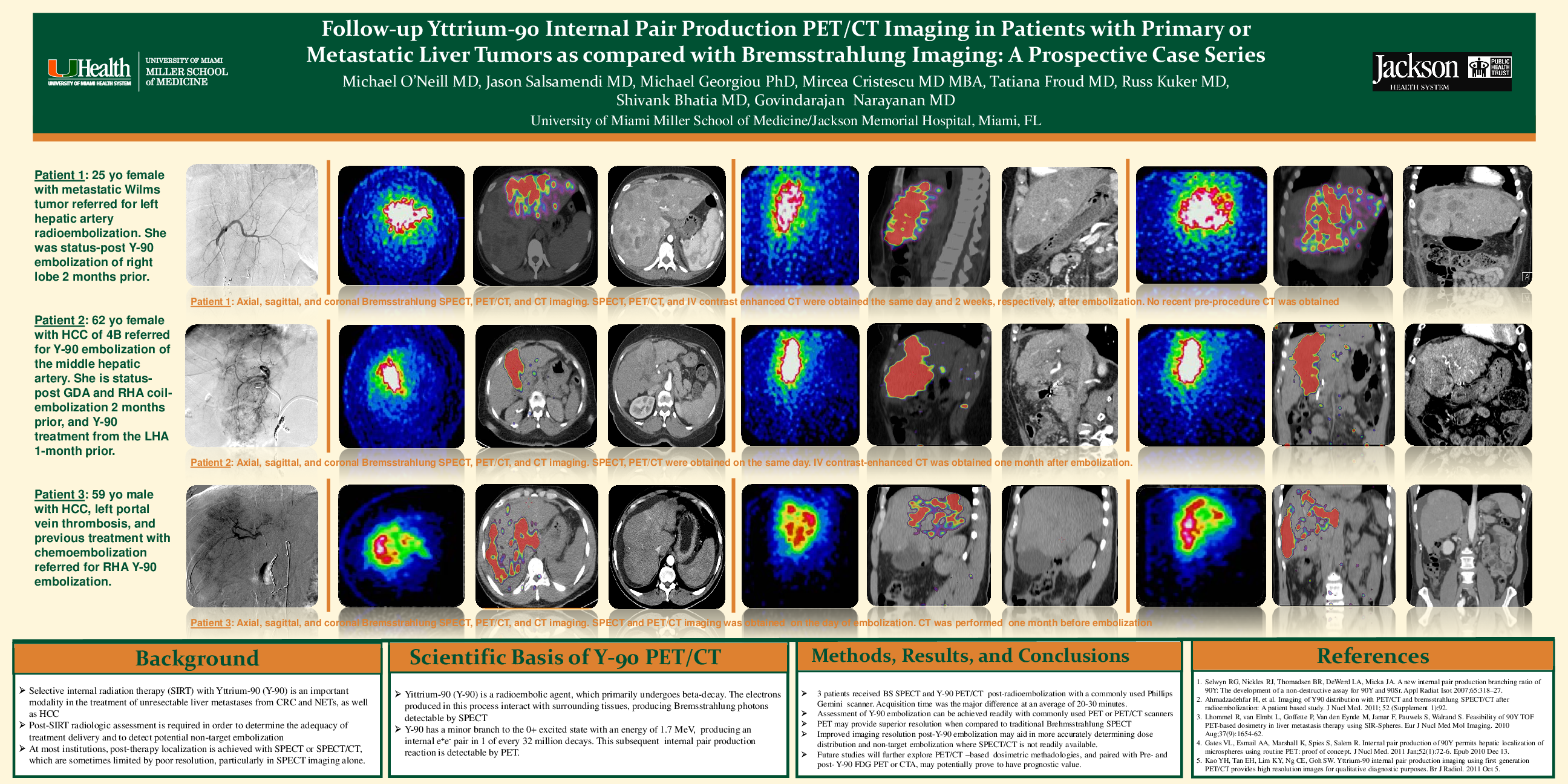
Follow-up Yttrium-90 Internal Pair Production PET/CT Imaging in Patients with Primary or Metastatic Liver Tumors as compared with Brehmsstrahlung Imaging: A Prospective Case Series
Abstract
Objectives: To demonstrate non-target embolization much more precisely and quickly, where applicable
Demonstrate improved accuracy in the depiction of the treatment distribution, as well as quantify the degree of radioactivity in any individual portion of the tumor in the form of point values.
Methods: This is a prospective non-blinded case series involving the acquisition of a pair production PET/CT as soon as possible after an already performed Y-90 Sirspheres treatment of hepatic malignancy. The feasibility of this method has been demonstrated in a few pilot studies, although no large prospective series have been performed to our knowledge. It is performed in addition to the standard Brehmsstralung SPECT scan to allow for comparison.
The measures used will include: Degree of correlation with expected vs. achieved tumor coverage by the treatment; Degree of anatomic dose correlation between treatment distribution depicted by the two modalities; Determination of average intensity values of treated areas vs. non-treated background liver parenchyma, for later correlation with various patient outcomes; Detection of non-target embolization, where applicable, and qualitative comparison between the two modalities as to the conspicuity of the abnormality.
Results: We have thus far demonstrated high quality and accurate PET/CT studies in all subjects, which correlate well with both the known distribution of tumor burden and with the angiographic findings. For example, in one case, the PET/CT helped define that the dose distribution covered all of hepatic segment 4, rather than the planned selective treatment of segment 4b, for example. In another subject, who has multifocal disease, the PET/CT demonstrated the dose distributions more accurately than the Brehmsstrahlung imaging. In both of these examples, the added information obtained with the PET/CT was clinically useful, because it could better define the treated area and help exclude non-target embolization. Other patients studied so far had similarly successful and useful results.
Conclusions: Pair production Yttrium-90 PET/CT is a practical and highly accurate method to confirm anatomic dose distribution of Y-90 in the setting of hepatic tumors. It may be a viable alternative Brehmsstrahlung imaging alone, and it has been suggested to more accurately depict dose distribution than even SPECT/CT. Therefore, we anticipate that it may in fact ultimately emerge as an equivalent modality to SPECT/CT in the post Y-90 treatment setting.
Related articles