Abstract
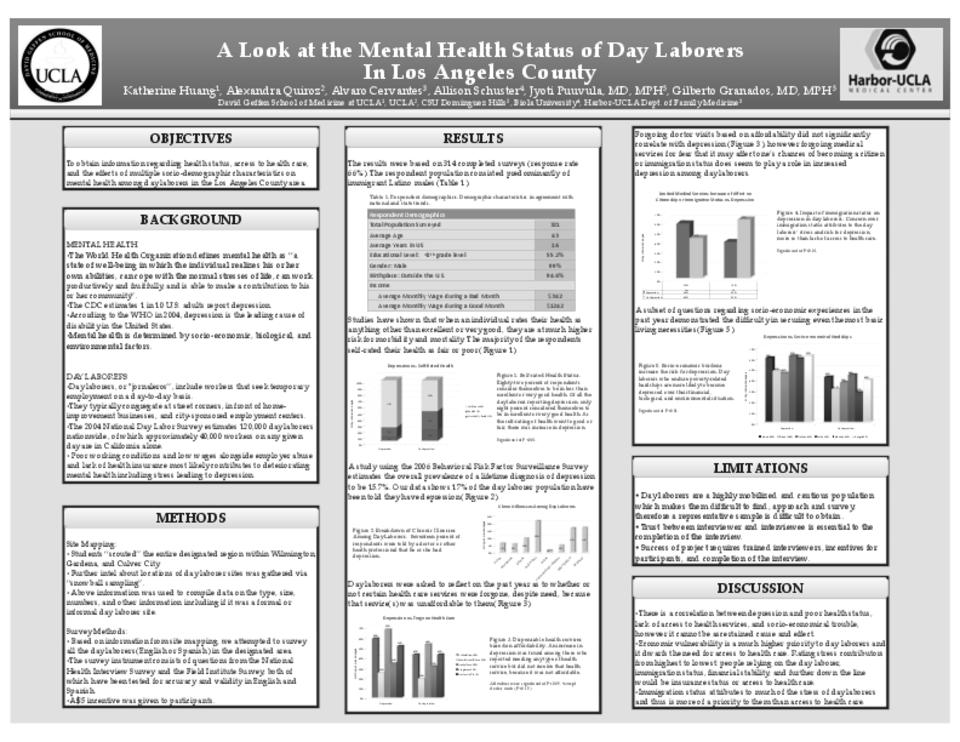
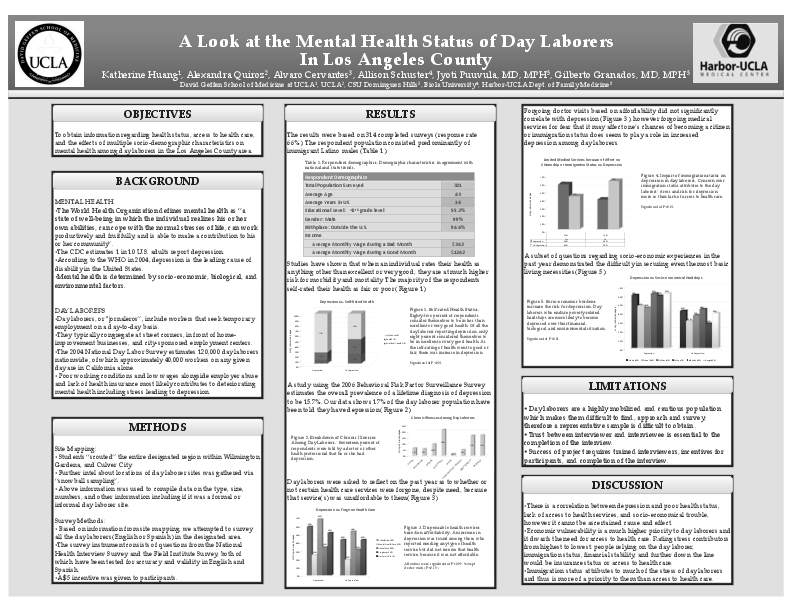
BACKGROUND: Day laborers, people seeking temporary employment on a day-to-day basis, amount to some 120,000 people nationwide. According to the National Day Laborer Survey about 40,000 day laborers look for jobs daily in California alone. The nature of a day laborer leaves this population very vulnerable, further compounded by the fact that a majority are undocumented and do not have health insurance. The World Health Organization (WHO) recognizes that “poor mental health is strongly related to other health conditions…including lower educational achievements, substance abuse, violence, and poor reproductive and sexual health” and ultimately impacts the ability of an individual to contribute to his or her community. Rates of depression among day laborers were obtained as part of a health needs assessment as we surveyed day laborers in the South Bay of Los Angeles County to learn more about day laborers’ health status, access to health care, and attitudes toward healthcare services.
METHODS: Potential day labor sites from Wilmington to Culver City were mapped, and day laborers counted. We attempted to survey all day laborers using parts of a national health inventory survey that had been tested, validated, and standardized and were used to compile a 90-question survey.
RESULTS: 314-day laborers were surveyed in 2011 and 2012. Of all the day laborers surveyed 99% were male, 94.6% were born outside the United States, and 84.1% were uninsured. When asked to rate one’s health on a scale of excellent, very good, good, fair, and poor, 55% reported their health being fair/poor. In assessing the prevalence of different chronic diseases among day laborers, 17.2% reported a diagnosis of depression or other depressive disorder.
DISCUSSION: In 2004, the WHO reported depression as the leading cause of disability as measured by years-lived with disability. Of all the chronic diseases assessed in this survey, depression or other depressive disorder was the highest among day laborers. An understanding of the factors and situations contributing to the development of depression in day laborers could provide a window to prevention or at the minimum alleviation from mental health issues, giving day laborers a better chance to improve their ability to care for themselves and become an asset to society.