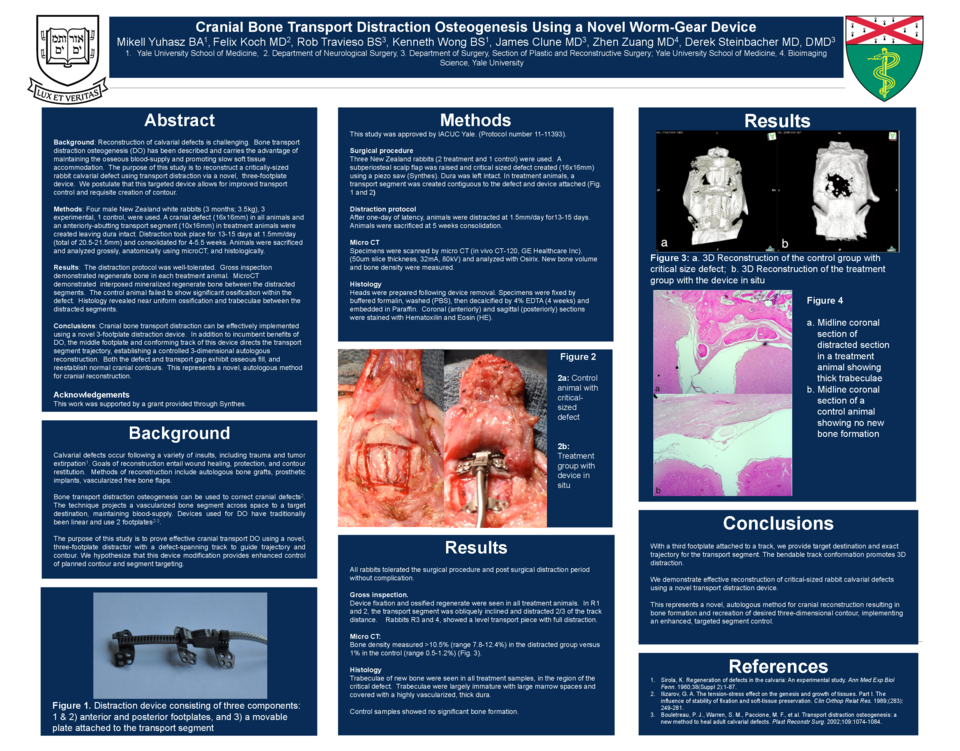
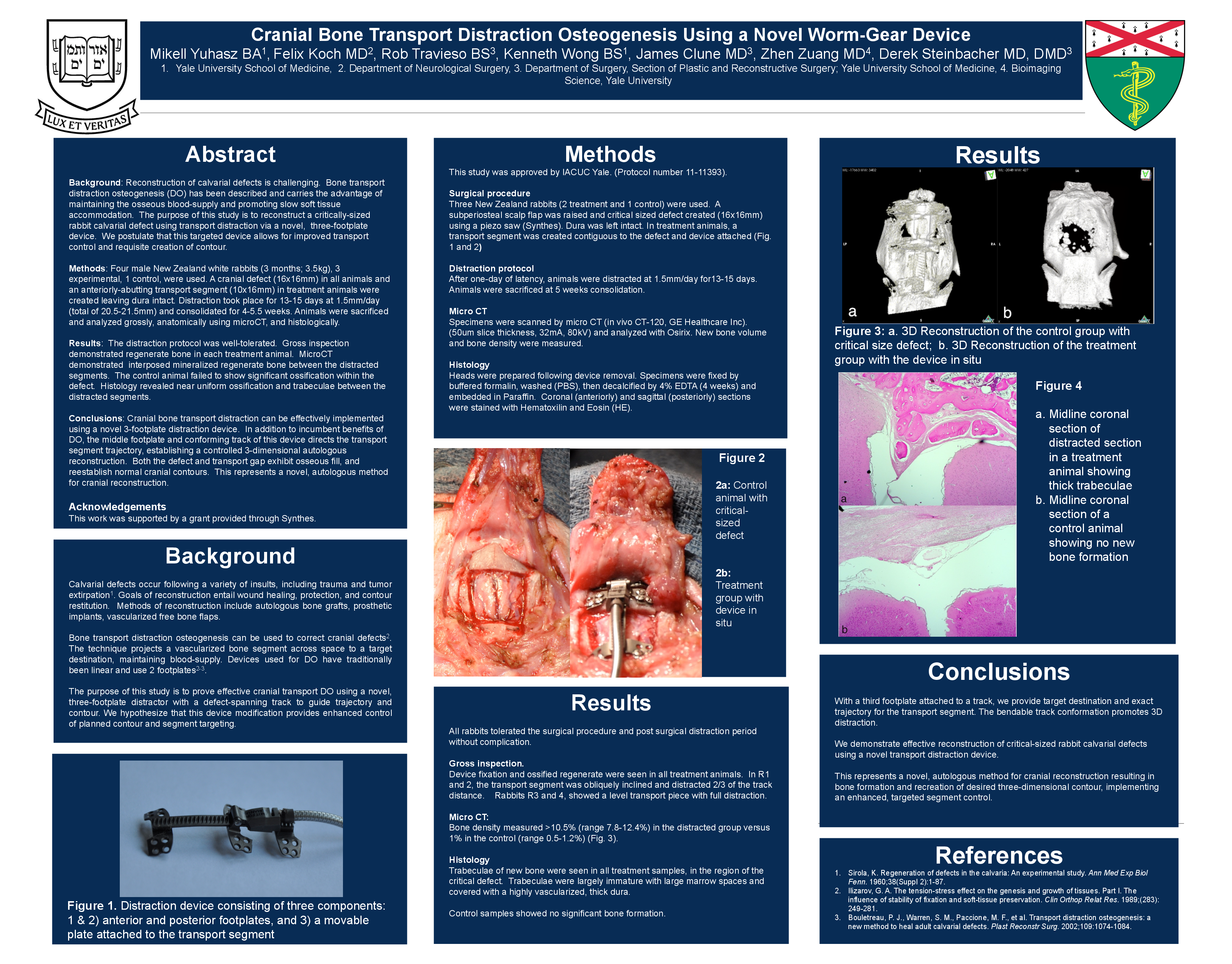
Targeted cranial bone transport distraction is enhanced using a novel device
Abstract
Calvarial defects occur following a variety of insults, including trauma and tumor extirpation, and can be challenging to reconstruct. Bone transport distraction osteogenesis (DO) is a technique that allows for adequate soft tissue expansion and maintains vascularity. The purpose of this study is to reconstruct critically-sized rabbit calvarial defects using transport DO via a novel, three-footplate, worm gear device. We postulate that this device allows for targeted, exact transport segment trajectory and requisite restitution of cranial contour. This study was approved by the Yale University IACUC (11393). Four male New Zealand white rabbits (3 months; 3.5kg), 3 experimental, 1 control, were used. A cranial defect (16x16mm) in all animals along with an anteriorly-abutting transport segment (10x16mm) in treatment animals. Distraction took place for 13-15 days at 1.5mm/day (total of 20.5-21.5mm) and consolidated for 4-5.5 weeks. The animals were sacrificed and analyzed grossly, anatomically using microCT, and histologically. The procedure was well tolerated. Gross inspection demonstrated regenerate bone in each treatment animal. Natural cranial contour was achieved with histology demonstrating near uniform osteoid and trabeculae between segments in the distraction groups. The control animals showed no significant ossification. Micro-CT demonstrated interposed mineralized regenerate bone between the distracted segments in both treatment groups. Bone density measured >10.5% (range 7.8-12.4%) in the distracted group versus 1% in the control (range 0.5-1.2%). We demonstrate effective reconstruction of critical-sized rabbit calvarial defects using a novel transport distraction device, which enhanced targeted segment control and restitution of three-dimensional contour.
Related articles