Abstract
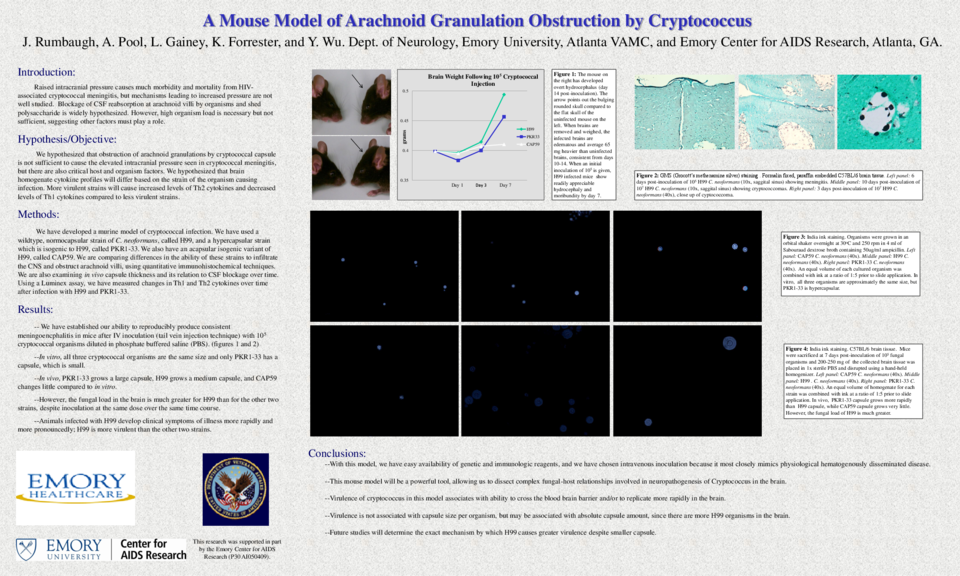
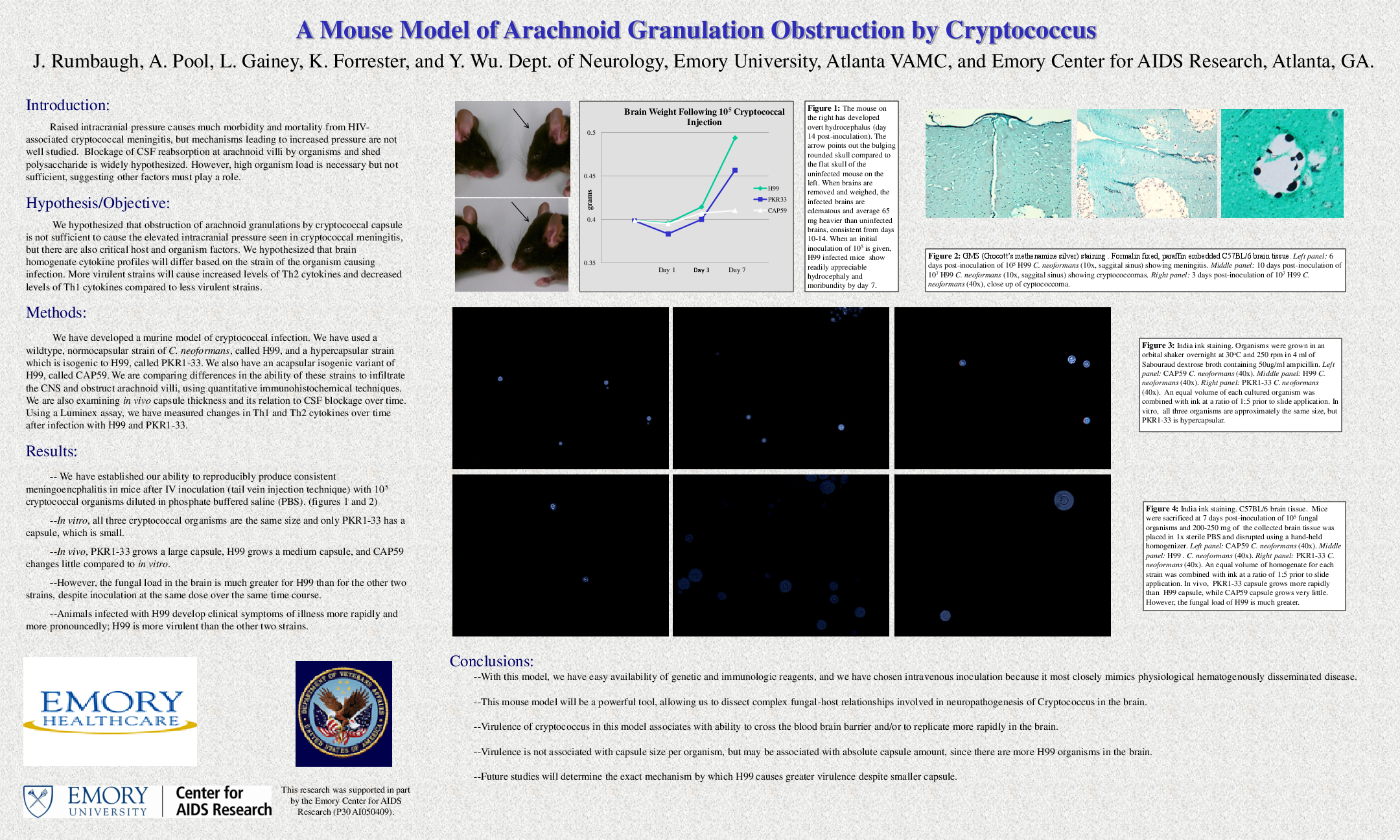
Raised intracranial pressure causes much morbidity and mortality from HIV-associated cryptococcal meningitis, but mechanisms leading to increased pressure are not well studied. Blockage of CSF reabsorption at the arachnoid villi by organisms and shed polysaccharide capsule is widely hypothesized. However, high organism load is necessary but not sufficient, suggesting other factors must play a role. We hypothesized that obstruction of arachnoid granulations by cryptococcal capsule is not sufficient to cause the elevated intracranial pressure seen in cryptococcal meningitis, but there are also critical host and organism factors. Also, that brain homogenate cytokine profiles will differ based on the strain of the organism causing infection. More virulent strains will cause increased levels of Th2 cytokines and decreased levels of Th1 cytokines compared to less virulent strains. We have developed a murine model of cryptococcal infection. We have used a wildtype, normocapsular strain of C. neoformans, called H99, and a hypercapsular strain which is isogenic to H99, called PKR1-33, and an acapsular isogenic variant of H99, called CAP59. To compare differences in the ability of these strains to infiltrate the CNS and obstruct arachnoid villi, we are utilizing quantitative immunohistochemical techniques. Using a Luminex assay, we have measured changes in Th1 and Th2 cytokines over time after infection with H99 and PKR1-33. We have established our ability to reproducibly produce consistent meningoencphalitis in mice after IV inoculation (tail vein injection technique) with cryptococcal organisms. (figures 1 and 2). In vitro, all three cryptococcal organisms are the same size and only PKR1-33 has a capsule, which is small. In vivo, PKR1-33 grows a large capsule, H99 grows a medium capsule, and CAP59 changes little compared to in vitro. However, the funga load in the brain is much greater for H99 than for the other two strains, despite inoculation at the same dose over the same time course. Animals infected with H99 develop clinical symptoms of illness more rapidly and more pronouncedly; H99 is more virulent than the other two strains. --With this model, we have easy availability of genetic and immunologic reagents, and we have chosen intravenous inoculation because it most closely mimics physiological hematogenously disseminated disease. This mouse model will be a powerful tool, allowing us to dissect complex fungal-host relationships involved in neuropathogenesis of Cryptococcus in the brain. Virulence is not associated with capsule size per organism, but may be associated with absolute capsule amount, since there are more H99 organisms in the brain. Future studies will determine the exact mechanism by which H99 causes greater virulence despite smaller capsule.