Abstract
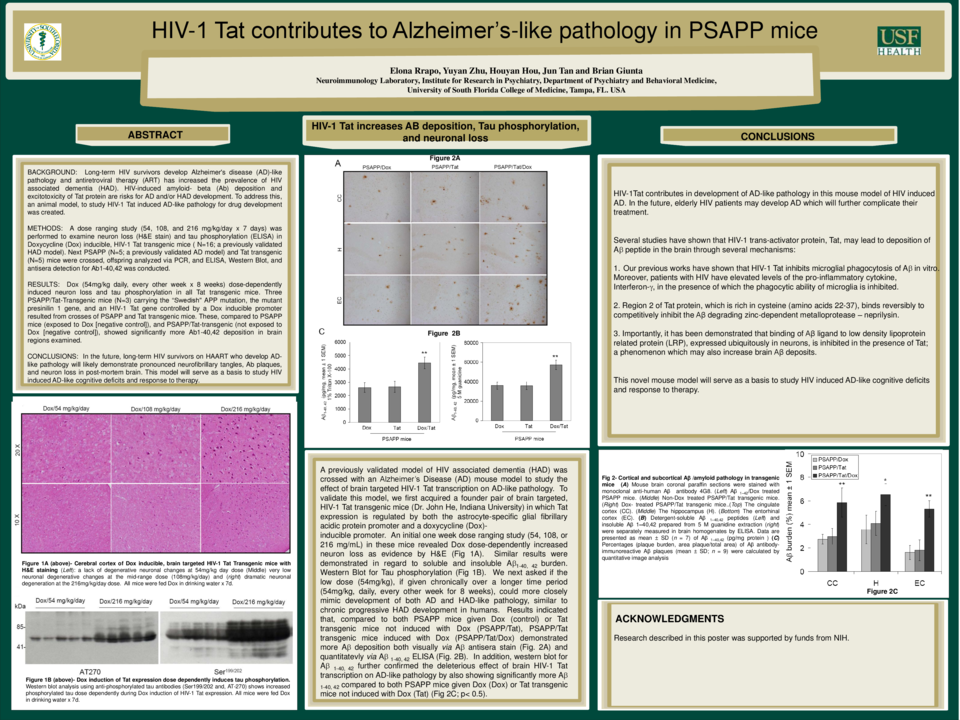
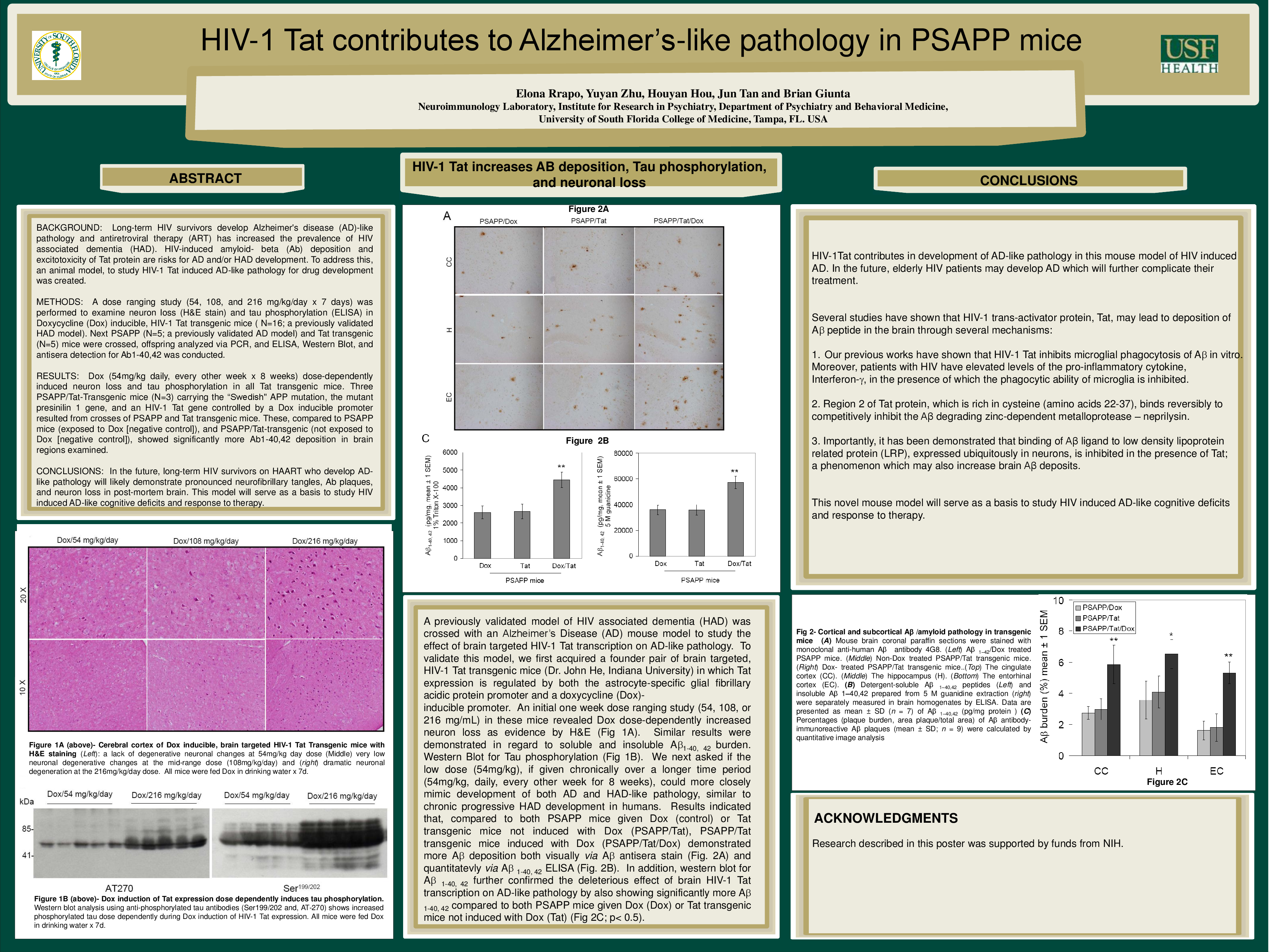
BACKGROUND: Long-term HIV survivors develop Alzheimer's disease (AD)-like pathology and antiretroviral therapy (ART) has increased the prevalence of HIV associated dementia (HAD). HIV-induced amyloid- beta (Ab) deposition and excitotoxicity of Tat protein are risks for AD and/or HAD development. To address this, an animal model, to study HIV-1 Tat induced AD-like pathology for drug development was created.
METHODS: A dose ranging study (54, 108, and 216 mg/kg/day x 7 days) was performed to examine neuron loss (H&E stain) and tau phosphorylation (ELISA) in Doxycycline (Dox) inducible, HIV-1 Tat transgenic mice ( N=16; a previously validated HAD model). Next PSAPP (N=5; a previously validated AD model) and Tat transgenic (N=5) mice were crossed, offspring analyzed via PCR, and ELISA, Western Blot, and antisera detection for Ab1-40,42 was conducted.
RESULTS: Dox (54mg/kg daily, every other week x 8 weeks) dose-dependently induced neuron loss and tau phosphorylation in all Tat transgenic mice. Three PSAPP/Tat-Transgenic mice (N=3) carrying the “Swedish" APP mutation, the mutant presinilin 1 gene, and an HIV-1 Tat gene controlled by a Dox inducible promoter resulted from crosses of PSAPP and Tat transgenic mice. These, compared to PSAPP mice (exposed to Dox [negative control]), and PSAPP/Tat-transgenic (not exposed to Dox [negative control]), showed significantly more Ab1-40,42 deposition in brain regions examined.
CONCLUSIONS: In the future, long-term HIV survivors on HAART who develop AD-like pathology will likely demonstrate pronounced neurofibrillary tangles, Ab plaques, and neuron loss in post-mortem brain. This model will serve as a basis to study HIV induced AD-like cognitive deficits and response to therapy.