Abstract
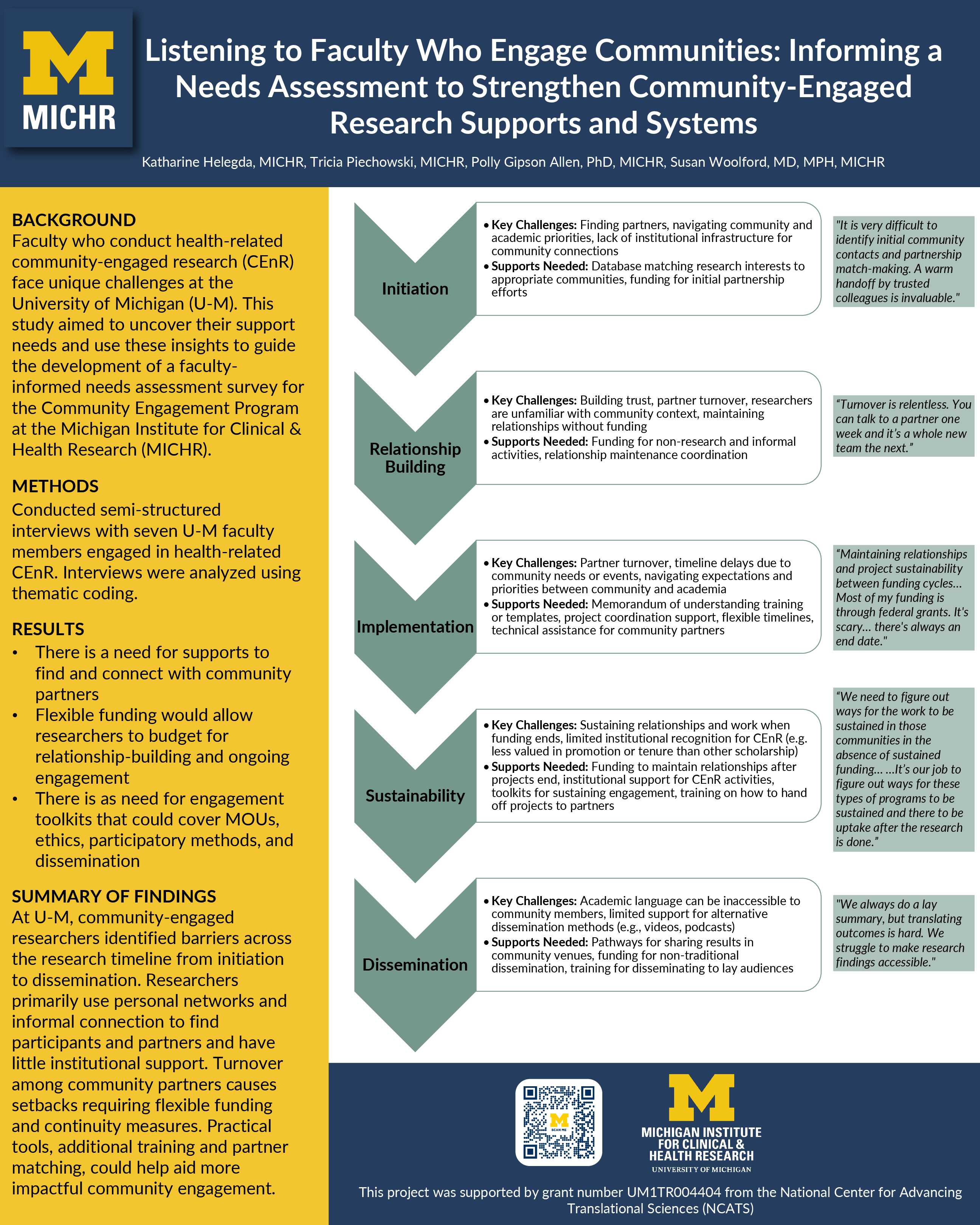
Lay Summary: The Community Engagement (CE) Team at MICHR interviewed seven University of Michigan faculty members to better understand their experiences, and needs in conducting Community Engaged Research (CEnR). These conversations helped shape a needs assessment survey that will be sent to over 1,000 CEnR researchers across U-M’s three campuses. By starting with in-depth interviews, the team ensured the survey reflects the wide variety of needs in the CEnR community. This process centered faculty voices and allowed their experiences to directly inform the assessment. Results from the survey will help the CE team tailor future services and resources to better support faculty doing CEnR, improve community partnerships, and ensure research leads to meaningful health improvements.
Objectives/Goals: The objective of this study was to identify the support needs of faculty conducting health-related Community Engaged Research (CEnR) at the University of Michigan (U-M). Our primary goal was to develop a faculty-informed needs assessment survey.
Methods/Study Population: We conducted semi-structured interviews with seven U-M faculty members engaged in health-related CEnR. Participants were affiliated with the Michigan Institute for Clinical and Health Research (MICHR), represented a variety of health disciplines, and had varying levels of CEnR experience. Interviews explored research processes, challenges, and support needs. Transcripts were thematically analyzed. Findings informed the design of a university-wide needs assessment survey, to be distributed to ~1,000 faculty conducting health-focused CEnR across all three of U-M's campuses. This formative qualitative study represents the initial phase of a broader, mixed-methods effort to strengthen institutional support for translational research through community engagement.
Results/Anticipated Results: Interviews revealed key needs across the CEnR lifecycle from study design, partnership development, project management, and dissemination. Themes included the value of introductions to communities by trusted faculty, challenges sustaining partnerships between funding cycles, and the need for greater recognition of CEnR in promotion and tenure. These insights directly shaped the needs assessment survey, which aims to validate and expand on these themes. Findings from the survey will inform CE Team priorities, guide service development, and address barriers that limit the effectiveness and impact of community-engaged translational research at U-M.
Discussion/Significance of Impact: By centering faculty voices, this work ensures future programming and services are aligned with real-world needs. Strengthening institutional support for CEnR will improve the systems, methods, and process that enhances its effectiveness and impact, accelerating research translation and fostering stronger university-community partnerships.