Abstract
Lay Summary: The landscape analysis reviewed resources at U-M that support research involving local communities across Ann Arbor, Flint, and Dearborn campuses. The team identified what exists and what is missing. These findings will help the Michigan Institute for Clinical and Health Research enhance its support for researchers, staff, and community partners working together. The poster also shares a simple approach that other universities can use to check their own resources and fill gaps, making community-engaged research easier and more effective for everyone involved, and helping speed up the translation of research into community benefit.
Objectives/Goals: This poster will provide key insights from a landscape analysis examining resources for community-engaged research (CEnR) across three University of Michigan (U-M) campuses. Highlights will include notable gaps and limitations, and how the analysis will inform future U-M CTSA CE programming to support CEnR efforts at U-M.
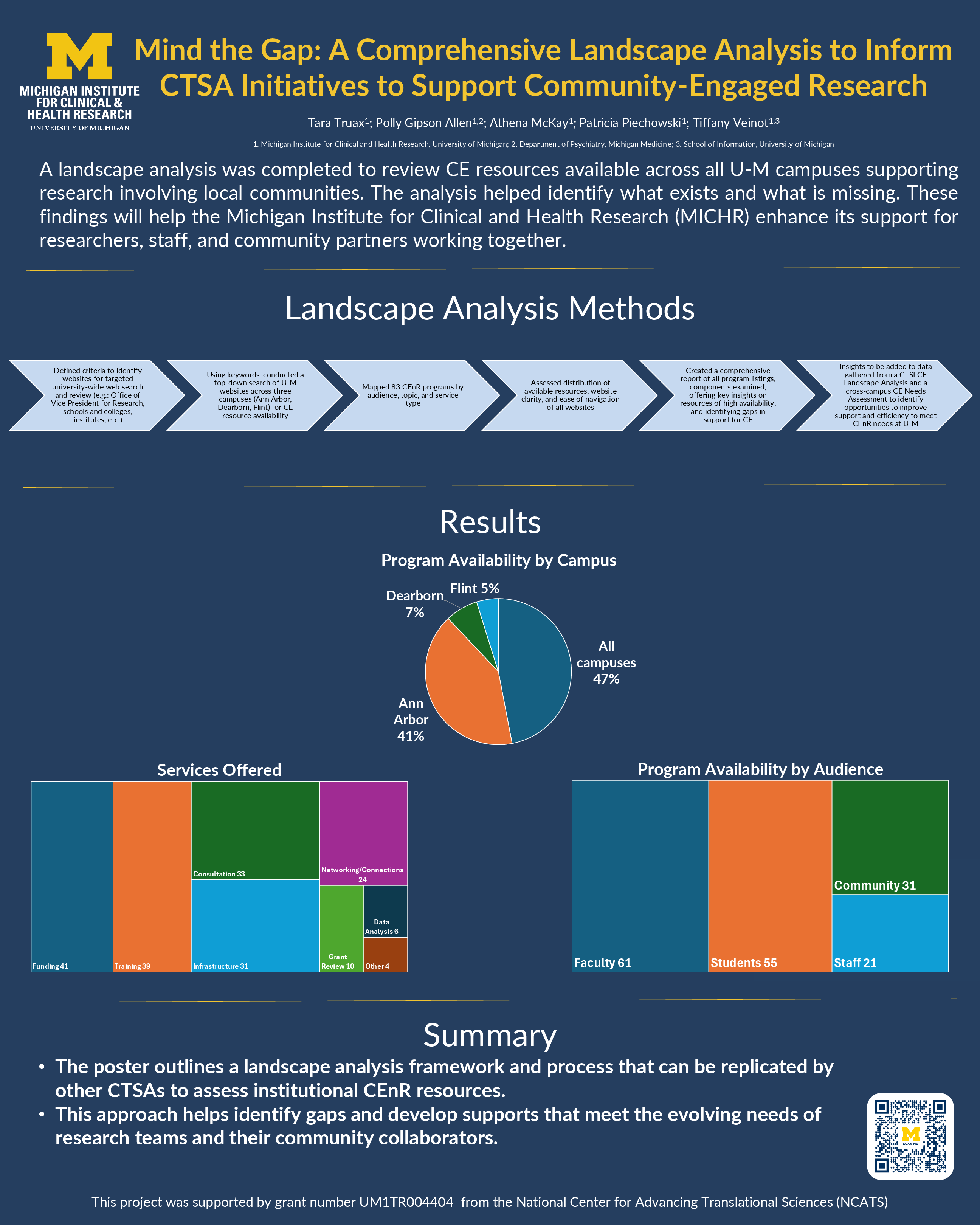
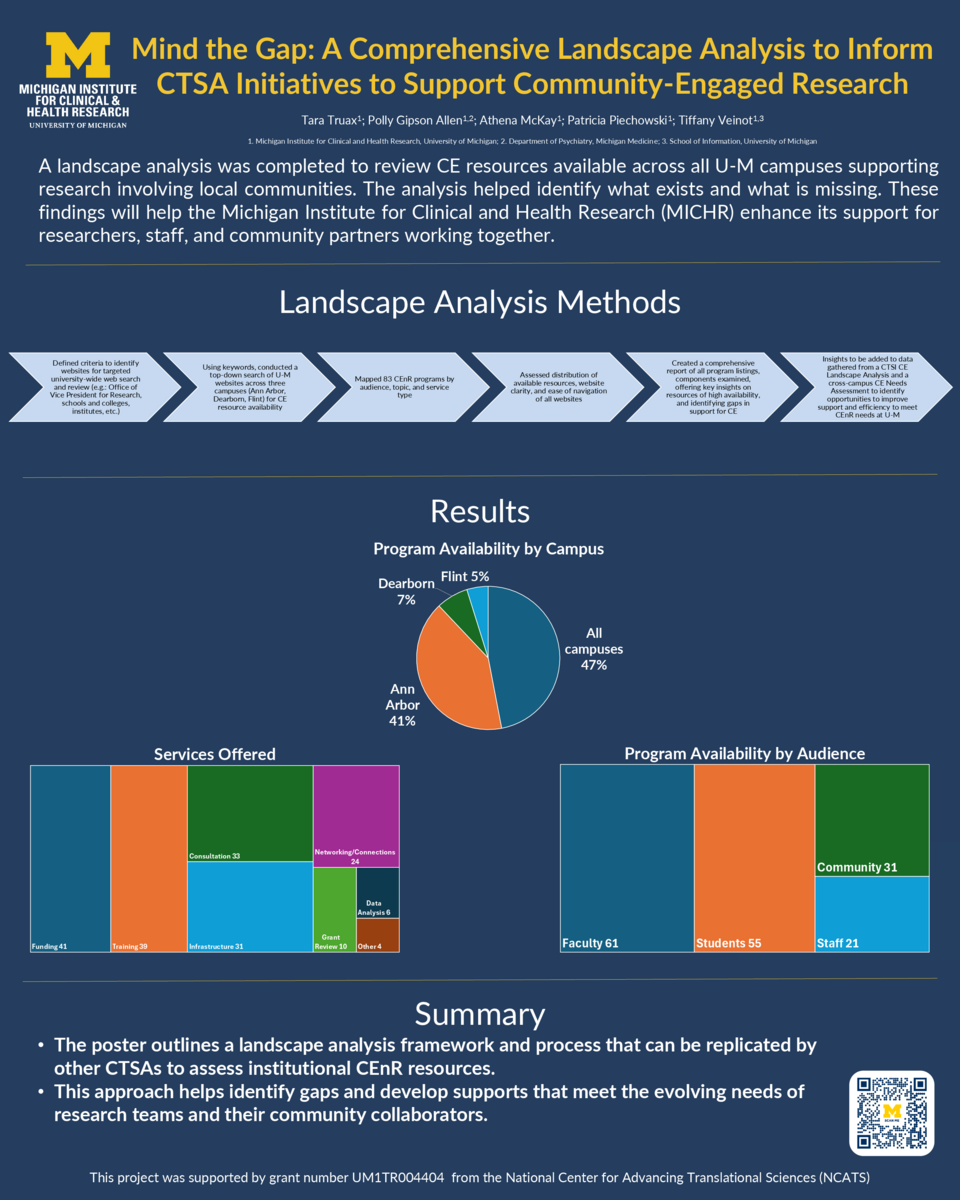
Methods/Study Population: A landscape analysis of CE resources available at U-M was conducted as part of a multi-pronged approach to inform CTSA CE services. Through a comprehensive review of U-M websites, the analysis identified 83 CEnR programs and services across Ann Arbor, Flint, and Dearborn campuses of U-M. Programs were mapped by audience (faculty, staff, students, community partners), topic, and service type. Assessment of distribution, website clarity, and ease of navigation further illuminated opportunities to improve support and efficiency to better meet the needs of those engaged in CEnR at U-M.
Results/Anticipated Results: The landscape analysis identified 83 CEnR-related programs and services at U-M, most concentrated in Ann Arbor, and with the highest concentration in a few units. Data analysis services, resources for sustaining and sharing work, and structured grant feedback were relatively rare. Availability of funding for community-focused initiatives was infrequent and generally under $10,000. Over 70% of resources were available to faculty or students, 18% were available to the community, and just under 13% were open to staff. Findings will be used by MICHR to identify opportunities for future CE initiatives.
Discussion/Significance of Impact: The poster outlines a landscape analysis framework and process that can be replicated by other CTSAs to assess institutional CEnR resources. This approach helps identify gaps and develop supports that meet the evolving needs of research teams and the community partners they collaborate with.