Laparoscopic versus Open Peritoneal Dialysis Catheter Insertion: A Cost Minimization Analysis
Abstract
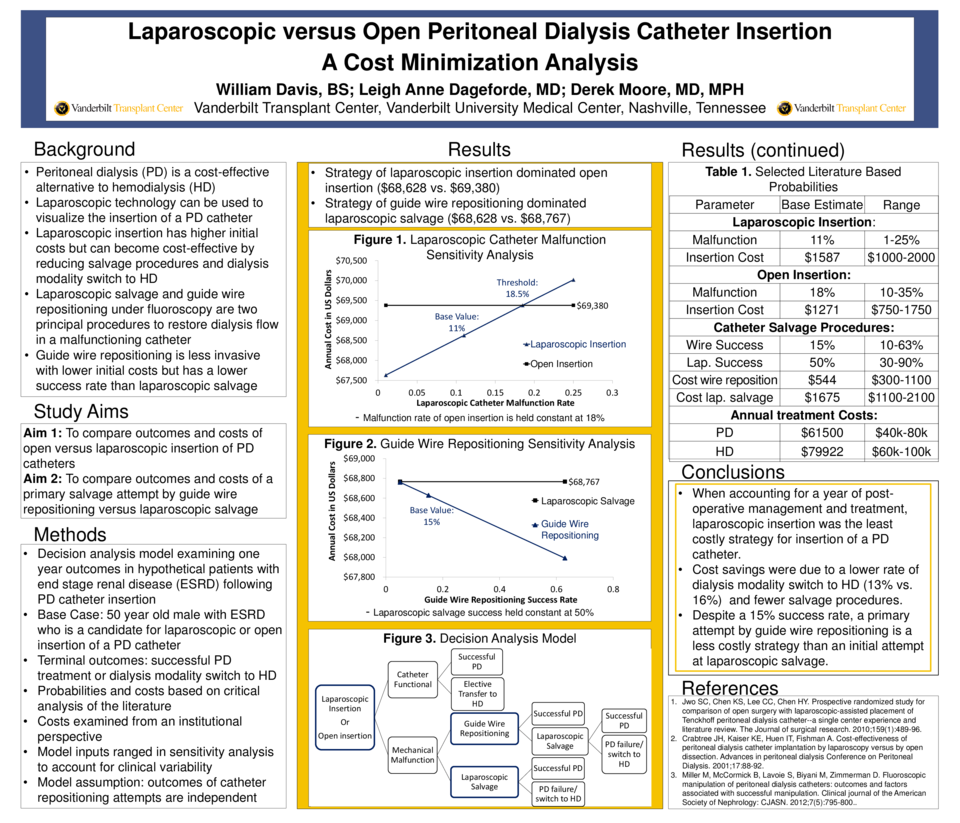
INTRODUCTION: Treatment of end stage renal disease in the United States costs $29 billion annually, with over 600,000 cases accounting for 9% of total Medicare spending. Peritoneal dialysis (PD) is a cost effective alternative to hemodialysis (HD). PD catheters have traditionally been inserted through a small open incision, but insertion using laparoscopic visualization has become increasingly popular and is associated with less catheter malfunction. The aim of this study was to determine if laparoscopic insertion results in cost savings by decreasing post-operative complications and future salvage procedures.
METHODS: A decision analysis model was constructed to simulate one year outcomes after PD catheter insertion by either the open or laparoscopic approach. Possible outcomes following PD catheter placement included functional catheter, infection, and catheter malfunction. Ultimately, patients continued with successful PD or switched to HD. Baseline probabilities, costs and ranges were determined from a critical review of the literature. Sensitivity analyses were performed to determine the model strength over a range of clinically relevant probabilities.
RESULTS: The total annual costs, including post-operative management and dialysis treatment, were $68,628 for laparoscopic insertion and $69,380 for open insertion. Technique failure after one year, defined as switch to HD, was 13.1% for laparoscopic insertion and 16.1% for open insertion. In the case of a catheter malfunction, an initial attempt at salvage by fluoroscopy-guided wire manipulation cost less than a strategy of primary laparoscopic repositioning.
CONCLUSION(S): When accounting for a year of post-operative management and treatment, laparoscopic insertion was the least costly approach for insertion of a PD catheter. Despite higher initial costs, PD catheter insertion under laparoscopic visualization results in lower total costs due to decreased rates of malfunction. With increasing emphasis on cost effective care, laparoscopic insertion is a valuable tool for initiating PD.
Related articles