Abstract
Background:
Cardiac pacing has been a widespread intervention used in management of bradyarrhythmias and conduction disorders. Non-physiological pacing (NPP) has been the standard approach to conduction disorders due to technical simplicity and lead positioning. Recent evidence suggests non-physiological pacing methods contribute to long-term adverse effects due to asynchronous ventricular activation and electrical dyssynchrony.
Physiologic pacing techniques have recently emerged as an alternative focusing on maintaining natural synchrony of ventricular depolarization, referred to as conduction system pacing (CSP). Physiological pacing maintains the His-purkinje network, minimizing electrical and mechanical dyssynchrony to provide improved clinical outcomes.
Recent studies have demonstrated promising results with CSP. Studies reported improved LVEF, decreased hospitalizations, along with average shorter QRS duration (QRSd). However, more research is needed to observe full long-term efficacy of physiologic pacing in severe cardiovascular conditions.
This systematic review and meta analysis aims to compare clinical outcomes in physiologic and non-physiologic pacing methods, emphasizing changes in QRSd, LVEF, and post-pacing hospitalizations.
Methods:
A Pubmed and Web of Science search for randomized control trials where clinical outcomes of physiological vs non-physiological cardiac pacing was investigated, and 7 articles were selected for review. A systematic review was conducted adhering to PRISMA guidelines. A statistical meta-analysis was conducted to observe for statistically significant differences across extracted data.
Results:
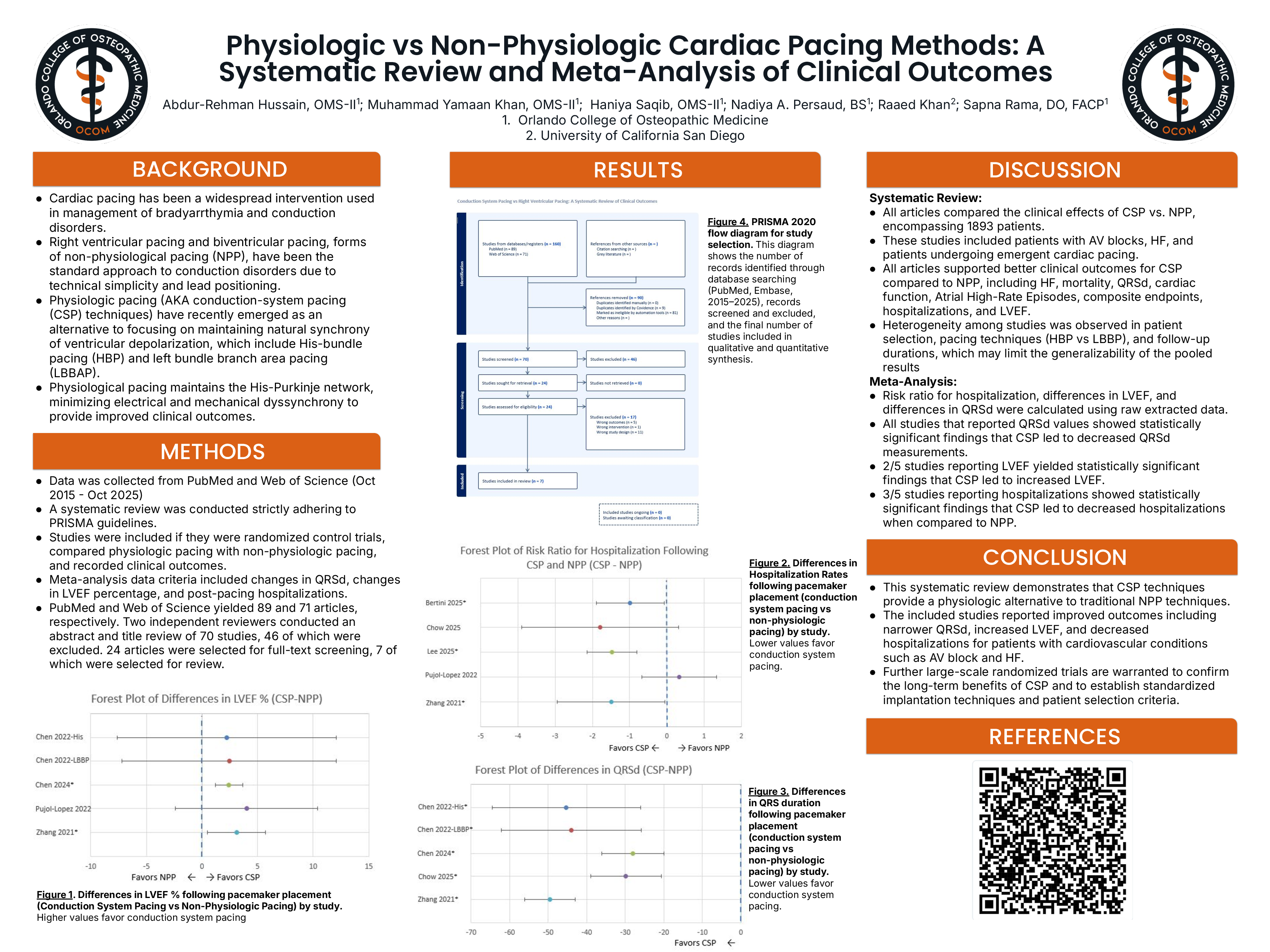
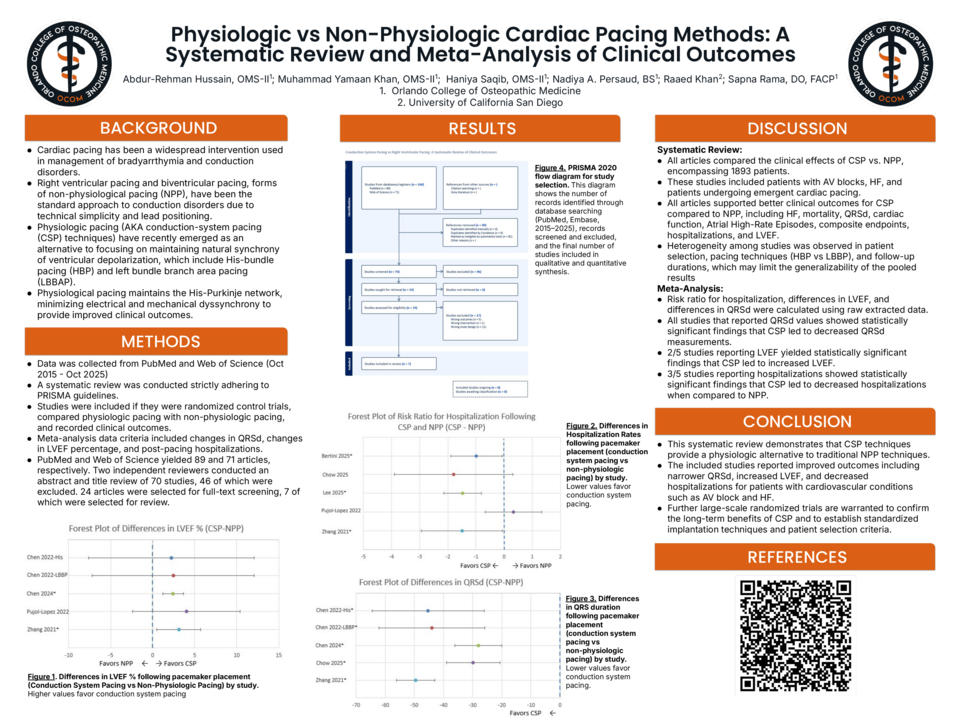
All articles, encompassing 1893 patients, compared the clinical effects of CSP vs. NPP, favoring CSP outcomes. Risk ratio for hospitalization, differences in LVEF, and differences in QRSd were calculated using raw extracted data. All studies that reported QRSd values showed statistically significant findings that CSP led to decreased QRSd measurements. 2/5 studies reporting LVEF yielded statistically significant findings that CSP led to increased LVEF. 3/5 studies reporting hospitalizations showed statistically significant findings that CSP led to decreased hospitalizations when compared to NPP.
Discussion:
This systematic review demonstrates that CSP techniques provide a physiologic alternative to traditional NPP techniques. The included studies reported improved outcomes including narrower QRSd, increased LVEF, and decreased hospitalizations for patients with cardiovascular conditions such as AV block and HF. While current evidence supports that preserving physiologic ventricular conduction minimizes electrical and mechanical dyssynchrony, further studies are warranted to confirm the long-term efficacy and support the development of implementing standardized protocols.