Abstract
Introduction:
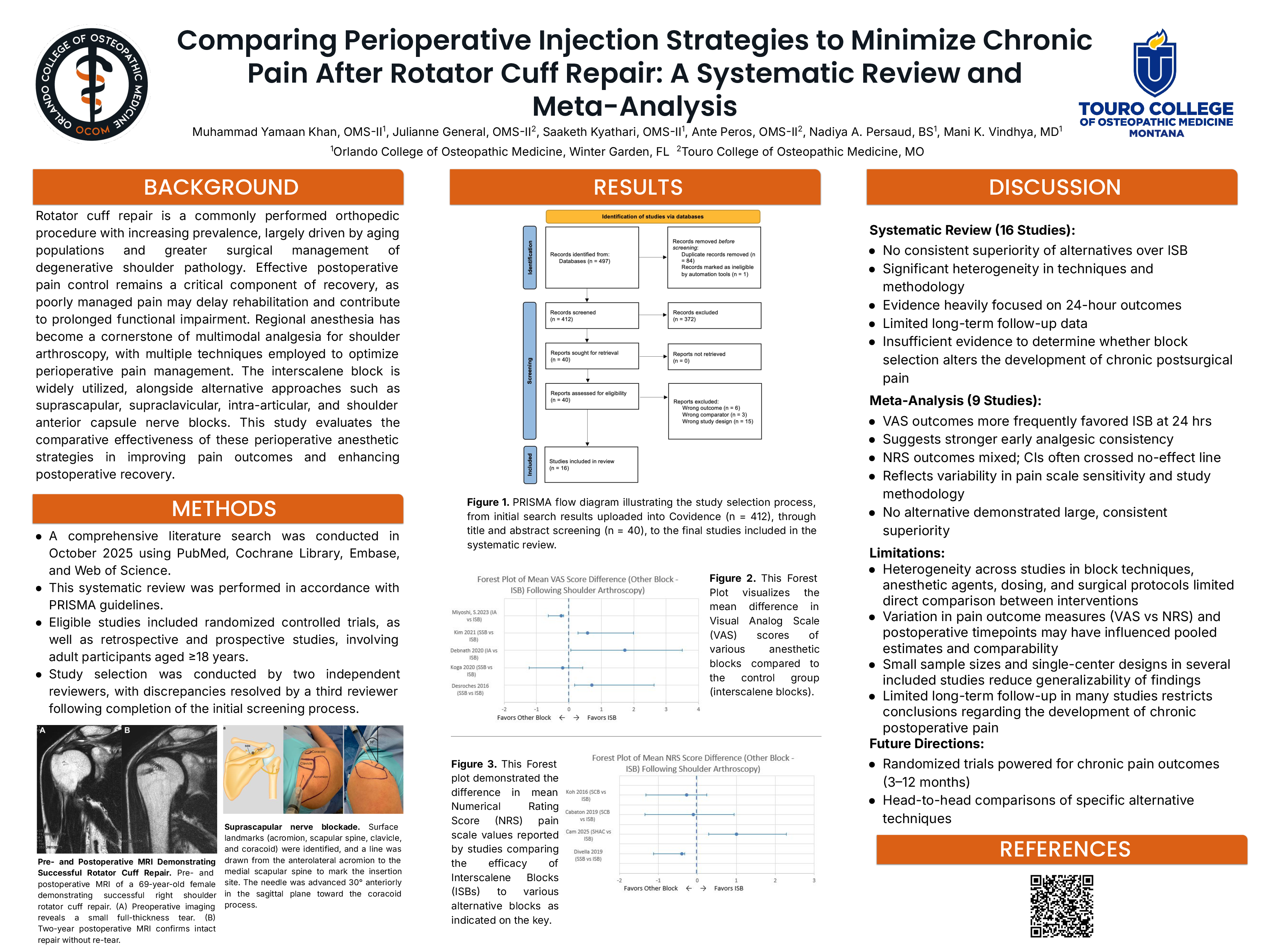
The interscalene block (ISB) has historically been one of the most commonly utilized regional techniques for rotator cuff repair. Several alternative injection strategies have been developed include the suprascapular nerve block (SSB), supraclavicular blocks (SCB), intra-articular blocks (IAB), and the shoulder anterior capsule (SHAC) nerve block. This systematic review and meta-analysis aims to synthesize current evidence evaluating perioperative injection strategies for minimizing chronic pain following arthroscopic rotator cuff repair in adults aged ≥18 years.
Methods:
This systematic review was performed in accordance with the PRISMA guidelines. Search was conducted using the PubMed database, Cochrane Library, Embase, and Web of Science (2025). The search string used was: "rotator cuff repair" AND ("chronic pain" OR "postoperative pain") AND ("nerve block" OR "regional anesthesia" OR "interscalene"). 497 studies were imported for screening into the Covidence software. 412 articles were included in the title and abstract screening. Our two independent reviewers selected 40 articles to move on to the full-text review, 16 for inclusion in our systematic review, and 10 for inclusion in our meta-analysis.
Results:
2 types of pain scores were reported by 9 studies, which included ISBs as a comparator. ISBs were favored in terms of mean VAS score difference at 24-hours postop by 3 out of the 5 studies that reported on VAS. However, one article did support that the use of intra-articular blocks was superior to ISBs at this time point. 4 articles reported NRS pain scores of ISBs and other blocks at 24-hour postop. 2 articles were inconclusive, one article supported that ISBs were superior, and one article supported that SSBs were superior compared to ISBs at 24-hours postop.
Discussion:
Across 16 included studies, there were 9 eligible for quantitative synthesis. Across the 9 studies included, VAS-based outcomes more frequently favored ISB at 24 hours, suggesting greater consistency in early analgesic effect. In contrast, NRS-based outcomes were mixed, with confidence intervals frequently crossing the line of no effect, reflecting variability in pain scale sensitivity and study design. No alternative technique demonstrated large or reproducible superiority.
Conclusion:
This systematic review and meta-analysis support the continued role of interscalene block (ISB) as a highly effective and reliable technique for early postoperative analgesia following arthroscopic rotator cuff repair. In selected clinical contexts, alternative injection strategies may provide comparable analgesia, potentially with fewer adverse effects.